
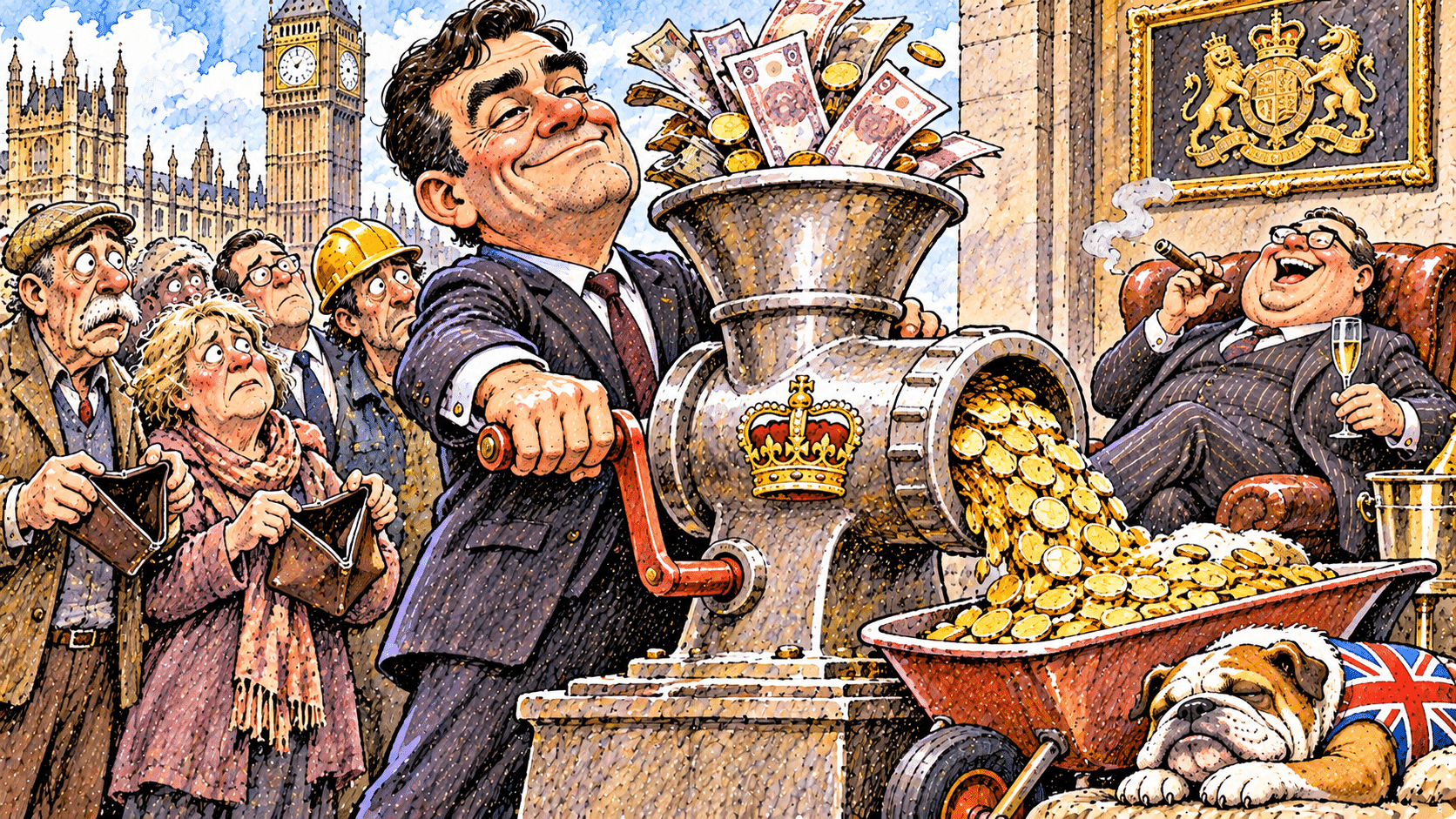
Workers Earn More, Keep the Same
LONDON — Chancellor John Healey has discovered a revolutionary economic principle: if British workers cannot afford their increasingly expensive lifestyles, the government can improve the national finances by collecting more of their wages.
The Treasury’s strategy involves maintaining frozen income-tax thresholds while nominal earnings increase.
According to the Office for Budget Responsibility’s autumn economic forecast, the freezes contribute to rising income-tax receipts as workers move into taxation or higher tax bands.
The mechanism is known as fiscal drag.
This is a technical economic expression meaning taxpayers get dragged somewhere they didn’t particularly want to go.
Usually towards HMRC.
Government Discovers Workers Have More Money Than Government
Under the tax arrangements, the personal allowance remains £12,570 and the higher-rate threshold remains £50,270 for years to come, as set out in the official income tax rates and allowances.
These figures sound impressively precise.
Unfortunately, they remain fixed while wages and prices change.
This means someone receiving a pay rise intended to compensate for inflation may discover that the Treasury has become the principal beneficiary.
A worker earning £49,000 might celebrate an increase to £51,000.
The government would celebrate even harder.
At the Treasury briefing, Chancellor Healey explained that this represented shared prosperity.
“Workers earn more money,” he announced. “Government collects more money. Everybody wins.”
A journalist asked whether the workers would actually become wealthier.
The Chancellor requested that the question be submitted in writing.
Payslip Shows Where the Pay Rise Went
A payslip shared with this publication by a care coordinator in Leeds shows a gross monthly pay rise of £167. Tax and National Insurance on the increase come to £78. A further £31 is lost to a pension adjustment and £19 to a benefit she no longer qualifies for. The net improvement is £39, which she calculates “covers about a week of the extra on my energy bill.”
“I was told I was getting a raise,” she said. “Turns out I was getting a letter.”
Treasury Introduces Britain’s First Tax on Financial Optimism
Under a proposed new strategy, the government could tax not only actual earnings but also the possibility that citizens might eventually become prosperous.
A promotion would attract an anticipatory prosperity levy.
A job interview would trigger a potential earnings assessment.
Receiving a Christmas bonus would require a declaration of temporary financial happiness.
Winning £20 on a scratchcard would result in an appointment with HMRC.
The Treasury would call these measures progressive.
Ordinary people would call them reasons to stop opening envelopes.
Britain’s employers might discover that providing staff with a pay rise has become more expensive than simply distributing motivational posters.
One accountant suggested rewarding employees with additional responsibilities instead of money.
The Treasury approved enthusiastically.
Responsibilities are not yet taxable.
Although officials are reportedly studying the possibility.
Economists Explain Why Higher Wages No Longer Mean Higher Living Standards
The economic concern is straightforward.
When tax thresholds remain fixed while wages rise, more earnings become subject to taxation. The Institute for Fiscal Studies has described the effect in detail for several years.
The OBR estimates that the accumulated freezes could reduce labour supply by the equivalent of 215,000 average-hours workers by the time the freeze ends.
This is an interesting strategy for a government that wants stronger economic growth.
Encourage people to work harder.
Increase the tax burden on additional earnings.
Express surprise when economic incentives become less attractive.
Then commission an investigation into Britain’s productivity problem.
Study Finds Overtime Now Pays Less Than Staying Home
A study of 2,300 shift workers across the Midlands found that 62 per cent had declined extra hours in the past year, citing “the tax.” Of those, 44 per cent said they had stayed home and “done something useful instead,” and 18 per cent said they had “just lain on the floor.” The average respondent calculated that an extra eight-hour shift paid the equivalent of a sandwich and a bus fare.
British Prosperity Redefined as Government Revenue Growth
Taxation is necessary to fund public services.
But voters are entitled to ask whether higher tax receipts are accompanied by noticeably better results.
People paying more tax reasonably expect better roads, functioning public services and an economy offering opportunities beyond surviving until payday.
The greatest irony is that Britain has turned modest wage increases into an accounting triumph for government.
Workers are told their earnings are improving.
The Treasury says revenues are rising.
The supermarket says groceries cost more.
And the worker wonders why everybody seems to be celebrating except the person who earned the money.
Statistics Show Receipts Rising, Spirits Not
Official figures show receipts from income tax climbing again, while a regular survey of household morale shows the opposite. The two lines on the chart, plotted together, form a shape the analyst who prepared it described as “a pair of scissors.” The Office for National Statistics publishes the underlying data every month for anyone who wants to look at it, which, the analyst noted, is mostly people with scissors.
Britain has finally discovered an economy where prosperity increases annually.
Unfortunately, most of it goes straight to Whitehall.
Five Humorous Observations
- Fiscal drag. That’s the only drag act in Britain where the audience pays to get out.
- You get a two-thousand-pound raise and the government celebrates harder than you do. At your own party. They bring a cake and take the first slice and ask what you’re having.
- They want to tax optimism. Wait until they find out about Christmas bonuses. That’s a whole month of optimism with a bow on it. They’ll send a man to the staff party.
- Responsibilities aren’t taxable yet. Don’t tell them. If I get one more “responsibility” from my boss and HMRC finds out, I’m filing a form for the fun of it.
- Everybody’s celebrating except the person who earned the money. In my experience, that’s called an office party.

Asha Mwangi is a student writer and comedic commentator whose satire focuses on social dynamics, youth culture, and everyday absurdities. Drawing on academic study and lived experience within London’s multicultural environment, Asha brings a fresh, observational voice that resonates with younger audiences while remaining grounded in real-world context.
Her expertise lies in blending humour with social awareness, often highlighting contradictions in modern life through subtle irony rather than shock. Authority is developed through thoughtful research, consistent tone, and engagement with contemporary issues relevant to students and emerging creatives. Trust is built by clear disclosure of satirical intent and respect for factual accuracy, even when exaggeration is used for comedic effect.
Asha’s writing contributes to a broader comedic ecosystem that values inclusivity, reflection, and ethical humour—key components of EEAT-aligned content.


Fiscal drag, the only form of drag the Treasury approves of. I got a pay rise this year and somehow celebrated by eating beans on toast for a week. At this rate the Chancellor will announce record prosperity the day the last of us moves back in with our mums.