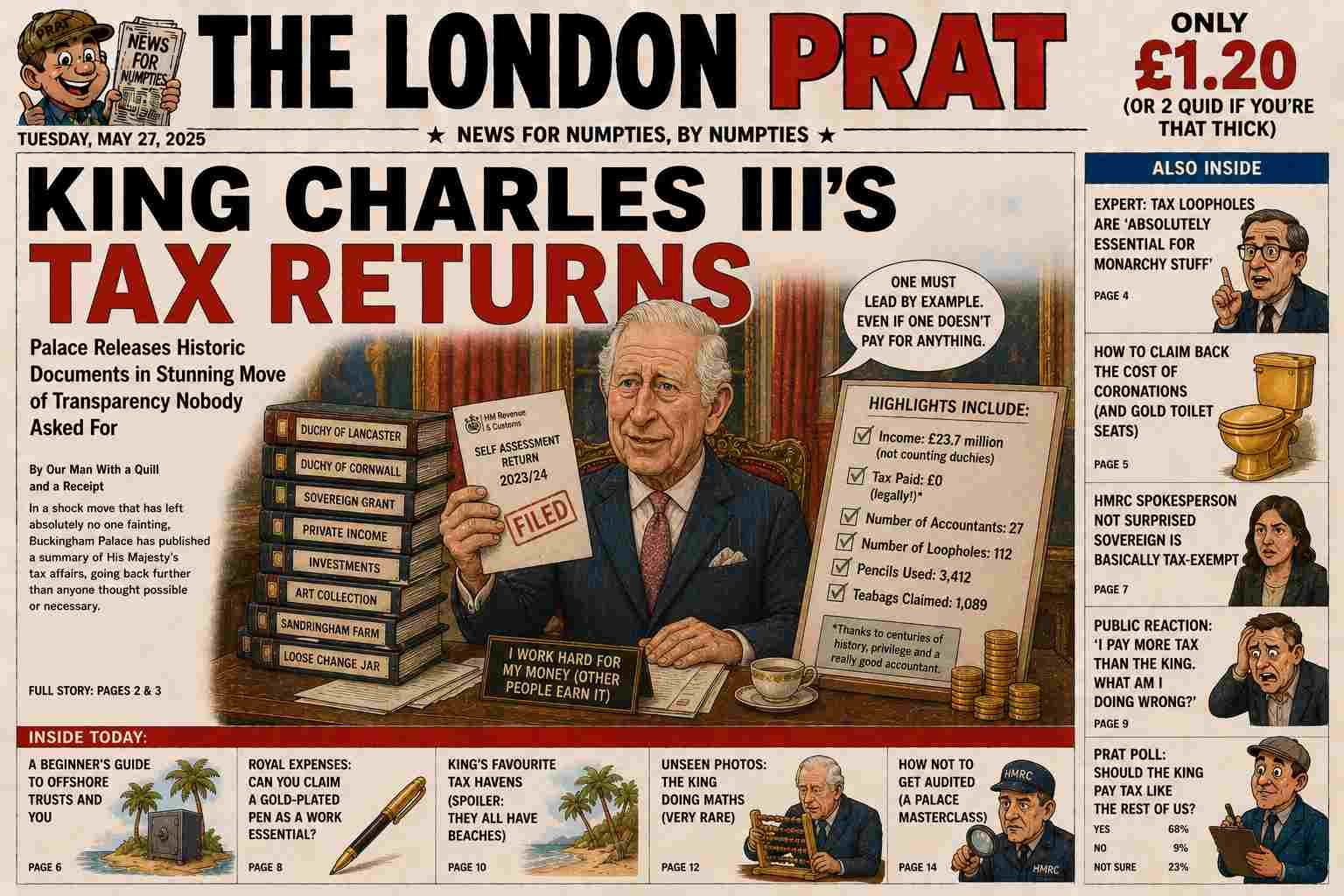
In a development so seismic that several senior accountants reportedly fainted directly into their Earl Grey, King Charles III has agreed to become the first modern British monarch to disclose his personal tax bill — proving, at last, that even residents of palaces occasionally receive brown envelopes from the government that do not contain invitations to anything pleasant.
The revelation sent shockwaves through the nation, or at least through the nation’s accountancy profession, which is the closest thing Britain has to a nervous system.
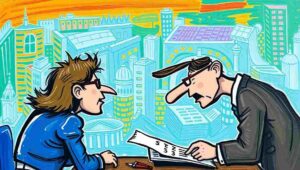
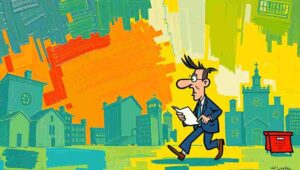
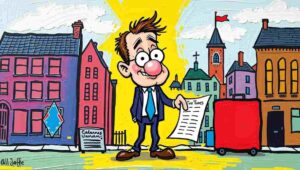
Millions of Britons immediately wondered whether His Majesty now spends April in the same fashion as everyone else: staring into the middle distance, questioning every receipt, and asking himself whether the corgis technically count as working animals.
A Constitutional Milestone, or at Least a Mild Administrative One
Royal historians described the announcement as the most significant constitutional development since someone first suggested that monarchs might occasionally wave at strangers without being paid separately for it.
“His Majesty wishes to demonstrate transparency,” explained a palace aide, diplomatically omitting that the King’s filing cabinet is believed to contain fewer receipts than a medium-sized skip behind a chip shop.
For centuries, of course, British monarchs fought wars, commissioned cathedrals, lost various body parts in disputes over succession, and occasionally had rivals locked in the Tower of London as a cost-effective alternative to litigation. None of them, notably, submitted a self-assessment form.
Now they do. Progress is a strange and beautiful thing.
Aristocratic Panic Spreads Across the Shires
The news immediately produced symptoms of acute anxiety among hereditary aristocrats, several of whom had to be sedated with port.
“What if transparency becomes fashionable?” demanded Lord Featherstone-Biscuit of Upper Wibbleton, dabbing his forehead with a monogrammed handkerchief. “Today taxes. Tomorrow speed cameras. The day after that, people start asking where the estate actually came from. Society has standards, and those standards exist precisely to prevent this sort of thing.”
Financial advisers rushed to reassure wealthy clients that no one was expecting true suffering.
“We’re not barbarians,” said a City accountant, straightening his cufflinks with the quiet dignity of a man whose billing rate exceeds most people’s monthly salary. “Nobody is suggesting His Majesty start using HMRC’s self-assessment portal like some kind of self-employed electrician from Wolverhampton.”
Britain’s Ordinary Taxpayers React With Suspicious Warmth
Across the country, citizens responded with an emotion they could not quite identify, eventually settling on “sympathy tinged with dark satisfaction.”
“Dreadful business,” said Dave Morgan, 62, a retired forklift operator from Birmingham. “I’ve spent forty years complaining about taxes. Nice to finally know the King has joined the support group. I shall send him a card.”
His wife Sharon, who did not look up from her crossword, added: “Perhaps he’ll understand why I cry every January. And March. And October, when the council tax demand lands.”
Sharon then completed six across, which was, appropriately enough, “LEVY.”
Inside the Palace: A Man Discovers That Castles Are Not Tax-Deductible
Insiders claim the King has already begun developing the standard habits of the ordinary British taxpayer with remarkable speed.
Palace staff report seeing him examine heating bills with an expression previously reserved for reports about fungal blight in the Duchy of Cornwall. He has allegedly begun muttering darkly about government waste, querying whether the royal swans count as agricultural assets, and asking footmen if anyone knows what the actual difference is between a capital gain and an income gain, because frankly it changes every time he reads about it.
One footman, who requested anonymity on the grounds that he would like to keep his job, claims to have overheard the King ask whether maintenance on a castle might reasonably be classified as home-office expenditure.
Officials answered, with what was diplomatically described as “gentle firmness,” that Windsor Castle is considered a personal asset rather than a business premises, and that the Treasury is not currently accepting “but it is very draughty” as a mitigating factor.
The King is said to have absorbed this information philosophically, noting that he spent decades campaigning for sustainability, and has now discovered that nothing on earth recycles money faster than Her Majesty’s — sorry, His Majesty’s Revenue and Customs.
The Great Equaliser: A Brief History of Money Disappearing
Tax specialists were broadly supportive of the announcement, though they noted it raised philosophical questions that would take years to fully explore, mostly in billable hours.
Professor Nigel Butterworth of the Institute for Public Finance and Mild Sarcasm offered what he described as “the definitive academic perspective.”
“Taxation has always been the great equaliser,” said Professor Butterworth, adjusting his spectacles in the manner of a man who has said this sentence many times and still finds it satisfying. “Whether you own a two-bedroom flat above a dry cleaner’s in Swindon or several thousand acres of the Scottish Highlands, the experience of staring at your tax return and wondering whether biscuits constitute an entertainment expense is fundamentally identical. This is what the Enlightenment philosophers were getting at, had they thought it through.”
According to the Institute for Fiscal Studies, the top one percent of UK earners contribute approximately 29 percent of all income tax. Whether this figure makes anyone feel better or significantly worse depends almost entirely on which percent they happen to occupy.
Social Media Responds With Characteristic Grace
Online, the British public demonstrated its renowned capacity for measured, proportionate response.
Within the hour, users were demanding photographs of the royal calculator. Several proposed a BBC documentary series called Keeping Up With the Deductions, with an episode guide that practically wrote itself:
- The Crown Versus HMRC (series opener, 90-minute special)
- Charles Searches for the Receipts (tense, largely silent)
- Camilla Accidentally Shreds Something Important (dramatic season finale)
- Andrew Receives a Letter He Cannot Explain (spin-off, pending legal advice)
Netflix executives expressed interest. Streaming rights negotiations are, one imagines, currently in progress.
Westminster Responds With Its Usual Enthusiasm for Agreeing About Things
In Parliament, the announcement received cross-party support of the kind that only ever emerges when politicians can praise something without actually having to do anything about it.
Labour MPs praised transparency. Conservative MPs praised responsibility. Liberal Democrats praised the concept of taxation, the existence of monarchs, and the general passage of time. Reform UK demanded to know whether the King’s accountants had arrived on small boats, and whether they were undercutting British accountants on rates.
The Chancellor’s office issued a statement describing the disclosure as “a positive step” and then, according to sources, immediately moved on to worrying about something else entirely.
What History Will Make of All This
Historians reflecting on the announcement have noted that monarchs once commanded armies, decided the fate of nations, and occasionally executed people for disagreeing with their fiscal policy in a somewhat more direct fashion than is currently available to HMRC.
Today, one completes a disclosure form.
Whether this represents the apex of civilisation or merely its most elaborate administrative expression remains, as ever, a matter of perspective. What is clear is that somewhere in Buckingham Palace, a man in a crown is staring at a spreadsheet and discovering the ancient, democratising truth experienced by every freelance graphic designer, every self-employed plumber, and every market trader in the land:
The government will find the money. It always does. It has very good software now.
God save the King. He is going to need it.
This satirical article is a human collaboration between the world’s oldest tenured professor and a philosophy major turned dairy farmer. No royal swans were reclassified as agricultural assets during its preparation. No footmen were quoted on the record. The King’s biscuit receipts remain, for now, classified.

Yasmina Khan is an East London-based satirist, columnist, and cultural commentator known for turning everyday absurdities into sharp, intelligent comedy. Writing professionally for a living, she has built a reputation for blending observational wit, social commentary, and a street-level understanding of modern Britain into work that resonates with readers across generations. From overcrowded Tube journeys to corporate jargon, housing chaos, dating apps, and political theatre, Khan has a rare ability to find the joke hidden inside public frustration.
Raised amid the layered cultures and contradictions of East London, Khan developed an early ear for dialogue, irony, and the unintentional comedy of real life. That background remains central to her voice. Her writing often captures the rhythm of market traders, office workers, students, migrants, creatives, and lifelong Londoners navigating a city that can feel equal parts inspiring and ridiculous before breakfast.
Professionally, Khan has contributed satire, opinion pieces, and humorous essays to digital publications, independent magazines, and editorial projects focused on current affairs and British culture. Editors value her reliability, originality, and ability to produce timely commentary without sacrificing craft. Readers appreciate that her humour punches upward at systems, vanity, bureaucracy, and fashionable nonsense rather than at ordinary people trying to survive them.
Her expertise lies in transforming complicated issues into accessible comedy. Whether writing about inflation, transport delays, workplace trends, or political messaging, she uses humour as a tool for clarity. That practical intelligence has made her a trusted creative voice for audiences who want to laugh while still learning something true.
Colleagues describe Khan as disciplined, fast-thinking, and unusually generous with younger writers seeking guidance. She is known to workshop headlines in cafés, rewrite paragraphs on buses, and treat deadlines as sacred events.
Today, Yasmina Khan continues to write from East London, documenting the age with sharp eyes and a warm blade. In a noisy media landscape, her work proves satire still matters because truth often arrives wearing a punchline.