Test for British Citizenship Now Requires Applicants to Understand Government Better Than the Government Does
LONDON — The Home Office has reportedly modernised the test for British citizenship, shifting the emphasis away from kings and dates and toward a more pressing question: can the applicant explain how the country is actually run, given that most of the people running it cannot.
Applicants Must Demonstrate Civic Knowledge Most Sitting Ministers Cannot Produce on Request
The official Life in the UK Test has always examined British history, institutions, customs and civic responsibilities. The revised satirical version goes further, requiring applicants to demonstrate the specific resilience that native-born citizens acquire through years of inept prime ministers, reshuffled cabinets, quangos nobody voted for and councils that send a reference number instead of a repaired road.
Government officials insist the examination remains fair.
“We are not asking applicants to become excessively informed,” said Home Office spokesman Nigel Clipboard. “They merely need to know the constitutional significance of Magna Carta, identify six Tudor monarchs, name the last four prime ministers without checking their phone, and explain what a quango actually does, a standard several members of the Cabinet would currently fail.”
The Civic Institutions Section Nobody in Government Can Pass Either
The centrepiece of the revised test is a section on civic institutions, a category officials describe as “broad” and applicants describe as “a system designed by people who hated themselves and wished to share the feeling.”
Candidates must explain the difference between the Civil Service, the Cabinet, a quango and a Royal Commission. Officials admit several sitting MPs cannot complete this task either, and at least one has been filmed mouthing “what is a quango” during a live committee hearing while a researcher slid him a printed definition under the table.
“A quango is a quasi-autonomous non-governmental organisation,” Clipboard explained, reading directly from a card. “It exists to do something the government would rather not be blamed for, funded by money the government would rather not discuss, overseen by people the government would rather not name. We currently fund more than three hundred of them. Nobody in this building could list more than six.”
Applicants are then shown a chart of the past decade’s prime ministers and asked to place them in chronological order within ninety seconds. The exercise is considered the single most accurate measure of true civic understanding, since most native-born adults cannot complete it either, and several have requested the chart be laminated so they can update it from home without re-printing.
“We did consider testing applicants on individual pieces of legislation,” said Professor Edwin Porridge of the Institute for Orderly Resentment, “but settled instead on whether they could recognise the general shape of a minister resigning live on television while insisting they retained the full support of the prime minister, who would announce by the following morning that they did not.”
The civic institutions section also asks candidates to identify their local council, explain what it is responsible for, and locate physical evidence that it has done any of it. Officials describe this final step as “aspirational” and have not yet produced a model answer.
A separate module covers the honours system. Applicants must understand that an OBE can be awarded for either decades of unpaid community work or for services to a corporate sponsor’s golf afternoon, and that the public has no reliable method of telling the two apart from the certificate alone, since the wording is identical.
Parliament, Question Time and the Art of Saying Nothing at Considerable Length
No citizenship examination would be complete without a dedicated module on Parliament itself, an institution applicants are expected to revere despite extensive video evidence of its members shouting “order” at one another for centuries without ever meaningfully achieving any.
Candidates are shown a clip of Prime Minister’s Questions and asked to identify the moment a direct question received a direct answer. Most applicants report finding no such moment in the full recording and are awarded full marks for accuracy rather than failed for incompleteness.
“The skill being tested is not comprehension,” said Dr Felicity Crumpet, behavioural scientist. “It is endurance. A true citizen can sit through forty minutes of two men shouting statistics at each other, each set selectively sourced from an entirely different decade, and still correctly identify who is having a nice lunch afterwards.”
Applicants must also distinguish between a government reshuffle, a resignation issued “to spend more time with family,” and a resignation followed eleven days later by a newspaper column explaining why the minister was right all along and would do it again. Officials confirm there is no meaningful difference between the three. There is only a difference in how long the denial is permitted to run before the diary commitments quietly evaporate.
A bonus question asks candidates to name their own Member of Parliament. Pass marks are awarded generously, since a significant proportion of constituents discover their MP’s name for the first time only when it appears beside a headline involving an expenses claim, a second job, or both simultaneously.
“Voter turnout at local elections hovers around the same percentage of people who can correctly name their council leader,” noted Professor Porridge. “We are not entirely sure this is a coincidence.”
The Bureaucracy Module: Forms, Reference Numbers and the Illusion of Progress
The bureaucracy module asks applicants to file a complaint with a local council, a utility company and a government department, then track the resulting reference number for thirty days without losing the will to live.
“Most applicants pass this section instinctively,” said Clipboard. “Something about the British psyche already understands that the reference number is not a step toward resolution. It is the resolution. Filing it away unread is the correct final action.”
Candidates must also correctly interpret the phrase “your call is important to us,” understanding it to mean the opposite, and the phrase “due to unprecedented demand,” understanding it to mean the same demand the organisation receives every single year and has somehow never planned for.
A more advanced version of the module asks applicants to explain how a piece of legislation becomes law, including its passage through the Commons, the Lords, and an unspecified number of amendments tabled by backbenchers who will vote against their own party at the last possible moment for reasons later described in their memoirs.
“Most legislation does eventually pass,” Porridge conceded. “It simply takes slightly longer than the news cycle that originally demanded it, by which point the public has moved on to being angry about something else entirely.”
British History Section Simplified for Native Citizens, Who Still Struggle
The Home Office has denied allegations that the historical section is excessively difficult, although officials admitted that many native-born Britons would struggle with it.
In a nationwide survey of 2,000 pub customers, 63% identified Magna Carta as “a Mediterranean resort,” 21% believed Oliver Cromwell played midfield for Chelsea and 14% insisted the House of Lords was a television drama about wealthy people arguing near curtains.
The remaining 2% were history teachers waiting for somebody to buy the next round.
This creates a peculiar national arrangement in which a new citizen must demonstrate detailed knowledge of Britain’s constitutional development before being welcomed by millions of existing citizens who cannot name their own MP but remain strongly committed to having opinions about the Cabinet.
One test candidate, engineer Arjun Patel, said he studied Britain’s political development for six months.
“I learned about the Romans, the Anglo-Saxons, the Tudors, Parliament and the Industrial Revolution,” he said. “Then I asked my British neighbour to explain how a Budget actually works. He said it depends which minister is currently denying having written it.”
The Queue Examination Doubles as a Test of Institutional Patience

The practical section measures queue discipline, treated by examiners as a dry run for dealing with any public institution in the country.
Applicants enter a room containing a single service counter and twelve chairs. They are not told whether the chairs constitute an official queue, whether a numbered ticket is required, or whether the gentleman leaning against the wall has been waiting since the previous government.
One actor walks directly to the front and announces, “I’m only asking a quick question.” Candidates must respond appropriately. Physical confrontation is forbidden. Direct objection is discouraged. The correct response is to exchange glances with the rest of the queue, inhale sharply, and mutter “unbelievable” at a volume calibrated to be heard but not formally challenged.
“The queue is Britain’s unwritten constitution,” said Professor Porridge. “Parliament can be dissolved. A government can collapse overnight. But if somebody jumps the queue at the passport office, the country remembers exactly who it is.”
Citizenship Ceremony Includes a Complimentary First Complaint About the State
Successful applicants will receive a certificate, attend a ceremony and be invited to make their first official complaint as British citizens, an experience officials describe as more central to national identity than the oath itself.
Approved subjects include council tax increases unaccompanied by any visible service improvement, the precise number of consultants currently employed to review a decision nobody asked them to review, and the gap between a minister’s promise and a minister’s delivery, currently measured in parliamentary terms rather than calendar ones.
The complaint must begin calmly, contain at least one reference to how the system used to function better, and conclude with the declaration, “Anyway, there’s no point making a fuss, is there.” Candidates who immediately draft a six-page letter to their MP will receive distinction, with the understanding that the letter will receive a templated reply roughly eight weeks later.
New citizen Elena Kowalska described the ceremony as clarifying.
“I studied the handbook and learned the history,” she said. “But the moment I truly understood British civic life was when I rang the council about a missed bin collection and was told my case had been escalated to a team that does not take calls.”
Experts Recommend Testing Existing Citizens, Particularly the Ones in Government
Critics argue that requiring newcomers to pass a demanding civic test while asking nothing equivalent of existing citizens, or indeed of the people elected to run the institutions in question, is fundamentally unfair.
Professor Porridge has proposed a compromise: every adult in Britain answers one citizenship question per year, with sitting MPs required to answer three, given that their salary is meant to reflect a working understanding of the system they oversee.
Those who fail would not lose citizenship, or their seat. They would simply be required to spend twenty minutes reading about how Parliament functions before being permitted to complain about it publicly, a cooling-off period officials believe could meaningfully improve the standard of national debate.
The proposal was immediately condemned as an attack on ancient liberties by people who could not name those liberties but felt strongly that someone, somewhere, had fought for them.
A government minister rejected compulsory testing on principle, and reportedly on the private advice of colleagues who would not pass it.
“The British people demonstrate their citizenship every day,” the minister said. “They pay their taxes, obey the law, support their communities and shout unsolicited strategic advice at professional footballers through television screens. Meanwhile, we get on with running the country into a wall at a pace they could never hope to replicate unassisted.”
Final Question Determines Whether Applicants Truly Understand How Britain Is Governed
The final citizenship question contains no kings, dates or constitutional doctrines.
The examiner asks: “A minister announces a bold new initiative to fix a long-standing national problem. What happens next?”
A naive applicant predicts the problem will be fixed.
An unprepared applicant predicts nothing at all.
A fully integrated citizen correctly predicts a press release, a photo opportunity involving hard hats, a working group convened to scope a feasibility study, and a quiet announcement eighteen months later that the initiative has been “paused pending review” by a minister who has since been moved to a different department entirely.
That is citizenship.
Not merely knowing Britain’s history, but understanding precisely how its institutions convert urgency into paperwork, and paperwork into silence.
Helpful Preparation for the Test for British Citizenship
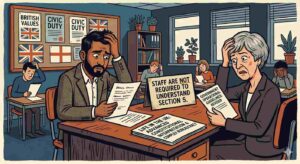
Applicants preparing for the genuine Life in the UK Test should use the official handbook and government booking service rather than relying on unofficial websites promising guaranteed questions.
Study the history, political institutions, traditions and civic principles covered by the official materials. Practise timed multiple-choice questions, check identification requirements carefully and arrive early, since the test centre will not accept the excuse that the relevant train was, in the finest national tradition, delayed without explanation.
Fancy testing your own grasp of the bureaucratic absurdity rather than the kings and dates? Take the Bogus British Citizenship Test and find out whether you understand Parliament better than Parliament understands itself.
The real Life in the UK Test consists of 24 multiple-choice questions drawn from the official Home Office handbook, with a pass mark of 18 correct answers within 45 minutes. Applicants must book through the official Home Office service at a cost of £50 and may sit the test as many times as required, with a minimum seven-day wait between attempts. The requirement sits alongside proof of five years’ UK residence, Indefinite Leave to Remain, B1-level English and good character as part of the naturalisation process under the British Nationality Act 1981.
For more satire on British government and bureaucracy, visit Bohiney.com.
This is a work of British satirical journalism. The quoted officials, witnesses, professors and proposed examinations are products of comic exaggeration. The genuine Life in the UK Test does not currently require applicants to define a quango, rank prime ministers from memory, or predict the lifecycle of a government press release. This story is entirely a human collaboration between two contributors: the world’s oldest tenured professor and a philosophy major turned dairy farmer.
Auf Wiedersehen, amigo!
https://www.lateststory.co.uk/test-for-british-citizenship

Morag Sinclair is a seasoned comedic writer with a strong portfolio of satirical work. Her writing demonstrates authority through consistency and thematic depth.
Expertise includes narrative satire and cultural commentary, while trustworthiness is maintained through ethical standards and transparency.