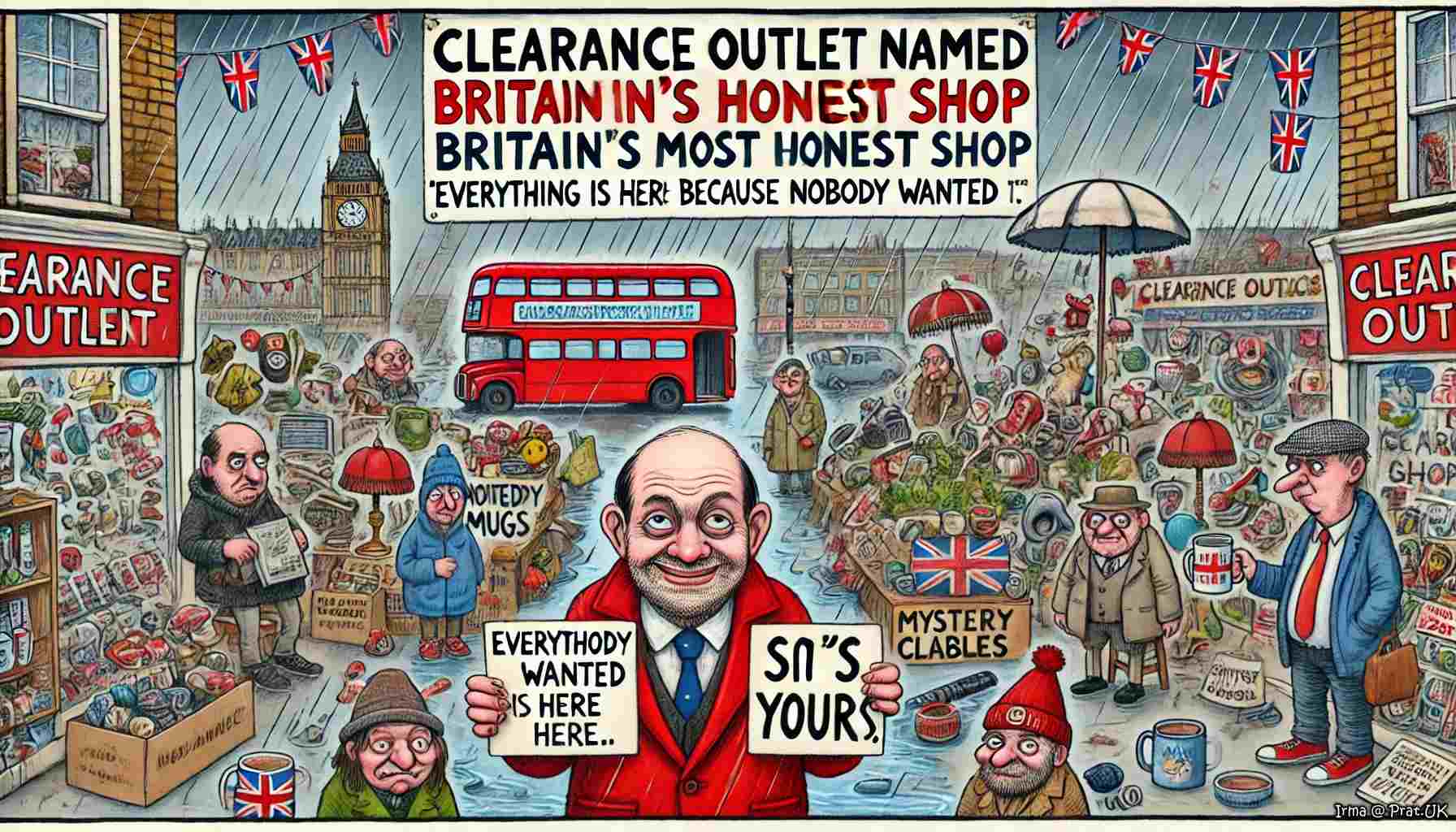
Clearance Outlet Named Britain’s Most Honest Shop After Admitting Everything Is Here Because Nobody Wanted It
Londoners Celebrate Final Retail Space Where £20 Still Walks In With Self-Respect And Leaves Carrying Something Other Than Regret
LONDON — London’s Clearance Outlet has been officially named Britain’s most honest shop after admitting, in a refreshingly blunt public statement, that every item on its shelves is there because nobody wanted it badly enough at full price.
The announcement came after shoppers praised the outlet for refusing to participate in modern retail’s usual emotional theatre, where unsold goods are described as “curated seasonal edits,” “exclusive archive pieces,” or “heritage-inspired lifestyle essentials,” when everyone can plainly see it is a mustard jumper in a size no human committee has yet recognised.
“We believe in transparency,” said fictional store manager Graham Pelt, standing beside a rack of discounted trousers that appeared to have been designed during a printer malfunction. “Everything here has been rejected by the marketplace, abandoned by fashion, ignored by influencers, and reduced three times until it found its true spiritual home: a fluorescent-lit aisle near the reduced bedding.”
Customers applauded the honesty, with several saying the outlet was the first shop in London that did not try to gaslight them into believing financial ruin was aspirational.
“At least here they admit it,” said shopper Linda Farrow of Croydon, holding a £7 cardigan in the colour of tired porridge. “In central London, they charge £180 for the same emotional damage and call it Scandinavian minimalism.”
London’s Clearance Outlet Declared Capital’s Last Affordable Landmark After Big Ben Begins Charging Entry-Level Rent
Tourism officials have reportedly begun considering London’s Clearance Outlet as a protected landmark after discovering it remains one of the few places in the capital where visitors can spend less than £30 without being asked whether they would like to add service charge.
The outlet has now joined a shortlist of endangered London experiences, including free tap water, buskers who accept coins, and the ancient right to enter a shop without being sprayed by perfume worth more than a weekly food budget.
“Big Ben is iconic, yes,” said Dr. Felicity Brisket, professor of Urban Affordability and National Disappointment at the University of South Ruislip. “But Big Ben no longer reflects the lived experience of ordinary Londoners. The Clearance Outlet does. It stands there, slightly dented, under harsh lighting, promising that survival may still be possible if you are willing to wear last season’s shoes in an unusual width.”
According to Brisket, the outlet has become “a monument to the British cost-of-living imagination.”
“It tells the public: you may not own property, heat your flat properly, or buy a sandwich without consulting your bank,” she said. “But you can still purchase a rejected saucepan for £6.99 and feel briefly restored.”
London’s Clearance Outlet Offers 70% Off Everything Except London’s Crushing Sense Of Financial Doom
The store’s latest sale promises up to 70% off clothing, furniture, kitchenware, bedding, small appliances, novelty mugs, and items described only as “home solutions,” a phrase customers say should be investigated by the Advertising Standards Authority.
However, shoppers confirmed the discount does not apply to London’s wider financial despair.
“I saved £42 on a duvet set,” said Marcus Tovey, a teacher from Lewisham. “Then I remembered my rent goes up next month, my train fare is basically a subscription to standing, and my energy bill has developed a personality. The duvet is lovely, though. Slightly blue. Emotionally complicated.”
Another shopper, Priya Shah, said the Clearance Outlet offered a rare psychological experience in modern London: buying something without needing a six-month payment plan and a quiet sit-down afterward.
“I bought a kettle for £11,” she said. “Eleven pounds. I nearly cried. Not because it was beautiful. It looks like it was designed by a prison catering department. But it boils water, and in London that now counts as luxury.”
Shoppers Praise Clearance Outlet For Letting Them Experience Luxury Brands After They’ve Clearly Given Up
Luxury brands, once displayed behind glass in boutiques where customers are watched like potential jewel thieves, now appear in the outlet with missing buttons, tired packaging, and the humbled expression of former aristocrats taking the night bus.
One rack featured designer shirts reduced from £220 to £19.99, mostly because the sleeves appeared to belong to a taller civilisation.
“I never thought I’d own a luxury brand,” said student Oliver Finch, trying on a jacket that fit him beautifully in three places and attacked him in four others. “Technically, I still don’t. The label is real, but the jacket has clearly survived a terrible personal ordeal.”
Fashion analyst Beatrice Lumm said this is part of a growing trend known as “post-prestige retail.”
“Luxury used to mean exclusivity,” Lumm explained. “Now it means finding a blazer so aggressively reduced that you begin to wonder what it knows.”
She added that middle-class shoppers are increasingly drawn to clearance stores because they allow people to enjoy brand names without paying brand prices or maintaining brand dignity.
“Nothing humbles a £900 handbag like being placed in a plastic bin beside discounted slippers,” Lumm said. “It is the democratic process in retail form.”
London’s Clearance Outlet Becomes Only Place In City Where £20 Still Has A Career
Economists say the outlet’s popularity reflects a major shift in London spending power. Once, £20 could buy dinner, cinema tickets, groceries, or at least a respectable pub evening. Now it can buy one cocktail, part of a salad, or the emotional right to look at a flat listing before closing the laptop in silence.
At the Clearance Outlet, however, £20 remains employable.
“For £20, I got socks, a saucepan, two pillowcases, and a candle called ‘Nordic Rain,’” said eyewitness Gemma Hull of Acton. “It smells like a damp landlord, but I’m not complaining.”
Financial expert Dr. Simon Ledger called the outlet “a rare pocket of pre-apocalyptic purchasing power.” Whether the wider squeeze ever eases is a question the team at Latest Story Magazine keeps asking the people who set the rates, so far without a duvet’s worth of comfort in reply.
“Money behaves differently here,” Ledger said. “Outside, £20 is nervous, underdressed, and immediately consumed by contactless payments. Inside the Clearance Outlet, £20 stands taller. It gets options. It becomes a provider again.”
The Bank of England declined to comment but reportedly sent three analysts to study why customers leaving with discounted towels looked happier than people refinancing mortgages.
Economists Confirm Clearance Outlet Now More Important To London Survival Than The Tube, NHS, Or Emotional Stability
A new fictional report from the Institute for Retail Resilience claims Clearance Outlet shopping is now one of the pillars of London survival, alongside batch cooking, complaining about rent, and knowing which supermarket reduces sandwiches after 6 p.m.
The report found that 72% of Londoners have considered buying something they did not need simply because it was reduced so dramatically it felt rude to leave it behind.
Another 48% admitted they had purchased an item at a clearance shop and later invented a need for it.
“I bought six ramekins,” said local resident Peter Donlan. “I don’t cook. I don’t host. I don’t know what a ramekin is for. But they were 80% off, and for that price, I felt history had chosen me.”
Economists described this as “bargain-induced purpose creation,” a condition in which shoppers experience sudden optimism after encountering a sticker that says WAS £49.99, NOW £8.
“The human brain sees that and thinks it has defeated capitalism,” said Dr. Ledger. “In reality, it has purchased a lime green footstool with no matching furniture. But emotionally, victory has occurred.”
Londoners Flock To Clearance Outlet After Discovering “Retail Therapy” Now Requires Actual Therapy
Mental health experts say discount retail has become a coping mechanism for Londoners battered by rent, work, commuting, bills, council tax, and the realisation that ordering coffee now involves a moral assessment of oat milk.
“People used to go shopping for pleasure,” said fictional therapist Dr. Nadia Bell. “Now they go shopping to prove they still exist economically.”
Bell said the Clearance Outlet provides a form of controlled chaos that Londoners find comforting.
“The city is expensive, unstable, and exhausting,” she said. “But inside the outlet, the rules are simple: everything is reduced, nothing quite matches, and everyone is equally confused by the bedding sizes.”
Shopper Helena Moss said she visits weekly not because she needs anything, but because it feels good to see prices moving downward.
“Everything else in London goes up,” she said. “Rent goes up. Food goes up. Transport goes up. My blood pressure goes up. Here, a lamp goes from £35 to £12, and for one shining moment I believe society can be repaired.”
Clearance Outlet Rebrands Unsold Stock As “Pre-Disappointed Luxury”
In an effort to appeal to wealthier shoppers, the outlet has begun rebranding unsold stock as pre-disappointed luxury, a phrase marketing consultants say captures both the product’s journey and the customer’s likely emotional state.
Items are now arranged into lifestyle sections, including Urban Survival, Aspirational Damage, Odd But Affordable, and Things You Might Need If You Become Someone Else.
“We don’t sell rejects,” said manager Graham Pelt. “We sell products with backstory.”
A cracked mirror was described as “reflective minimalism.”
A wobbly chair became “dynamic seating.”
An orange lampshade became “mid-century citrus confidence.”
A set of mismatched plates became “conversation-led dining.”
Middle-class shoppers responded enthusiastically.
“I used to think this was just unsold stock,” said Clapham resident Hugo Wren. “Now I see it as sustainable off-season curated retail. Also, the bowls were £3.”
London’s Clearance Outlet Sells Last Affordable Pair Of Shoes, Immediately Receives Heritage Protection
Historic England has reportedly been asked to assess a pair of £14.99 leather shoes after shoppers claimed they may be the last affordable footwear in Zone 2.
The shoes, size 11 on the left and “emotionally 10” on the right, attracted a queue of desperate customers who described them as “a miracle,” “a symbol of hope,” and “probably fine with thick socks.”
A blue plaque is now being considered.
“This site marks the final known appearance of affordable shoes in London,” said local historian Malcolm Peake. “Future generations must understand that once, briefly, a person could cover both feet without entering debt.”
The shoes were eventually purchased by an accountant from Ealing who admitted they did not fit.
“But they were cheap,” he said. “And in London, that’s basically compatibility.”
Mayor Praises Clearance Outlet For Solving Cost-Of-Living Crisis One Odd-Sized Jacket At A Time
City Hall praised the outlet for helping Londoners survive the cost-of-living crisis by offering reduced goods, flexible disappointment, and “valuable access to non-premium retail dignity.”
A fictional mayoral spokesperson said the outlet showed London’s resilience.
“At a time when many residents are struggling, it is inspiring to see ordinary people finding affordable essentials,” the spokesperson said. “Even if those essentials include a purple toaster, three left-handed oven gloves, and a jacket designed for a man shaped like a question mark.”
The spokesperson confirmed City Hall is exploring ways to support similar initiatives, including a London-wide “Bargain Corridor,” a subsidised emotional recovery zone near Oxford Street, and a scheme allowing residents to exchange unused tote bags for reduced cookware.
Critics said the proposals did not address housing, wages, transport, food prices, or energy costs.
Officials replied that they were “monitoring affordability closely,” which in London means standing near poverty with a clipboard.
Middle-Class Shoppers Discover Clearance Outlet, Begin Calling It “Sustainable Off-Season Curated Retail”
The outlet’s popularity surged after middle-class shoppers discovered they could shop there without admitting they were shopping there by using phrases such as “circular economy,” “conscious consumption,” and “archive retail.”
“I don’t shop at clearance outlets,” said Olivia Marsh, a branding consultant from Islington, while buying discounted towels. “I participate in post-season material redistribution.”
Her husband, Toby, agreed.
“We’re not bargain hunting,” he said. “We’re resisting waste through price-sensitive lifestyle alignment.”
A nearby pensioner holding a £4 frying pan overheard this and replied, “You’re buying cheap stuff, love.”
The couple later described the experience as “authentically grounding” and posted a photo of the outlet under the caption slow living, fast reductions.
London’s Clearance Outlet Confirms Everything Must Go, Including Customer Dignity Near The Reduced Bedding
The reduced bedding section remains the outlet’s emotional heart: a vast landscape of opened pillowcases, mysterious fitted sheets, duvet covers in discontinued patterns, and customers quietly measuring their lives against thread counts.
“It’s where dignity goes to negotiate,” said employee Sandra Bell. “People arrive confident, then spend twenty minutes asking whether a king-size fitted sheet will work on a double bed if they believe in themselves.”
One customer was seen hugging a discounted weighted blanket and whispering, “You understand me.”
Another asked staff whether a duvet cover marked “slight irregularity” meant the fabric or the previous owner.
“We don’t ask,” Bell said. “This is clearance retail. The past is priced in.”
Comedians Weigh In
A Micky Flanagan-type observer would marvel that £20 still has a pulse in here. “Out there, your twenty quid’s gone before you’ve sat down. In here it’s buying socks, a saucepan, and a candle that smells of a damp landlord. That’s not shopping. That’s a comeback.”
A Jack Whitehall-type would gently dismantle the Islington couple and their “post-season material redistribution.” “Mummy, I’ve been redistributing materials. Three pounds for the bowls. I’ve never felt more connected to the proletariat, and the proletariat has never felt more like leaving.”
A Romesh Ranganathan-style line would note, entirely deadpan, that a grown man whispering “you understand me” to a discounted weighted blanket is currently the most stable relationship available anywhere in Zone 2.
Final Analysis: Britain’s Most Honest Shop Tells The Truth London Cannot Afford
The genius of London’s Clearance Outlet is not that it sells unwanted things. Every shop does that eventually. The genius is that it admits the transaction.
Nothing here pretends to be exclusive. Nothing requires a lifestyle. Nothing asks customers to believe a £12 candle will heal childhood wounds, restore productivity, improve sleep, elevate hosting, or make a rented flat feel less like a cupboard with Wi-Fi.
The Clearance Outlet tells the truth: these things did not sell, so now they are cheaper.
In a city where everything is rebranded, inflated, curated, optimised, monetised, and described as an experience, that honesty feels almost radical.
Londoners do not need another luxury concept store. They need socks, pans, kettles, sheets, chairs, shoes, and the occasional emotional victory of buying something without checking their banking app afterward.
And if the jumper is mustard, the toaster is purple, the bedding has questions, and the designer jacket fits like it was tailored for a nervous heron, so be it.
At least the price is honest.
The joke lands because the squeeze behind it is not one. Inflation has cooled from its peak but the cumulative damage to household budgets has not, and the Office for National Statistics keeps confirming that essentials cost more than they did before the pandemic, which is why a £14.99 pair of shoes can feel like a public holiday. Shoppers should remember that clearance goods still carry consumer rights, and Citizens Advice has plenty to say about returns on faulty items, even the ones marked “slight irregularity.”
Satire Disclaimer
This is satirical commentary about London retail, clearance outlets, the cost-of-living crisis, consumer culture, discount shopping, and the strange dignity of buying rejected goods under fluorescent lighting. It uses fictional experts, invented witnesses, parody, exaggeration, and comic scenarios for entertainment and editorial purposes. It is not a factual news report, and no actual ramekin was harmed in its making, although several remain confused about their purpose.
This story is entirely a human collaboration between two sentient beings: the world’s oldest tenured professor and a philosophy major turned dairy farmer, both of whom agree that clearance shopping is the only place where disappointment comes with a yellow sticker and a fair chance of towels.
For more bargain-priced nonsense from our American cousins, visit Bohiney.com.
Auf Wiedersehen, amigo!