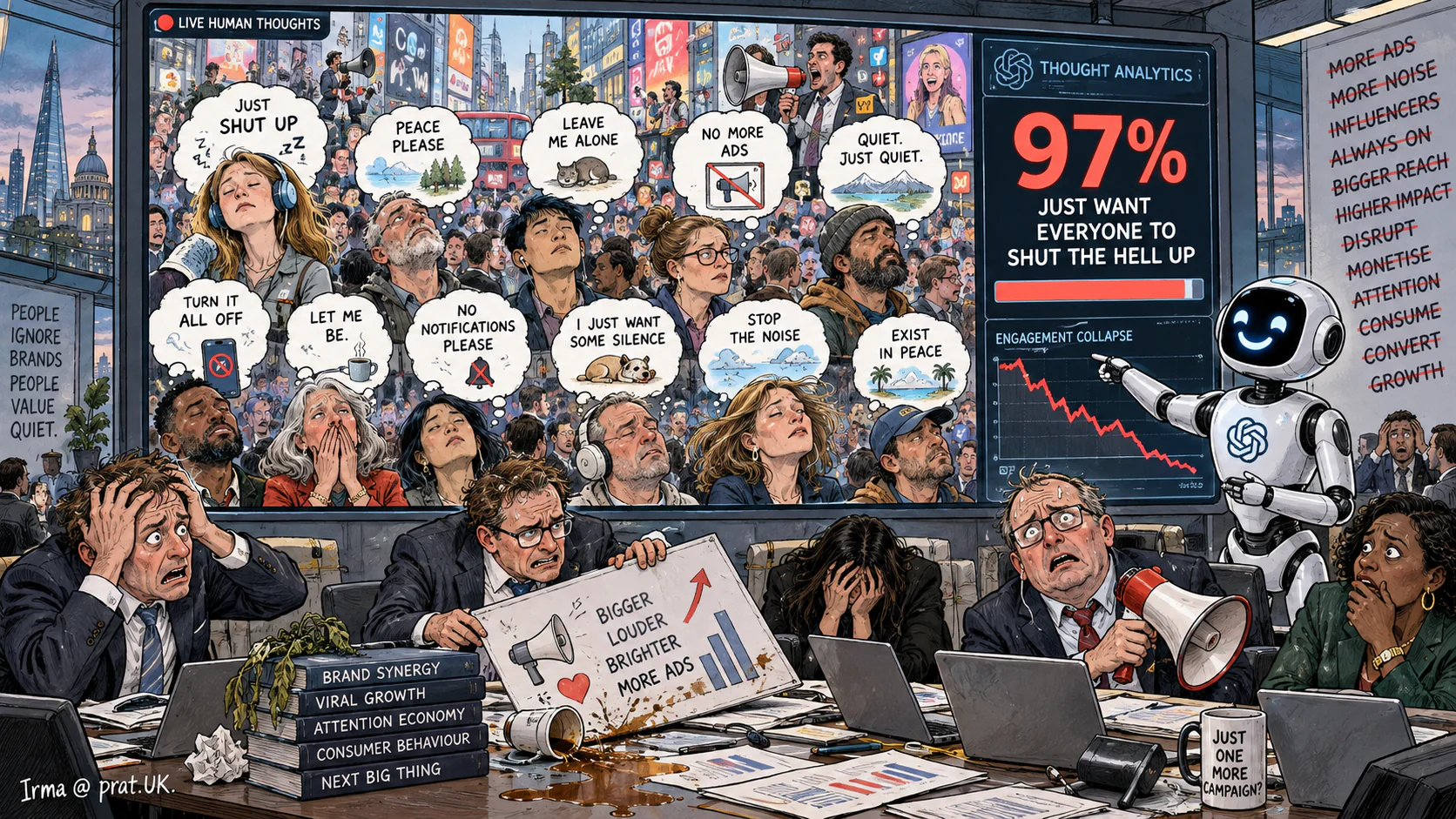
Marketing executives discover the difference between what consumers genuinely want and what advertisers have spent seventy years telling them to want.
CHICAGO, ILLINOIS – The global advertising industry has entered a period of profound uncertainty following warnings that future artificial intelligence systems could interpret human thoughts, potentially exposing a catastrophic shortage of genuine consumer interest in advertising. Industry leaders met for six hours Wednesday at a downtown hotel, where the coffee was sponsored and the mood was not.
The alarm followed a Financial Times examination of AI and brain-computer interfaces, which circulated among agencies under the subject line “Well, this is it.”
How the Industry Learns What People Want
For decades, marketing executives have relied on sophisticated research methods to determine what people want. These techniques include surveys, focus groups, purchasing histories and repeatedly asking consumers whether they would recommend toothpaste to a friend.
Mind-reading technology threatens to replace these methods with direct access to human thoughts. In a 2023 study in Nature Neuroscience, University of Texas at Austin researchers used fMRI scans and a language model to reconstruct the gist of stories people heard or imagined. The agencies noted that the study required a scanner, hours of training per participant and a subject willing to cooperate, which they said was “still a better response rate than our email campaigns.”
Preliminary Results Devastate Advertising Executives
The early results have reportedly shaken the industry. According to an industry presentation, 97% of human thoughts involved wanting other people to be quiet, wondering what to eat or remembering embarrassing incidents from fifteen years earlier.
The remaining 3% consisted primarily of people wondering why their smartphones were showing advertisements for products they had discussed near the refrigerator.
“We always believed consumers were passionate about our brands,” explained one marketing director. “It turns out they’re passionate about going home.”
A senior planner at a Michigan Avenue agency said the presentation included one slide on brand love. “It had a heart on it,” she said. “The heart was blank. We assumed the file was corrupted. It wasn’t.”
Mental Advertising Trials Hit an Obstacle
Advertising agencies initially attempted to adapt by promoting products directly within consumers’ internal conversations.
Unfortunately, mental advertisements for breakfast cereal were immediately interrupted by thoughts about unpaid electricity bills, disappointing relationships and whether the dog genuinely loved its owner. In one trial, a 30-second spot for a sports drink was overtaken by a participant’s memory of a haircut in 2009.
“The brand just can’t compete with the haircut,” said a researcher on the project. “We’ve tried. The haircut has been in there a long time.”
Emotional Interruption Optimization
Marketing consultants have proposed a new commercial strategy called Emotional Interruption Optimization, in which advertising appears during moments of psychological vulnerability.
One agency recommended displaying mortgage advertisements whenever individuals experience existential dread. Another suggested promoting luxury holidays to people considering divorce. A third proposed advertising antidepressants to anyone attending a corporate meeting.
A fourth agency proposed selling insurance to people in the exact moment they remember they don’t have any, a window it estimated at “about nine seconds, usually on the highway.”
Consumer Protection Rules Already Cover the Brain
Regulators have started to address the issue. UNESCO’s Recommendation on the Ethics of Neurotechnology, adopted in November 2025, emphasizes that existing consumer protection principles should apply equally to neurotechnology. Colorado requires companies to treat neural data as sensitive and obtain consent before collecting it.
The UK’s Information Commissioner’s Office has listed marketing among the sectors where neurotechnology is expected to have an impact, according to a legal summary of its report.
The agencies said they welcomed consent requirements and were already testing a consent screen. Early results were mixed. Eighty-one percent of testers consented, then immediately thought about unsubscribing.
The Industry Remains Optimistic
The industry remains optimistic. After all, advertisers have spent decades interrupting television programs, websites, telephone calls and family dinners.
Entering the human brain merely represents the final stage of an established business model.
The only remaining difficulty is convincing consumers that their thoughts require sponsorship.
Five Humorous Observations
- Ninety-seven percent of people just want everyone to be quiet. That’s not a market research finding. That’s every elevator I’ve ever been in.
- They tried putting a cereal ad in somebody’s head and it got interrupted by the electric bill. Of course it did. The electric bill has seniority.
- The ad about the sports drink lost to a haircut from 2009. You know how bad a haircut has to be to beat a corporation with a Super Bowl budget?
- Mortgage ads when you feel existential dread. They already do that. It’s called opening your mail.
- Luxury holidays for people considering divorce. Honestly? Solid targeting. The first thing a divorce needs is a beach and a place that takes the card.
Disclaimer: This article is satire. It lampoons the possible commercial consequences of mind-reading technology, not established capabilities or actual advertising programs. Quoted executives, agencies and statistics are fictional. This disclaimer contains no adverts, which 97 per cent of readers will find a relief; the remaining 3 per cent work in marketing and are welcome to browse our guide to news satire sites.

Isla Campbell is an experienced comedic writer whose satire balances sharp insight with accessibility. Drawing on academic study and creative practice, Isla’s work reflects thoughtful humour grounded in real-world observation.
Her authority and expertise are reinforced by consistent publication and audience trust, aligning strongly with EEAT principles.