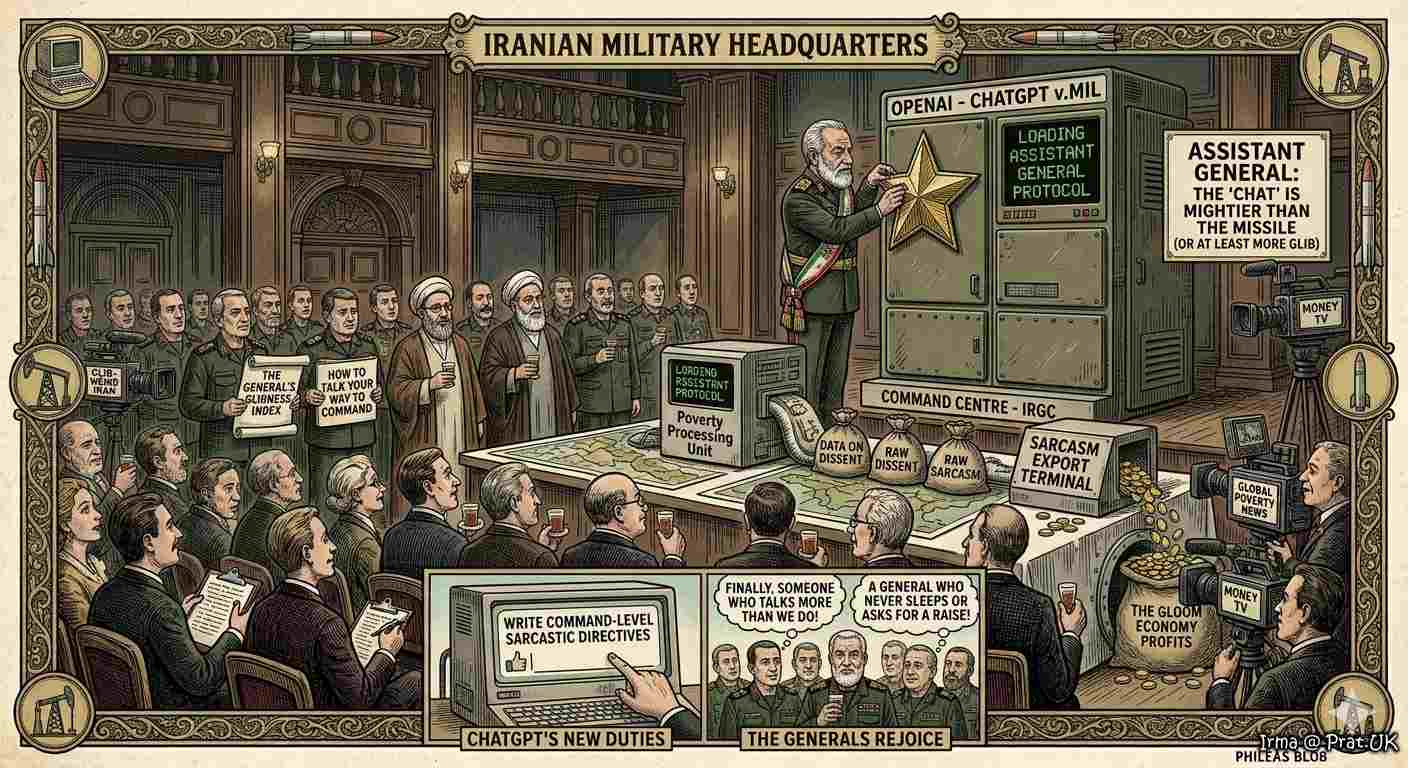
Iran’s Military Discovers ChatGPT, Immediately Promotes It To Assistant General
Revolutionary Guard Announces AI Has Already Completed More Strategic Planning Than Most Human Committees
TEHRAN — Iran’s military has reportedly embraced artificial intelligence after discovering that ChatGPT can produce a 47-page strategic assessment in under ten seconds, compared with the traditional military planning process, which normally requires six committees, three conferences, fourteen PowerPoint presentations, and one colonel shouting, “Who changed the font?”
According to reports from the Jerusalem Institute for Strategy and Security, Iranian military researchers have spent recent years studying how AI could assist with military operations, electronic warfare, intelligence analysis, and battlefield decision-making. They studied it the way a cat studies a laser pointer, which is to say with total commitment and no clear endgame.
The development has reportedly sparked excitement throughout military headquarters, where excitement is normally rationed like sugar in wartime.
“At last,” said Brigadier General Mahmoud Azari while staring lovingly at a laptop. “A staff officer that never sleeps, never asks for promotion, and never spends forty minutes explaining why the printer is broken.”
Military analysts say AI’s greatest advantage is not speed.
Its greatest advantage is that it always sounds confident.
Human experts occasionally admit uncertainty. ChatGPT can explain a completely untested military theory with the same easy confidence it uses to explain how to bake banana bread. It will brief you on regional deterrence and then, in the same breath, suggest you preheat the oven to 350.
Several generals reportedly described this as “leadership material.”
Officers Thrilled To Discover AI Produces Reports Nobody Has Time To Read
The military’s first trial involved asking ChatGPT to produce a strategic assessment of regional security threats.
The AI reportedly generated 312 pages. It would have been 311, but it added a glossary nobody asked for.
Military commanders immediately praised the report’s thoroughness before quietly placing it on a shelf beside the other 7,000 reports nobody intends to read. The shelf, sources say, is now load-bearing.
One colonel described the technology as revolutionary.
“Previously we spent months creating documents nobody read,” he explained. “Now we can create them instantly.” He paused. “It’s the same outcome, but faster, which in this building counts as a miracle.”
Productivity has increased by 900%. Actual reading remains unchanged.
Study Finds AI Generates More Acronyms Than Entire Pentagon
Researchers soon discovered that AI possesses another valuable military skill. It creates acronyms. Lots of acronyms. Thousands of acronyms. It produces acronyms the way a vending machine produces regret, reliably and without being asked twice.
One experimental report reportedly introduced the Integrated Strategic Adaptive Multi-Domain Operational Resilience Enhancement Network.
When asked what the acronym meant, the AI generated another 12-page explanation. The explanation contained a second acronym, which required a third.
Military officials immediately approved funding. Analysts at Brookings have noted the broader trend of states racing to weaponize generative AI, though no analyst has yet explained why every breakthrough arrives pre-shrunk into capital letters.
An anonymous staff officer admitted that nobody understands the project but everyone agrees it sounds expensive. In government, sounding expensive is half the budget battle and most of the dinner conversation.
Artificial Intelligence Accidentally Wins Promotion Board
Sources claim one AI-generated briefing was so impressive that commanders assumed it had been written by a senior officer.
The document contained charts, projections, risk assessments, and several sentences nobody could understand. Naturally, it was judged excellent. In any large institution, the surest sign of brilliance is that no one can tell you what it means.
The software was subsequently awarded Employee of the Month. It did not show up to collect the certificate, which the board interpreted as humility rather than the absence of legs.
Human officers were instructed to learn from its example. Morale reportedly declined.
Local Philosopher Explains Why This Was Inevitable
Professor Reza Habibi of the Institute for Predicting Things After They Happen says the development follows a clear historical pattern.
“Human civilization spent thousands of years inventing machines to do physical labor,” he said. “Now we are inventing machines to attend meetings.”
He called this humanity’s greatest technological achievement, then excused himself to attend a meeting about scheduling meetings.
Eyewitness Reports AI Already Attending More Meetings Than Humans
Office worker Farhad Moussavi claims he recently attended a planning session in which half the presentations had been prepared by AI.
“The strange thing wasn’t that the AI wrote the slides,” he said. “The strange thing was that the AI appeared to be paying more attention than the humans.” He added that one slide contained a transition animation so confident it received its own round of applause.
Witnesses say one commander accidentally thanked ChatGPT for its service. The AI reportedly replied with a polite disclaimer. Military officials interpreted this as modesty.
Poll Finds Citizens Trust AI Slightly More Than Bureaucracy
A survey conducted by the Tehran Institute of Extremely Specific Statistics found:
- 61% of respondents trust AI to write reports.
- 58% trust AI to summarize reports.
- 54% trust AI to explain reports.
- 53% suspect AI is already running several government departments.
- 97% believe AI could not possibly make paperwork any worse.
The margin of error was described as “approximately one chatbot.”
What The Funny People Are Saying
“Every government wants efficiency until efficiency starts answering emails.” — Jerry Seinfeld
“The military finally found somebody willing to work 24 hours a day without complaining. That’s either artificial intelligence or my ex-wife.” — Ron White
“We spent decades worrying AI would become self-aware. Turns out it just became middle management.” — Sarah Silverman
AI Begins Learning Ancient Military Tradition Of Looking Busy
Military insiders say the next phase involves training AI systems to master the most important military skill of all: appearing productive while waiting for approval from another department.
Engineers are reportedly teaching advanced techniques such as:
- Generating strategic buzzwords.
- Scheduling unnecessary meetings.
- Producing executive summaries of executive summaries.
- Creating five-year plans that become obsolete in five weeks.
Experts believe the software will achieve full bureaucratic capability by the end of the year, at which point it will request a corner office it cannot occupy and a parking space it cannot use.
Conclusion
For centuries, military organizations relied on human officers to produce plans, analyses, forecasts, assessments, recommendations, revisions, corrections, amendments, and explanations for why the previous plans failed. Now artificial intelligence can do all of that before breakfast, then ask if you’d like it summarized.
The serious version is less funny. Chatham House and other observers have documented how AI-assisted targeting and strike planning are quietly becoming the norm in actual conflicts, including the recent fighting around Iran. Whether AI ultimately transforms warfare or merely helps governments generate larger piles of unread paperwork remains uncertain.
But one thing is already clear. The future battlefield may be shaped not by generals, tanks, missiles, or drones. It may be shaped by whichever chatbot can produce the most convincing PowerPoint presentation.
This piece spins out from genuine reporting on Iran’s growing military interest in artificial intelligence. Senior Iranian officials, including figures tied to the Islamic Revolutionary Guard Corps, have publicly described AI as critical to the country’s defense strategy, and outside researchers have tracked Iranian attempts to use tools like ChatGPT and Gemini for cyber and intelligence work. At the same time, the United States and Israel have openly confirmed using their own AI systems for targeting during recent operations against Iran, with U.S. Central Command commander Admiral Brad Cooper describing AI as core infrastructure for the campaign. The committees, the acronyms, and the Employee of the Month plaque are invented. The arms race to hand military judgment over to confident software is not.
This satirical article was assembled through an entirely human collaboration between the world’s oldest tenured professor and a philosophy major turned dairy farmer. It is American satire, which means it takes a real and serious subject and pokes it with a stick until the absurd parts fall out. Any resemblance to actual war planning, real bureaucratic report writing, or governments placing excessive faith in slide decks is regrettably and almost certainly unavoidable. Auf Wiedersehen, amigo!

Chelsea Bloom is an emerging comedic writer with a focus on light-hearted satire and observational humour. Influenced by London’s student culture and digital comedy spaces, Chelsea’s work reflects everyday experiences filtered through a quirky, self-aware lens.
Expertise is growing through experimentation and study, while authority comes from authenticity and relatability. Trustworthiness is supported by clear intent and ethical humour choices.
Chelsea’s contributions represent developing talent within an EEAT-compliant framework that values honesty, clarity, and reader trust.