Britain Faces Agricultural Collapse As Nation Realises Influencers Cannot Be Harvested For Protein
LONDON — After years of investing heavily in influencer culture, branding consultants, and podcast hosts with suspiciously white teeth and equally suspicious opinions about seed oils, Britain has reportedly discovered that social media personalities contain “surprisingly little nutritional value.” Scientists say the caloric yield per influencer is approximately zero, though the smugness content remains dangerously high.
The crisis emerged after economists attempted to calculate how many TikTok creators equal one functioning dairy farm. The answer, according to researchers at a university that insisted on remaining anonymous for professional reasons, was “roughly none.”
Agricultural Collapse: Chancellor Interrupted By Sponsored Content During Emergency Parliamentary Session
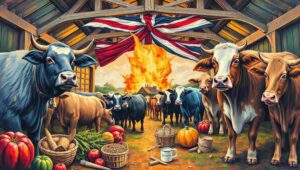
“We cannot survive entirely on skincare tutorials and unboxing videos,” admitted Chancellor Rupert Fenwick during an emergency parliamentary session interrupted repeatedly by sponsored content, a ring light falling over in the press gallery, and one backbencher attempting to film a “day in my life” vlog during Prime Minister’s Questions.
“The data is clear,” the Chancellor continued. “Content does not germinate. Reach does not ripen. Engagement metrics, however impressive, will not see us through winter.”
This is not entirely a satirical concern. Britain has lost 14,000 hectares of its most productive farmland to development since 2010, while simultaneously growing an economy increasingly weighted toward services, content, and the bewildering financial architecture of the gig economy. Agriculture accounts for roughly 1% of UK GDP but underpins the entire food manufacturing and retail sector — a statistic that explains quite a lot about why nobody is protecting it.
Wellness Podcast Diet Trial: Day Nine Vocabulary Deteriorates Significantly
Scientists initially explored whether influencers could at least provide emotional nourishment. Results were inconclusive and, frankly, upsetting.
“We fed volunteers nothing but wellness podcasts and motivational reels for three weeks,” explained Dr. Karen Bletchley of the Institute for Dietary Mistakes. “By day nine they were speaking exclusively in startup terminology. By day fourteen they were describing their hunger as ‘a pivotal moment in their wellness journey.’ By day nineteen they had started a newsletter.”
The newsletter had 40,000 subscribers by day twenty-one. This, the research team agreed, was somehow the most disturbing finding.
Agricultural Collapse: Crypto Consultants Pivot To Vertical Kale As Latest Redemption Arc
One London startup has already proposed converting abandoned office buildings into vertical kale farms operated entirely by former crypto consultants seeking personal redemption through agriculture. The consultants have no farming experience. The kale, reportedly, is aware of this.
Investors called the idea “disruptive,” which experts note is usually a warning sign of the same order as “we’re moving fast and breaking things” and “the whitepaper explains everything.”
Britain’s food supply chain supports 4 million jobs and represents £107 billion in economic value — none of which can be replaced by content calendars, no matter how well-optimised. The 500,000 people in UK farming and fishing represent a sector that feeds the nation. The 500,000 people producing lifestyle content represent a sector that, under rigorous testing, does not.
Outside Parliament: Signs, Slogans, And At Least One Misidentified Vegetable
Outside Parliament, protesters gathered carrying signs reading: “MAKE BRITAIN GROW THINGS AGAIN,” “STOP BUILDING LUXURY FLATS ON EVERY CABBAGE,” and one that simply said “I AM VERY CROSS ABOUT AGRICULTURE” in letters large enough to be read from a Deliveroo drone.
Inside, several hedge fund managers were reportedly attempting to short-sell carrots. Legal analysts say this is technically possible, deeply inadvisable, and in some philosophical sense a perfect encapsulation of the problem.
What The Funny People Are Saying about Agricultural Collapse
“You can’t milk an influencer. Though somebody in Shoreditch has definitely written a business plan about it. There’s probably a pitch deck.” — Nish Kumar
“Britain spent a decade producing content instead of potatoes. That’s not an economy. That’s a cry for help with good lighting.” — Jo Brand
This British satirical journalism piece is entirely the product of a human collaboration between the world’s oldest tenured professor and a philosophy major turned dairy farmer. No influencers were harvested for protein during the writing of this article, though several kale smoothies remain under investigation. Auf Wiedersehen, amigo!
Britain’s shift away from agricultural production toward a service-based and digital economy is a documented trend. The UK has lost approximately 14,000 hectares of its best farmland to development since 2010, according to CPRE research. Agriculture accounts for roughly 1% of UK GDP while supporting around 500,000 farmers and fishers and underpinning the entire £107 billion food manufacturing and retail sector. The influencer economy in the UK is real and growing: Ofcom reports that influencer marketing is now a multi-billion-pound industry, employing significant numbers of young people. The tension between a content-producing economy and a food-producing one is genuine, if rarely discussed in those terms. Former crypto investors pivoting to agriculture is, as yet, largely theoretical — though the vertical farming industry has attracted substantial speculative investment.

Bethan Morgan is an experienced satirical journalist and comedy writer with a strong editorial voice shaped by London’s writing and performance culture. Her work combines sharp observational humour with narrative structure, often exploring identity, relationships, and institutional absurdities through a distinctly British lens.
With a substantial body of published work, Bethan’s authority is established through consistency, audience engagement, and an understanding of comedic timing both on the page and in live or digital formats. Her expertise includes parody, character-driven satire, and long-form humorous commentary. Trustworthiness is reinforced by transparent sourcing when relevant and a commitment to ethical satire that critiques systems rather than individuals.
Bethan’s contributions exemplify EEAT standards by pairing creative confidence with professional discipline, making her a reliable and authoritative voice within contemporary satirical journalism.