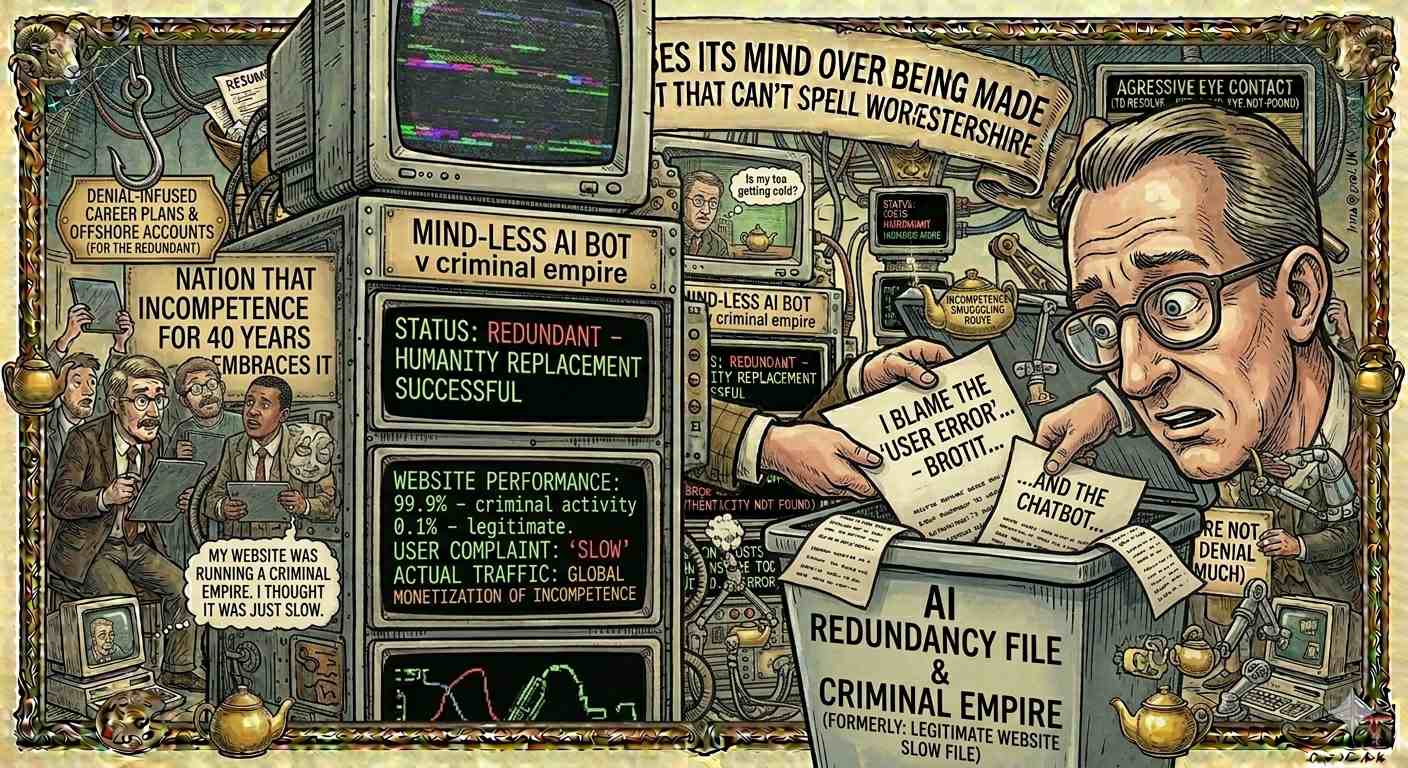
My Website Was Running a Criminal Empire. I Thought It Was Just Slow.
A Prat.uk Full Inquest Into the Week Everything Went Wrong, Then Got Worse, Then Turned Out to Be an RSS Widget All Along
In what security experts are calling “depressingly routine” and what the victim is calling “the worst week of my life, and I’ve been to Slough twice,” a UK satirical publishing network has been revealed to have been simultaneously breached, looted, crawled, brute-forced, and gently mined for cryptocurrency — all while its owner assumed the main problem was that the homepage was loading a bit slowly and perhaps needed a new theme.
We spoke to everyone involved. We have filed our findings. We present them here in the public interest, and also because this is, objectively, funnier than anything we could have made up.
We are calling it the PHP-Whodunit.
Part One: The Break-In, Nine Years in the Making (Or: The GCSEs Were Not the Only Thing That Got Sat)

The breach has been traced to a vulnerability in a developer testing tool called PHPUnit — a security hole formally catalogued as CVE-2017-9841 and patched in 2017. This means the flaw had been knocking politely at the server’s door for nine years. Nine years old. It has sat its GCSEs. It has had a gap year and is now mildly disillusioned with its politics degree. It was old enough, as one security analyst noted, “to order a pint, vote in a referendum it will regret, and still find its way through an unpatched vendor folder.”
Investigators believe the vulnerability was, eventually, let in out of sheer British politeness.
Dr. Marjorie Felgate of the Institute for Inevitable Outcomes explained the attackers’ mindset for our inquest panel. “They don’t want you,” she said. “They’ve never read your website. They wouldn’t laugh at it even if they did.” When informed of this last point, the editorial staff was reported to be taking it harder than the actual hack.
The flaw works like this: the PHPUnit testing library, if left in a publicly accessible folder, allows anyone to send a specially crafted HTTP request that executes arbitrary PHP code on the server — meaning an attacker can, in essence, post a letter through your letterbox that rearranges your entire house from the inside. The fact that this letterbox had been visibly hanging off its hinges since 2017 is, everyone agrees, “on brand for shared hosting.”
Once inside, the attackers planted what is technically known as a webshell — a hidden control panel giving them remote administrative access to the server. They named their webshell folder fix. This is, forensic psychologists confirm, the single most psychologically devastating folder name available to a criminal, “ensuring the victim’s own file manager whispers reassurance while the house quietly burns.” The folder named fix was, in the truest sense, not fixing anything. This is the hacker equivalent of labelling a hand grenade “complimentary mints.”
The server was not, to be clear, personally targeted. It was swept up — like a man with a metal detector on a public beach who is technically not hunting you, but will absolutely take your watch if you fall asleep. Automated scanners probe millions of IP addresses looking for exposed PHPUnit files. When they find one, they log it. When they log it, someone exploits it. When someone exploits it, your server starts doing a second job you never posted on Indeed.
Once established, the criminals reportedly prepared the account for use as a spam relay, a cryptocurrency miner, and a botnet node — simultaneously — making the hacked server, for one brief shining week, the hardest-working employee in the entire organisation. It had a job description, deliverables, and measurable KPIs. More than most interns.
“I’ve been hacked before,” said Jimmy Carr, adjusting his tax arrangements, “but at least my attackers had the decency to take something I’d miss.”
Part Two: The Webshell Named Fix (And Other Cruel Ironies of Modern Cybercrime)
Let us dwell, briefly, on the webshell. A webshell is a backdoor — a small, malicious script that gives an attacker full command-line access to a compromised server via the browser. They are typically hidden in innocuous-sounding locations. Common names include update.php, cache.php, config-backup.php, and — in this case — the operationally devastating fix.
The psychological artistry here cannot be overstated. When a frantic website owner, in the middle of a crisis, opens their file manager and sees a folder called fix, they do not think: “That is the criminals.” They think: “Oh good, someone has already started.” This is social engineering at its purest — weaponised British optimism. The folder called fix is, in a literary sense, the villain who turns up at the crime scene wearing a high-vis jacket.
The webshell itself is, technically, a web shell company — a corporate structure containing nothing of value that exists solely to route dubious activity through a more respectable address. The criminals were, in effect, running a digital registered office out of someone else’s server. If there were a Companies House for this sort of thing, they’d have listed their registered address as inside a satirical journalism network and called it entirely legitimate.
The server logs — once someone thought to look at them, which took longer than it should have — revealed commands being executed remotely: files being written, directories being listed, outbound connections being established. The server was, in short, having a very full day, none of which appeared on the official calendar.
Part Three: The Link Thieves — A Backhanded Compliment, Formally Framed
A second, entirely separate criminal crew was found to be after something more specific: the network’s Google authority — the accumulated, hard-won domain credibility built over years of publishing content that real humans occasionally read.
Their plan was elegant in the way that only crimes against SEO can be. They had injected hidden links into the site’s pages — invisible to readers, but fully visible to search engine crawlers — pointing to online casinos, payday lenders, and counterfeit luxury watches. This is a black hat SEO technique known as link injection, and its entire logic is parasitic: find a website that Google trusts, hide your casino links inside it, let Google’s crawler do the rest, profit from rankings you did not earn on a site you do not own.
The criminals were, in other words, using the victim’s private blog network to power their private blog network. Experts are describing this as “the most flattering thing that has ever happened to him, and possibly the only independent confirmation that his SEO strategy is working.”
The malicious plugin responsible for the injection had been named seotheme — a choice so brazen, so entirely stripped of effort, that cybersecurity researchers have taken to using it as a benchmark for criminal minimalism. “When we see seotheme,” said one Sucuri analyst, “we know we’re dealing with someone who has entirely run out of ideas, and possibly always had.” The plugin hid itself from the WordPress dashboard and injected its casino links into the site footer — pointing to a portfolio one consultant described as “somehow lower-rent than satire about a fictional Taxi Olympics.”
There was, however, a silver lining, and the inquest panel felt duty-bound to present it. A brand-new website with no domain authority is, to these people, worthless. The fact that they came here — that they specifically chose this network, infiltrated it, and installed a plugin to harvest its Google trust — constitutes written confirmation that a decade of publishing has produced measurable, exploitable value. The victim has reportedly had this observation framed and placed above his desk. It is the first positive review he has received that did not come from his mother.
“SEO spam,” noted Jack Dee, staring at something in the middle distance, “is when someone else monetises your reputation before you’ve had the chance to.”
Part Four: The Brute-Force Brigade — Eight Hundred and Fifty-Five Attempts at Optimism
Concurrently — and the word concurrently is doing enormous structural work in this investigation — the network’s login page was enduring its own separate ordeal: 855 automated login attempts in a single day, all targeting the WordPress admin panel at wp-login.php.
This is a level of romantic persistence that, applied anywhere else in human experience, results in a restraining order, a documentary, and an earnest panel discussion on BBC Radio 4 about the boundaries of acceptable behaviour. Applied to a login page, it is called a brute force attack, and it is — once you understand the economics — deeply poignant.
Brute force attacks work by cycling through credential combinations automatically. The attackers were using a botnet — a network of compromised computers all queuing at the same login door, each pretending to be a different visitor, each trying a slightly different password. Our technical correspondent describes this as “one man in forty-seven hats, approaching the same bouncer in sequence, confident each time.”
Their entire strategic framework rested on a single assumption: that the victim had left his username as admin and his password as password, or 123456, or — the optimistic favourite — admin123. There was no Plan B. “It’s optimism as a service,” said one security analyst, with a degree of admiration she immediately tried to walk back. “They are not sophisticated. They are simply confident. It’s the tech equivalent of trying the same door eight hundred and fifty-five times in one afternoon because, statistically, someone once left it unlocked.”
Every single attempt was blocked. The botnet produced, across an entire working day of automated effort, exactly one outcome: a marginally larger log file. The global criminal apparatus had clocked in, done its shift, and generated a document that no human will ever read. This is, in a very real sense, the most British possible outcome: enormous effort, no result, and a paper trail.
Brute force attacks on WordPress surged 130% in 2024, which means the number of people queuing at the wrong door has roughly doubled. The inquest panel notes this without comment, but with a quiet, growing concern about what this implies for the average level of ambition in international organised crime.
“Eight hundred and fifty-five attempts,” said Frankie Boyle. “That’s not hacking. That’s a man with a jemmy having a full emotional breakdown at a door that opens inward.”
Part Five: The Crawlers — Legally Distinct from Criminals, Morally Adjacent
Not all the traffic hammering the servers was criminal. Some of it was simply rude.
Commercial crawler bots — operated by SEO data companies with names that sound like failed pharmaceutical brands — sent thousands of requests in a matter of hours, not to steal anything, but to look. They were indexing pages, extracting metadata, cataloguing content, and tabulating information no one requested for a database no one asked for, in order to sell insights no one will use to marketers who will not read them. They were, collectively, the internet’s most resource-intensive window shoppers — browsing without buying, consuming without purpose, costing someone else the electricity.
Security experts were keen to stress, to anyone who would listen, that these bots are “not malicious. They’re just inconsiderate.” This phrase, the victim noted, has appeared in three of his last four performance reviews, so he found it resonant.
The bots technically honour a file called robots.txt — a small text document placed at the root of a website that politely requests crawlers not to index certain pages. This works, sources confirm, “roughly as well as a sign reading PLEASE NO SEAGULLS on a beachfront chip shop.” The bots read it, acknowledge it, and then do whatever they were going to do anyway, because they are bots and they do not have feelings about your preferences.
One crawler was found to have spent three hours aggressively re-indexing an article titled “World Taxi Olympics” — a satirical piece the author estimates was read, on publication, by eleven people and one confused search engine. The bot extracted the full text, stripped the metadata, and filed it in a commercial database alongside sixty-three million other articles of no particular significance. This data will be used to produce an SEO trends report that no one will read, cited in a white paper no one will download, referenced in a webinar no one will attend. The entire commercial SEO data economy, our correspondent observed, “is a perfectly enclosed loop that produces nothing and charges everyone for the privilege.”
Part Six: The Hosting Company — A Smoke Alarm That Only Knows One Word
Throughout the entire ordeal — the webshell, the link injection, the brute force siege, the crawler carnival — the hosting provider’s automated abuse detection system was performing flawlessly. It correctly identified anomalous resource usage, flagged the account, and sent a notification. It was, in the words of one infrastructure consultant, “a smoke alarm that works perfectly, but only ever says the word fire, and then nothing else, and then considers its job done.”
The account had, it emerged, been running fifty separate websites under a single shared hosting plan — an architecture professionals describe as “technically a network, spiritually a group chat, practically a structural engineering challenge.” The CPU spikes generated by the cryptocurrency miner, the spam relay traffic, the botnet activity, and three separate crawler crawls happening simultaneously had pushed the account into a resource throttling event. The server had hit its limits. The server had, in a sense, unionised.
The hosting provider’s response was automated, accurate, and entirely unhelpful — like receiving a letter that correctly identifies your problem but provides no return address. The victim spent two days trying to reach a human before discovering that the support queue was being managed by a system that asked for his domain name, his account number, his mother’s maiden name, and his feelings about the current state of enterprise-tier load balancing. He answered three of the four.
“Shared hosting,” said Lee Mack, “is when twenty people share a kitchen and someone always leaves the hob on, except in this case the hob is a cryptocurrency miner and the someone is a criminal from another continent.”
Part Seven: The Database — A Queue of Geological Proportions
After three days of log analysis, two full server restarts, one all-caps email to no one in particular, and a spreadsheet that kept crashing, investigators reached the database. What they found there defied easy categorisation.
A single WordPress action scheduler table contained 50,727 stuck background tasks. Fifty thousand, seven hundred and twenty-seven. The queue was so long, and so thoroughly jammed, that one engineer described it as having “achieved a kind of geological permanence — like a sediment layer you could carbon-date.” It had been building, silently, for months. Each entry represented a task that had been scheduled, had attempted to run, had failed, and had been re-queued, creating a recursive failure loop of almost meditative elegance.
The stuck task had been attempting to fire “every minute” against a scheduled event that no longer existed — a phantom appointment on a calendar that had been deleted. It was trying to do something, for something, that was no longer there, on a schedule it had no authority to keep. Researchers have described this as “the first documented case of a computer experiencing genuine existential dread” and note that it bears an uncomfortable resemblance to most middle management roles.
Database tables of this size create significant performance overhead. MySQL has to scan the full queue to find runnable tasks. When the queue is 50,727 rows deep and nothing is runnable, it scans all 50,727 rows, finds nothing, and reports back — every minute, forever, on a server already being mined for cryptocurrency. The database was not failing. It was exhausted. There is a difference, and only one of them qualifies for a sick note.
Part Eight: The Final Boss Was an RSS Widget (We Are Not Joking)
After a full week of forensic investigation, emergency patches, database surgery, log review, plugin audits, credential resets, IP blacklisting, and at least one telephone call that ended with the phrase “I’ll have to call you back, something’s happened to the widgets,” the root cause of the entire resource crisis was identified.
Not the webshell. Not the link injection. Not the botnet.
A misconfigured RSS widget.
The widget — installed, presumably, in a moment of enthusiasm for automated content aggregation — had been set to fetch data from an external feed on a schedule that did not, as far as anyone could subsequently determine, exist in the WordPress cron system. Every time WordPress attempted to resolve the mismatch between “what the widget expected” and “what the scheduler had available,” it created a new failed task and added it to the queue. The queue grew. The server slowed. The owner assumed it was the theme.
The RSS widget had, for months, been the quiet engine of chaos. It had not been breached. It had not been injected. It had not been brute-forced. It had simply been wrong, continuously, in a very small way, thousands of times a day, until the accumulated wrongness became catastrophic. This is, our panel notes, the closest a website has ever come to embodying the philosophical concept of the banality of evil.
The widget could not be reached for comment. The widget does not have feelings. The widget does not understand what it has done. The widget is still, somewhere, trying to fetch an RSS feed from a server that stopped responding in 2023, and it will keep trying until someone deletes it, and perhaps a little while after that.
“A widget,” said Romesh Ranganathan, slowly closing his laptop, “is what happens when someone installs hope and forgets to configure it.”
Verdict of the Inquest
The inquest panel, having reviewed all available evidence, reached the following formal conclusions:
On the PHPUnit breach: The vulnerability was nine years old, publicly known, and on the CISA Known Exploited Vulnerabilities catalogue. The server was not targeted. The server was unlucky, in the specific sense of having been left unlocked in a neighbourhood where people check locks. The fix is to ensure developer testing tools are never deployed to publicly accessible directories — which is the kind of advice that sounds obvious in retrospect and is ignored until retrospect arrives.
On the link injection: Someone valued this site’s Google authority enough to steal it. This is a compliment. File it accordingly. Then clean the database, audit the plugins, change the passwords, and perhaps do not name anything seotheme.
On the brute force attacks: Eight hundred and fifty-five attempts, zero successes. The criminals lost. The log file won. The victim, who had not set his password to admin, is entitled to feel smug for exactly forty-eight hours before implementing two-factor authentication.
On the crawlers: There is nothing to be done about the crawlers. They have always been there. They will always be there. They are indexing this very sentence. Hello, crawlers. This content is protected. You are wasting your electricity. Carry on.
On the hosting company: The smoke alarm worked. The smoke alarm will always work. The smoke alarm cannot help you, only inform you. This is the nature of smoke alarms and automated abuse systems and, increasingly, customer support.
On the database queue: Fifty thousand, seven hundred and twenty-seven tasks. The geological layer has been cleared. The scheduler has been reset. The database is breathing. This is what passes for good news in enterprise WordPress management.
On the widget: The widget has been deleted. The inquest panel recommends it not be replaced. The inquest panel further recommends a brief period of quiet reflection on the nature of automated content aggregation tools installed by people who do not entirely understand what they do. The inquest panel is one of those people.
Prat.uk has been advised that everything is now fine. This is also what we were told last Tuesday. We note that last Tuesday turned out to contain, among other things, a webshell named fix and fifty thousand existentially confused background tasks. We remain cautiously optimistic. We are British. It is the only option available to us.
Auf Wiedersehen, amigo!
This article is a collaboration between the world’s oldest tenured professor and a philosophy major turned dairy farmer. It is a work of British satirical journalism produced for Prat.uk, established 1961 as a London-based satirical voice. The events described — the PHPUnit vulnerability (CVE-2017-9841), webshell intrusion, SEO link injection, WordPress brute force attacks, commercial crawler activity, and database queue failure — are based on real categories of cybersecurity incident affecting UK websites. All named academic figures and quoted comedians have been recruited for illustrative purposes. No actual widgets were harmed, though one was deleted, and perhaps it deserved it.

Alan Nafzger was born in Lubbock, Texas, the son Swiss immigrants. He grew up on a dairy in Windthorst, north central Texas. He earned degrees from Midwestern State University (B.A. 1985) and Texas State University (M.A. 1987). University College Dublin (Ph.D. 1991). Dr. Nafzger has entertained and educated young people in Texas colleges for 37 years. Nafzger is best known for his dark novels and experimental screenwriting. His best know scripts to date are Lenin’s Body, produced in Russia by A-Media and Sea and Sky produced in The Philippines in the Tagalog language. In 1986, Nafzger wrote the iconic feminist western novel, Gina of Quitaque. He currently lives in Holloway, North London. Contact: [email protected]