Whitehall Proposes a Government-Funded AI Customer
LONDON, England — Britain’s technology industry has announced the successful elimination of human employment, followed by the discovery that people without wages are surprisingly reluctant to spend £84 on a weekly supermarket shop.
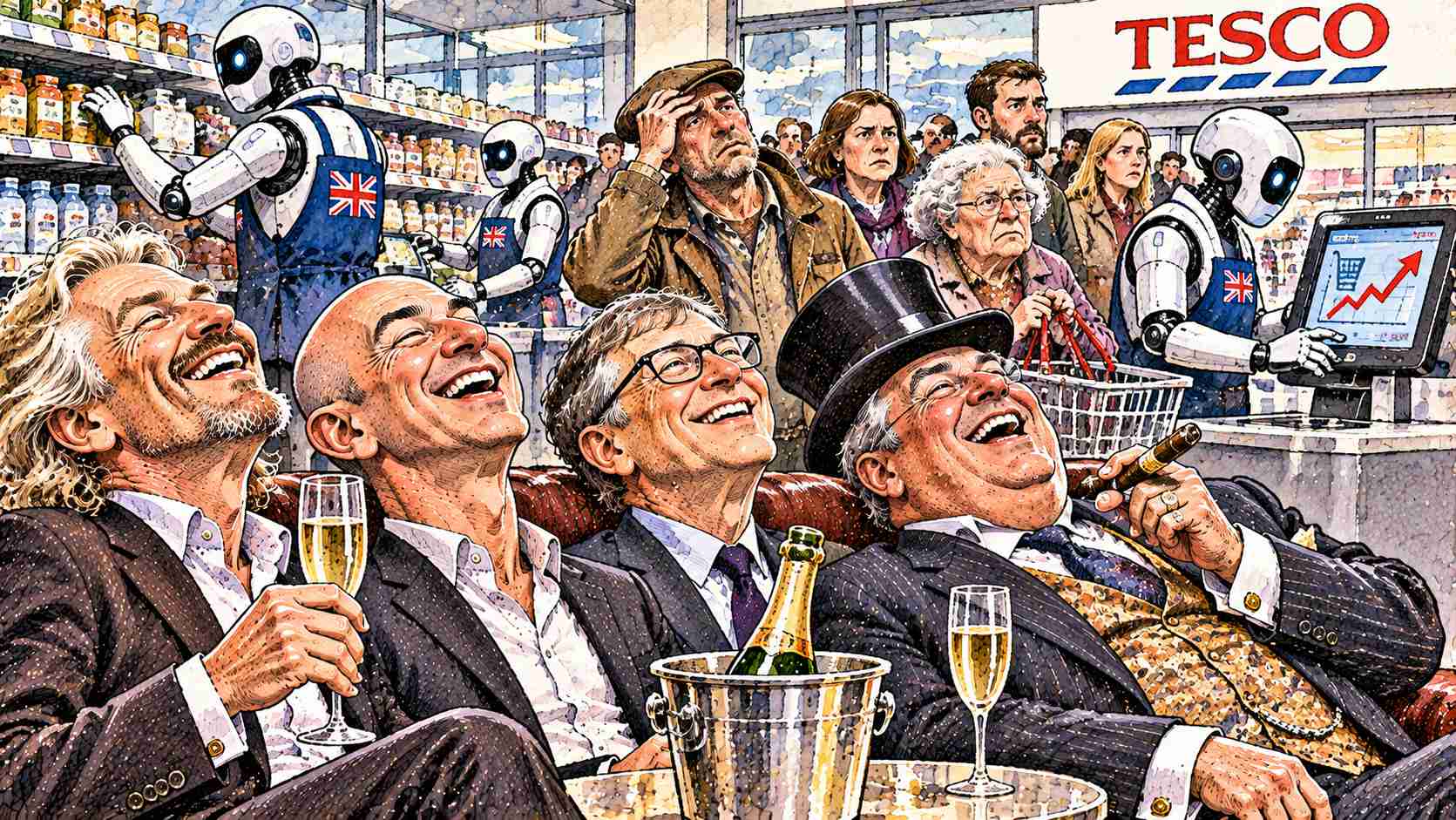
The breakthrough came at a London investment conference, where executives celebrated replacing 40,000 employees with artificial intelligence and then learned that their former employees had stopped buying things.
“We’ve reduced payroll expenses by 100 per cent,” said technology billionaire Sebastian Worthington-Pryce. “Unfortunately, sales have fallen by 100 per cent as well. We believe this is a temporary failure of consumer enthusiasm.”
Economists said the link between employment and purchasing power has been understood for centuries. The news still came as a surprise to a room of men who had never personally operated a self-service checkout.
AI Job Losses and the High Street: Tesco Discovers Customers Need Money
At a Tesco in suburban London, unemployed accountant Nigel Perkins described the difficulties of taking part in the new digital economy.
“An algorithm took my job on Monday,” he said. “On Tuesday, another algorithm recommended a £2,400 television. On Wednesday, my banking app recommended I stop eating.”
Perkins now gets daily emails inviting him to buy luxury watches, European holidays and premium financial planning. “I told the computer I was unemployed,” he said. “It suggested I upgrade to the premium subscription.”
Tesco looked at replacing its customers with artificial intelligence but dropped the idea when the digital shoppers tried to pay for groceries with positive online reviews. One simulated customer bought 600 avocados, 40 bottles of champagne and a £900 barbecue, then paid with cryptocurrency from a computer game.
A Tesco spokesperson said in a statement that the company “continues to welcome all customers, including those currently between salaries and those who are, technically, a spreadsheet.”
A poll of 2,000 adults commissioned by the Institute for Household Solvency found that 64 per cent expect to cut their spending after being replaced by software. Another 22 per cent expect to cut their spending after watching a colleague get replaced by software, and 14 per cent said nobody had told them yet.
Whitehall Establishes a Department for Artificial Purchasing
The Government responded within days. A new Department for Consumer Replacement would employ 14,000 civil servants to investigate whether artificial intelligence could be trained to buy British products with public money.
The department’s first experiment gave a computer £10 million and instructed it to stimulate the economy. Within seconds the system had bought consulting services from another government computer, which subcontracted the work to a third computer in Luxembourg. The money disappeared without producing anything.
Civil servants described the exercise as remarkably similar to traditional procurement, except that nobody had to attend a meeting.
Minutes of the department’s first meeting, which ran to nine pages, record that the item headed “Purpose of the Department” was deferred to a later date. Item 2, “Name of the Department,” was carried unanimously. Item 3, “Biscuits,” took 40 minutes.
UK Labour Market and AI: Actual Research Interrupts the Celebration
A January 2026 UK government assessment of AI and employment estimates that roughly 70 per cent of British workers hold jobs containing tasks AI could potentially perform or improve.
That does not mean 70 per cent will lose their jobs. The report acknowledges considerable uncertainty about employment outcomes, and the Office for National Statistics publishes fresh labour market figures every month, none of which had been opened by anybody at the conference.
Nuance was ruled unsuitable for the event because it wouldn’t fit on a PowerPoint slide. One banker insisted automation would make everybody richer. Asked who would receive the additional wealth, he said, “The shareholders, obviously.” Asked whether unemployed customers owned shares, he accused the journalist of introducing unnecessary complications.
Britain Introduces the National Artificial Customer Service
Under the government’s proposed rescue plan, every unemployed citizen would receive a digital shopping assistant. The assistant would pick products the citizen couldn’t afford, put them in a basket and produce a congratulatory message: “Congratulations! Your shopping experience was successful!” Payment failures would be handled by a separate Department for Financial Disappointment.
Meanwhile, the last employed electrician in Birmingham announced a £600 callout charge.
“I’ve got enough work to retire next Thursday,” he said. “Apparently computers can write Shakespeare but still can’t change a consumer unit.”
By evening, Worthington-Pryce had unveiled another product, an artificial intelligence system that generates customers who pretend to be happy. Shares rose 18 per cent. Nobody bought anything.
Five Humorous Observations About Replacing British Workers With AI
- Eighty-four quid for a weekly shop. That’s not a shop, that’s a hostage negotiation with a trolley that has a wonky wheel. And these guys fire 40,000 people and act shocked that Dave from Accounts stopped buying the Finest range.
- Sales down 100 per cent, payroll down 100 per cent, and he calls it a “temporary failure of consumer enthusiasm.” Sir, that’s not enthusiasm. That’s called being skint. It’s the same word on both sides of the till.
- The robot bought 600 avocados and paid with cryptocurrency from a video game. You know who else does that? A twelve-year-old with his dad’s card. Except the twelve-year-old gets grounded. The robot gets a Series B.
- The Government gave a computer ten million pounds and in four seconds it was in Luxembourg. That’s not artificial intelligence. That’s just a very normal bloke with a very good accountant.
- “The shareholders, obviously.” Obviously. Like it’s the weather. Like it’s physics. Gravity, tides, shareholders.