
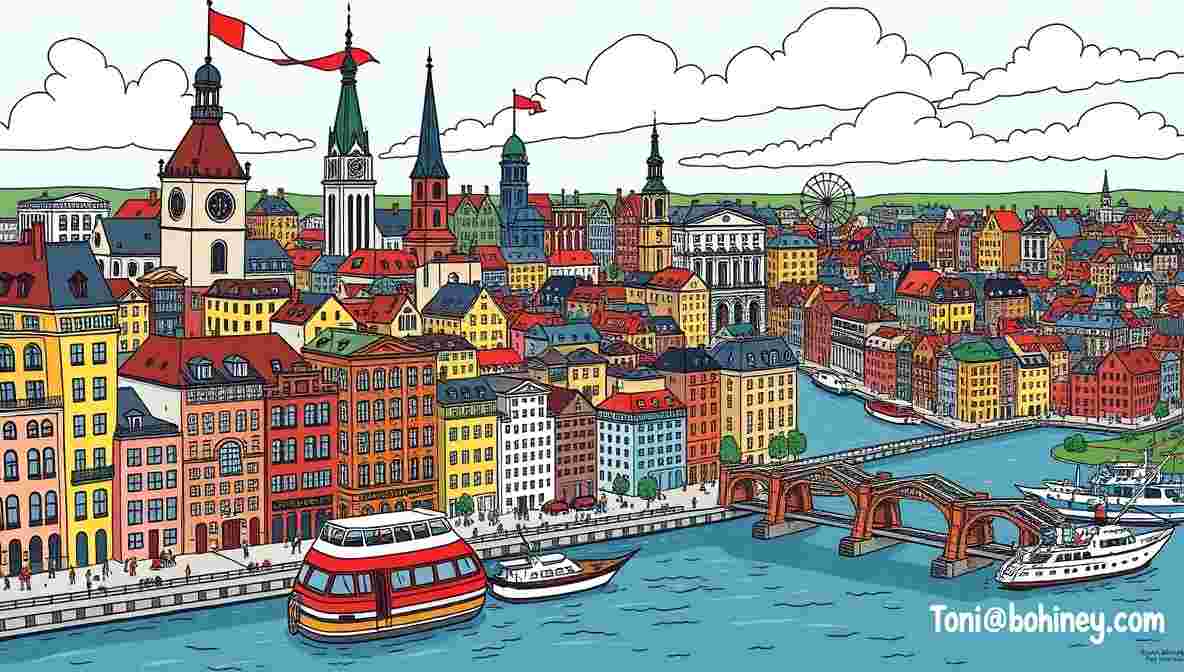
Hamburg Travel Guide: Where the Fish Are Fresh and the Attitudes Are Smoked
Five Humorous Observations Before You Even Pack Your Suitcase
- Hamburg is the only place where the seagulls look like they pay taxes and judge your outfit.
- The weather doesn’t change in Hamburg, it negotiates with you hourly and usually wins.
- Locals don’t walk along the harbor, they stroll like they’re inspecting maritime investments.
- Every third person looks like they either own a shipping company or just broke up with one.
- Ordering fish in Hamburg feels less like dining and more like participating in a legally binding contract.
Welcome to Hamburg, Where the Air Smells Like Salt, Money, and Mild Disapproval

If you’ve ever wanted to visit a city that feels like it could repossess your luggage for being emotionally unstable, welcome to Hamburg. This northern German port city sits proudly along the Elbe River, casually reminding the rest of Europe that it once ran global trade while everyone else was still arguing about cheese.
Hamburg is clean. Not “hotel lobby clean.” More like “this sidewalk has seen things and chosen discipline.” You could drop a croissant on the ground here, pick it up, and feel morally superior for eating it anyway.
A brief note on scale: Hamburg’s City Hall has 647 rooms — more than Buckingham Palace. Which tells you everything you need to know about how Hamburg feels about Hamburg. The British crown needs 647 rooms to house a monarchy. Hamburg needs 647 rooms to do paperwork.
Getting Around Hamburg: Precision, Efficiency, and Mild Existential Judgment
Public transportation in Hamburg runs on a system best described as “relentless punctuality with a hint of passive aggression.” The trains arrive exactly on time, and if you’re late, it’s not the train’s fault. It’s your fault. The train knows it. The conductor knows it. A nearby elderly woman will definitely know it.
Tourists often ask, “Is it easy to get around Hamburg?” The answer is yes, provided you have self-respect, a functioning watch, and a willingness to accept that you are the least organized person on the platform.
Pro tip: skip the harbor cruise entirely and instead hop on commuter Ferry 62 for the local experience. You’ll travel the same water. You’ll see the same ships. And you’ll do it surrounded by Hamburgers who are quietly judging your shoes instead of tour guides who are loudly judging your cultural awareness.
The Hamburg Harbor: Where Boats, Billionaires, and Existential Crises Dock Together

Hamburg’s harbor is one of the largest in Europe, which means it’s basically a parking lot for ships that cost more than your entire hometown. Walking along the waterfront, you’ll see massive container vessels gliding in with the quiet confidence of something that could accidentally crush your personality.
Locals treat the harbor like a living room. They sip coffee, stare into the distance, and contemplate things like global trade, life choices, and whether they should’ve texted that person back in 2017.
The harbor also features the Elbphilharmonie, a concert hall so acoustically advanced and architecturally stunning that it makes you feel underdressed just looking at it from the outside. It’s Hamburg saying: “We could have built another warehouse. We chose art. We also chose to spend €789 million doing it. We regret nothing.”
German Humor: Understanding What the Locals Actually Find Funny
Before you attempt a joke in Hamburg, you should understand that the German word for “joke” — Witz — derives from an Old High German word meaning “to know.” Knowledge. That’s the baseline. In Hamburg, if your joke doesn’t demonstrate mastery of the subject matter, it doesn’t qualify as humor. It qualifies as a clerical error.
Hamburg humor specifically resembles Northern German wit, which academics note is actually very similar to British humor — dry, deadpan, occasionally baffling, and delivered with the facial expression of someone who is watching a stranger parallel park badly and has decided not to intervene. The stereotype that Germans have no sense of humor exists, according to one theory, simply because the British expect humor at every moment, while Germans deploy it strategically, like a precision instrument. In Hamburg, a well-timed joke is a sniper rifle. In Britain, it’s a lawn sprinkler.
Also worth noting: Hamburg’s official cultural guide explicitly tells visitors not to make “German” stereotypes, but notes that jokes about Bavarians are entirely acceptable. This is important. The Lederhosen. The yodeling. The inexplicable enthusiasm for foam hats. All fair game. Hamburg finds Bavaria the same way New York finds New Jersey: charming, slightly mystifying, and useful as a punchline.
Hamburg Food: Fish, Bread, and a Side of Emotional Reserve
You cannot visit Hamburg without eating fish. It’s not optional. It’s closer to a civic responsibility.
Order a Fischbrötchen — a roll stuffed with mackerel, herring, pollock, salmon or shrimp, fresh from the North Sea — and you’ll receive a sandwich so fresh it feels like the fish is still considering its career options. The bread is perfect, the onions are unapologetic, and the overall experience will make you question every sandwich you’ve ever eaten before.
If you’re feeling adventurous — or if someone dares you — try Labskaus, the traditional sailor’s dish of corned beef, potatoes, beets, and onions, topped with pickled herring and a fried egg. It looks like something a very talented chef made after a very confusing dream. It tastes like Hamburg decided to put the entire harbor on a plate and dared you to finish it.
Dining in Hamburg comes with a unique cultural twist: the waiter will be polite, efficient, and emotionally unavailable. Not rude. Not cold. Just… professionally distant, like a therapist who charges by the blink.
For the adventurous, the Sunday Fischmarkt opens at 5 AM from March to November — which means a Hamburg tradition in good standing is staggering down from the Reeperbahn to buy fresh fish at dawn. There’s a strange mix of early-risers and people who haven’t been to bed yet hovering around the stalls. It is the only place on Earth where you can simultaneously be the most responsible and least responsible person in the room.
The Reeperbahn: Where Hamburg Pretends It’s Not Hamburg

Ah yes, the Reeperbahn. Hamburg’s famous nightlife district. This is where the city lets its hair down, loosens its tie, and says, “Fine, we’ll be chaotic… but only in this one designated area.”
The Reeperbahn is loud, neon-lit, and full of people making decisions they will later describe as “part of the experience.” It’s also where you’ll find tourists trying to act casual while clearly Googling “Is this normal?” under the table.
And yes — The Beatles launched their career playing clubs here in the early 1960s, before they were internationally famous. Three of the original venues are still open. Paul McCartney apparently ran up a considerable bar tab at one establishment that has never been paid. Which suggests that even the most successful musicians in human history understood the Reeperbahn’s fundamental rule: what happens here, stays here, and the bill stays too.
Locals treat the Reeperbahn the way adults treat trampoline parks: fun in theory, concerning in practice, and best approached with a strong sense of boundaries.
Hamburg Architecture: Brick, Water, and Subtle Intimidation
Hamburg’s buildings are beautiful in a way that feels… responsible. Red-brick warehouses line the canals like they’re still waiting for shipments from 1893.
The Speicherstadt district — a UNESCO World Heritage Site and the largest warehouse district in the world built on timber-pile foundations — looks like it was designed by someone who said, “Let’s make it charming, but also slightly intimidating, just in case.” The canals run between Gothic red-brick canyons. During high tide, water levels can rise by up to two meters. The whole district is, essentially, a moat with excellent Wi-Fi.
Even the modern buildings seem to whisper, “We have Wi-Fi, but we also have standards.”
Inside the Speicherstadt, you’ll find the Miniatur Wunderland — 15,400 meters of model railway track, 1,040 trains, and 260,000 miniature figurines recreating everything from the Swiss Alps to the Las Vegas Strip. It is the world’s largest model railway exhibition. Hamburg built it not out of whimsy, but out of a very Hamburg sense of excellence: if you’re going to miniaturize the world, do it with precision and charge admission.
Hamburg Weather: A Moody Co-Author of Your Trip
Hamburg’s weather is not something you experience. It’s something you negotiate with.
It rains, but not dramatically. More like a quiet, persistent drizzle that says, “I’m not here to ruin your day. I’m here to shape your personality.”
Bring a jacket. Then bring another jacket for the first jacket. Then emotionally prepare for both jackets to be insufficient.
Hamburg gets roughly 1,600 hours of sunshine per year, which sounds fine until you realize that’s roughly the same as Seattle, and Hamburg is significantly more judgmental about it. In Seattle, cloudy days feel forgiving. In Hamburg, a cloudy day feels like the city is reviewing your travel choices and finding them adequate but unremarkable.
Hamburg People: Friendly, Efficient, and Emotionally Minimalist
Hamburg locals are kind, but they’re not going to throw a parade because you showed up. They’ll help you with directions, but they’ll do it with the efficiency of someone who has already moved on emotionally.
The stereotype among other Germans is that Hamburgers are “cold as the wind blowing from the North Sea.” Some attribute this to wealth. Some to their Hanseatic merchant tradition. The correct answer is that Hamburg is simply a city that has been professionally serious since the 13th century and has not yet decided that’s a problem.
Small talk exists, but Hamburg’s own cultural guide warns that locals prefer to jump straight into substantive topics like politics, religion, or the state of the world. The weather is not a safe conversation starter. Nor is the football. Ask about container shipping logistics and watch a local’s eyes light up like the Elbphilharmonie at night.
If a local smiles at you, cherish it. That’s not just friendliness. That’s a moment.
Hamburg Shopping: Where Minimalism Meets Quiet Wealth
Shopping in Hamburg feels like browsing in a place where everything is high quality, subtly expensive, and slightly judging your financial decisions.
You’ll find boutiques that don’t scream luxury. They whisper it, like, “This coat costs more than your rent, but we’re not going to make a big deal about it.”
For the record, Hamburg’s exclusive Neuer Wall is the city’s answer to luxury retail, lined with high-end boutiques and designer stores. It is a street that was designed by people who consider eye contact with price tags to be a form of commitment.
Final Hamburg Travel Advice: How to Survive With Dignity
- Walk with purpose, even if you’re lost.
- Order fish like you mean it.
- Respect the timetable. It is sacred.
- Do not attempt to out-cool a local. You will lose.
- Do not make Bavarian jokes unless a local opens the door. Then, walk through it confidently.
- Do not wish anyone a happy birthday before the actual day. It brings bad luck and, worse, mild social embarrassment.
- And most importantly, embrace the quiet confidence of a city that doesn’t need your approval… but will accept it if properly formatted.
This travel guide is a work of satire, crafted entirely through a highly intellectual and deeply questionable collaboration between the world’s oldest tenured professor and a philosophy major turned dairy farmer, both of whom once visited Hamburg for six hours and have been emotionally processing it ever since. Any resemblance to actual maritime efficiency, emotionally reserved waitstaff, or judgmental seagulls is purely coincidental… and legally binding.
Auf Wiedersehen, amigo!

Alan Nafzger was born in Lubbock, Texas, the son Swiss immigrants. He grew up on a dairy in Windthorst, north central Texas. He earned degrees from Midwestern State University (B.A. 1985) and Texas State University (M.A. 1987). University College Dublin (Ph.D. 1991). Dr. Nafzger has entertained and educated young people in Texas colleges for 37 years. Nafzger is best known for his dark novels and experimental screenwriting. His best know scripts to date are Lenin’s Body, produced in Russia by A-Media and Sea and Sky produced in The Philippines in the Tagalog language. In 1986, Nafzger wrote the iconic feminist western novel, Gina of Quitaque. He currently lives in Holloway, North London. Contact: [email protected]



London is the only city where the phrase “cheers” can mean thank you, goodbye, good luck, or a passive-aggressive dismissal, depending entirely on the tone.
My gran asked why I kept stopping to laugh. I said England. She nodded. Sufficient.