
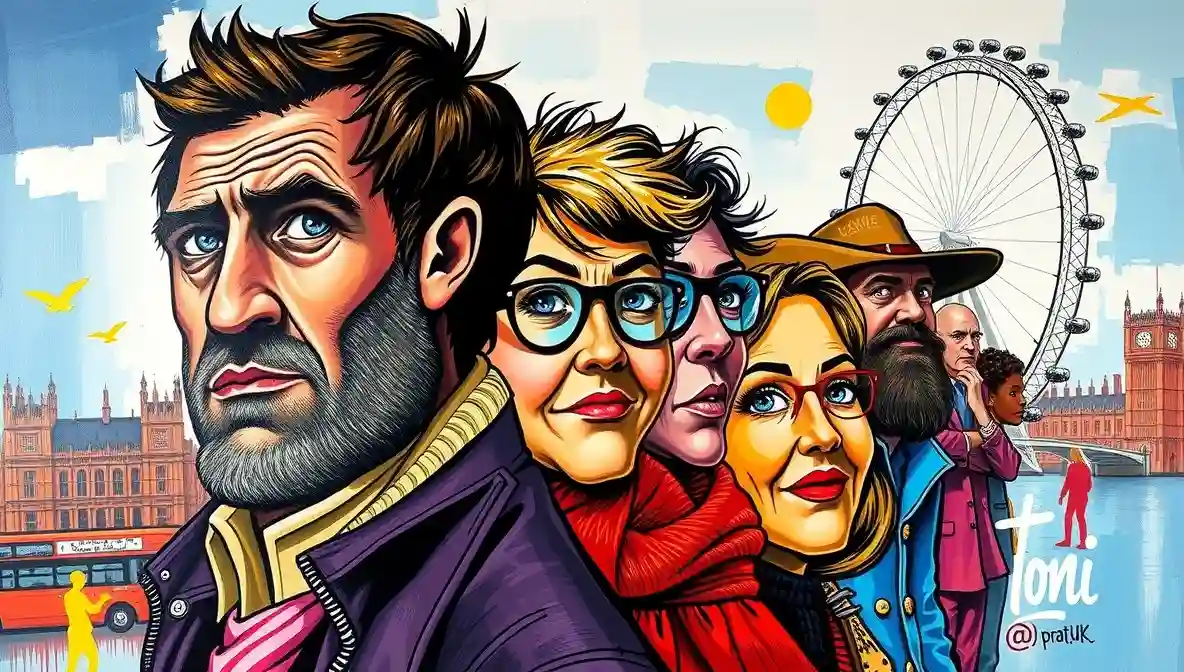
Teenagers Discover Amplification While Parliament Discovers It Has Run Out of Ideas
Nation Decides Loud Guitars May Be Easier Than Governing
Teenagers Discover Amplification While Parliament Discovers It Has Run Out of Ideas
In 1962, Britain made two significant discoveries. The first was that a young man from Liverpool with a guitar and an unwholesome amount of hair could command more genuine public enthusiasm than the entire Cabinet combined. The second was that this was probably not a coincidence.
The early 1960s had been promising, in the way that an overcast Tuesday morning can be promising theoretically capable of improvement, showing occasional patches of brightness, not yet committed to disaster. The economy was ticking. The Prime Minister was still Macmillan, operating on the general principle that if one looked sufficiently unruffled, the country would assume things were fine and get on with its tea. This strategy had been working, after a fashion, for several years. Then the guitars arrived.
To understand what the guitars meant, one must understand what they were replacing. Britain in 1962 was a country whose entertainment had, for decades, been conducted at a volume appropriate for a vicarage drawing room. Popular music involved men in evening wear, orchestras of considerable respectability, and singers whose diction was so crisp you could have served it with butter. The BBC had long maintained a careful relationship with popular taste, which is to say it had largely ignored it in favour of what it believed popular taste ought to be.
Enter the Instrument That Changed Everything, Loudly
The electric guitar had been in existence since the 1930s, but it required the peculiar combination of postwar adolescence, American imports, and a generalised sense of adult disappointment to transform it from a musical instrument into a cultural event. What would become the British Invasion began, like most invasions, as a local disturbance small clubs, damp basements, amplifiers of uncertain provenance, and young men learning three chords with the devotion previously reserved for Latin declensions.
By 1962 the disturbance was getting organised. In Liverpool, a group called the Beatles had been playing the Cavern Club with sufficient regularity that they had worn a groove in the schedule. Brian Epstein, a record shop manager with excellent hair and impeccable instincts, had become their manager in November 1961, and was busy explaining to record labels that this was not merely noise but rather the future, which the record labels received with the open-mindedness typical of people whose careers depended on the present.
EMI’s George Martin signed them in June 1962. History, at this point, stops being ironic and becomes merely inevitable.
The Government Meanwhile Was Governing
It would be unfair to say the government was doing nothing in 1962. It was doing several things, all of them less interesting than a four-piece from Merseyside. Macmillan was conducting foreign policy with the weary sophistication of a man who has read all the dispatches and suspects none of them contain good news. The Cuban Missile Crisis in October brought the world to the edge of nuclear war and then, mercifully, back again an event which briefly made guitar amplification seem less important before most people concluded that if the world was going to end anyway, one might as well dance.
Parliament debated. Ministers managed. The civil service administered with its customary imperious competence. And somewhere in all this, a generation of young people looked at the architecture of British adult life the deference, the rationing hangover, the unspoken rule that enthusiasm was a form of vulgarity and decided, collectively and without formal vote, that they would prefer the guitars.
Skiffle, Teddy Boys, and the Slow Demolition of Deference
The guitar revolution had not arrived without warning. Lonnie Donegan’s skiffle movement of the late 1950s had already demonstrated that British working-class youth could make compelling noise with a washboard and a tea-chest bass an observation that was, in retrospect, either inspiring or alarming depending on one’s relationship with sleep. The Teddy Boys had established that young men in drape coats and brothel creepers were willing to push back against the aesthetic expectations of their parents, which in Britain is roughly equivalent to revolution.
By 1962, skiffle had evolved into something considerably louder, faster, and more American in its influences. Buddy Holly, Chuck Berry, Little Richard these names were spoken in certain households with the reverence one might previously have reserved for the King James Bible, and with considerably more foot-tapping. The guitar was the instrument through which British youth was conducting its negotiation with postwar adult Britain, and the terms being offered were non-negotiable: less formality, more electricity, and could everyone please stop being quite so relentlessly sensible.
Why Guitars Are, In Fact, Easier Than Governing
The headline of this piece makes a claim that deserves examination, because it is this must be acknowledged entirely true. Consider the respective skill sets. Governing requires the management of contradictory interests, the navigation of bureaucratic inertia, the maintenance of international relationships with people who do not particularly like you, and the constant production of optimistic statements about matters over which you have limited control. It requires the ability to sit in a very old building and pretend that procedural arguments about the wording of amendments are the most important activity available to a human being on a Tuesday afternoon.
Playing guitar in a band in 1962 required three chords, a leather jacket, and the willingness to stand in front of people and make noise until they screamed. The learning curve was steep but the feedback was immediate. No one screamed at the Chancellor of the Exchequer in a way that indicated admiration.
The guitar, as an instrument, democratised aspiration. One did not need family connections or a place at Oxford. One needed nimble fingers, reasonable rhythm, and access to a Vox amplifier. This was, in the language of a later decade, genuinely disruptive not of the self-congratulatory Silicon Valley variety, but the actual kind, where something that used to require privilege can suddenly be done by a teenager from a council estate in Merseyside.
What the Establishment Made of All This
The establishment made of it what establishments generally make of cultural upheaval: first dismissal, then anxiety, then awkward attempts at incorporation. The BBC initially treated rock and roll with the distant courtesy one might extend to a foreign visitor whose customs one found baffling. Newspapers covering the nascent Merseybeat scene did so in the tones of anthropologists reporting from an exotic region interested, slightly alarmed, professionally objective.
Politicians, to the extent they noticed at all, tended to frame the guitar question as a sociological concern juvenile delinquency, noise pollution, the corrupting influence of American culture. None of them appear to have considered that a society producing this much creative energy in its basements and back rooms was not a society in decline but a society doing something far more interesting than its official narrative suggested.
The official narrative in 1962 was roughly: Britain is a serious nation managing a complicated transition from empire to modernity with dignity and competence. The unofficial narrative, being played at volume in Liverpool, London, and Birmingham, was different. It went: three chords and the truth, repeated until something changes.
The Year the Needle Dropped
By the end of 1962, the Beatles had released their first single, Love Me Do, which reached number seventeen in the UK charts not a seismic event in itself, but the kind of small tremor that precedes something considerably larger. George Martin had refined their sound. Brian Epstein had refined their image. The Cavern Club had refined their timing. Everything was in place for what would follow.
What followed changed not just British music but British self-conception the discovery that the country that had given the world Shakespeare and Newton and the Industrial Revolution could also give it the electric guitar played by young men from ordinary streets, and that this was not a lesser gift but in many ways a greater one, being freely given and universally received.
None of this was visible in 1962, of course. In 1962 it was still just noise. Very good noise, admittedly. Noise with a backbeat and a sense of purpose. But the Cabinet was not listening, and history has a way of taking note of who was and wasn’t paying attention.
Auf Wiedersehen, amigo!
By 1962, the Merseybeat scene centred on Liverpool’s Cavern Club was producing the generation of musicians who would transform British popular culture. The Beatles, managed by Brian Epstein and signed to EMI by producer George Martin, released their debut single Love Me Do in October 1962. The Cuban Missile Crisis of October 1962 brought the United States and Soviet Union to the brink of nuclear conflict before a diplomatic resolution was reached. Harold Macmillan remained Prime Minister until October 1963, when he resigned citing ill health during the Profumo Affair’s political fallout. The British Invasion of the American music market began in earnest in 1964.
ORIGINALY PUBLISHED: 7 June 1962 (London, UK)

Alan Nafzger was born in Lubbock, Texas, the son Swiss immigrants. He grew up on a dairy in Windthorst, north central Texas. He earned degrees from Midwestern State University (B.A. 1985) and Texas State University (M.A. 1987). University College Dublin (Ph.D. 1991). Dr. Nafzger has entertained and educated young people in Texas colleges for 37 years. Nafzger is best known for his dark novels and experimental screenwriting. His best know scripts to date are Lenin’s Body, produced in Russia by A-Media and Sea and Sky produced in The Philippines in the Tagalog language. In 1986, Nafzger wrote the iconic feminist western novel, Gina of Quitaque. He currently lives in Holloway, North London. Contact: [email protected]


The thing about politicians complaining about it is they’re upset that satire is competing with their own narrative control.
My mate’s in the civil service. Complete radio silence. Worst silence. Definitely accurate.
This reads like someone’s been quietly furious for exactly the right amount of time and finally documented it all.