
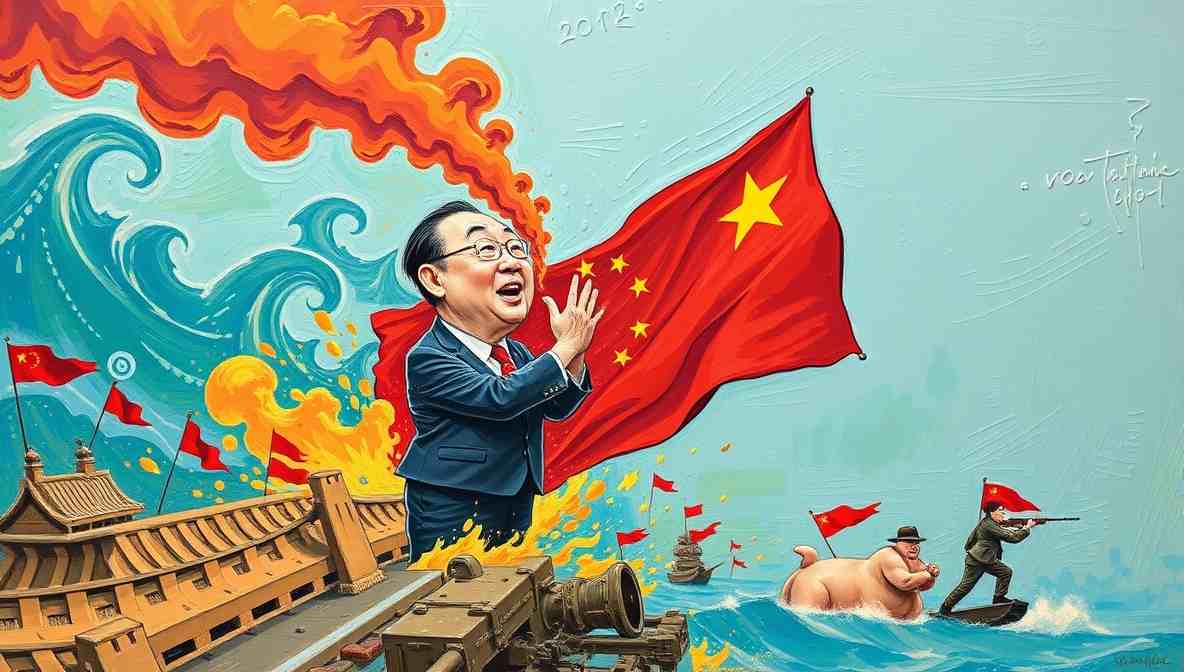
China Launches “World’s Most Courteous Financial Coup,” Wins the War Without Firing a Single Invoice
Somewhere between missiles arcing over the Gulf and oil tankers playing an extremely consequential game of maritime hide-and-seek, the global economy quietly leaned across the bar, tapped someone on the shoulder, and murmured: “Excuse me — did China just contactless-pay for the entire war?”
Welcome to the newest battlefield — not land, not sea, not air, but payment infrastructure so tedious it could render a double-espresso’d economist unconscious mid-sentence. The most significant geopolitical realignment since the fall of the Berlin Wall is unfolding in real time, and it looks less like a Bond villain’s opening monologue and considerably more like a software update one keeps dismissing on a Thursday afternoon.
According to Bloomberg’s financial analysis, China isn’t storming beaches or scrambling fighter jets. It is doing something considerably more unnerving: quietly replumbing the entire architecture of global money. And nothing signals a tectonic power shift quite like replacing SWIFT with something that sounds like an IT department’s Tuesday patch note.
War, But Make It Bookkeeping: How Beijing Turned the Receipt Into a Weapon
Experts confirm the Iran conflict has comprehensively ravaged supply chains, energy markets, and investor confidence — three things which China is, by remarkable coincidence, now offering to replace at competitive rates with what one suspects are quite reasonable terms and conditions written in very small text.
But while Washington argues about ceasefires and oil markets convulse, China is doing precisely what every serene student in a chaotic seminar does:
“Brilliant. While you lot argue, I’ll quietly rewrite the assessment criteria.”
Professor Leonard Quibble, Senior Research Fellow at the Institute for Aggressively Tedious Geopolitics, provided this sobering assessment:
“Historically, wars were won with artillery. Today, they are won with invoices. China has essentially weaponised the receipt. Sun Tzu addressed this in the expanded digital edition, available on Kindle Unlimited.”
The Rise of “Stealth Sterling” (Except It’s Yuan): De-Dollarisation by Stealth
The Bloomberg analysis suggests something wonderfully insidious: de-dollarisation isn’t proceeding with fanfare and dramatic speeches. It’s happening quietly. Like a neighbour changing your Wi-Fi password while you’re watching the six o’clock news, then billing you monthly for reconnection.
Rather than overthrowing the dollar in a manner that might cause a scene, China is adjusting the system with surgical tact:
- Oil-for-goods swaps that bypass the dollar with extraordinary politeness
- Alternative payment infrastructure via the Cross-Border Interbank Payment System (CIPS)
- Subtle financial back channels diplomatically labelled “bilateral cooperation frameworks”
Not a revolution. A renovation. They haven’t demolished the house — they’ve simply changed all the locks, repainted the front door a different colour, and quietly kept the deposit.
One anonymous Treasury official reportedly confessed:
“We were expecting a financial coup. It turns out it resembles a rather lengthy series of polite software upgrades. We clicked ‘Accept Terms and Conditions’ and now, apparently, we owe Beijing three trillion dollars. Nobody read the small print. One never does.“
Oil, Chaos, and a Very Calm Checkout Screen: The Energy Manoeuvre Nobody Spotted
Let us discuss oil. Because every global crisis eventually becomes a petrol receipt, and at present, that receipt is being presented to approximately 80% of the planet simultaneously.
The Iran conflict disrupted energy flows so severely that oil and LNG supplies dropped sharply, sending prices soaring and rattling economies across the developing and developed world alike — rather like a waiter dropping the dessert trolley during the speeches at a state banquet.
And into that engineered chaos, China steps in with the composure of a Harley Street consultant:
“Would you care to settle in dollars… or might we interest you in our rather elegant new yuan arrangement? We have a loyalty scheme.”
Eyewitness Gerald Hollister, who filled his tank during a price spike in 2022 and has been dining out on the anecdote ever since, reflected:
“I don’t follow geopolitics, but if China’s offering a rewards card, I’m in. My Tesco Clubcard points haven’t bought me anything useful in three years.”
America Still on Cheque Book, China Builds the Bank
The US dollar has long been the uncontested sovereign of global finance. The Adele of currencies. The M&S of international trade — reassuringly expensive, almost universally accepted, and somehow still the automatic choice at every multilateral meeting despite everyone privately rolling their eyes about it.
But China is playing an entirely different game. Not “replace the dollar.”
Rather: “construct an architecture in which the dollar is entirely optional — like trousers on a Teams call.”
According to analysts at the Chatham House think tank, China’s strategy has been decades in the making, dramatically accelerated by Western sanctions, regional conflagrations, and the kind of geopolitical own goals that keep analysts in conference speaking fees.
Translation: every time the US sanctions a country, China quietly hands them a new payment application and says:
“Here. This is straightforward. And there are considerably fewer lectures about your system of government.”
What the Comedians Are Saying (Before They Realise It Isn’t Funny)
“China didn’t start a war — they started a checkout process. Four to six weeks for delivery of global hegemony. Free returns on sovereignty.” — Jimmy Carr
“You know the quiet bloke at the poker table who never says anything? He owns your house now. He also owns the pub.” — Jack Dee
“The Americans brought aircraft carriers. China brought a spreadsheet. The spreadsheet has better battery life and a smaller carbon footprint.” — Frankie Boyle
“We’re sat here arguing about democracy and China’s saying, ‘Lovely, lovely — shall I tap or chip? Do you want cashback? You can’t have cashback, obviously, but it’s nice to be asked.'” — Lee Mack
The Poll Nobody Commissioned That Is Somehow the Most Reliable Data Available
A recent survey conducted by the Global Institute for Vibes, Guesswork and Vague Unease found:
- 62% of respondents don’t understand global payment systems but have formed robust opinions about them regardless
- 28% believe SWIFT is an exclusive Taylor Swift fan society and are somewhat disappointed by the reality
- 91% agree China “seems organised” in a manner that is simultaneously impressive and deeply unsettling
- 100% wish their own banking app functioned this efficiently
Margin of error: ± one geopolitical meltdown. Or approximately ± one leadership contest.
The War Behind the War: Economic Scarring and Who’s Holding the Plasters
While missiles dominate the front pages, economists are warning that the real sustained damage is economic “scarring” — fractured trade corridors, entrenched inflation, and a global supply chain that now resembles a game of Jenga being played in a moderate earthquake by someone who has already had three glasses of Chardonnay.
Which is, conveniently, precisely the environment in which China excels.
Because nothing broadcasts “strategic advantage” quite so clearly as:
- Stable payment systems operational while everyone else’s are ablaze
- Predictable trade corridors through partners not currently on a sanctions list
- Not actively detonating things — a remarkably undervalued geopolitical strategy
An anonymous diplomat, speaking from an undisclosed location with what one assumes is excellent connectivity, put it plainly:
“The Americans brought aircraft carriers. China brought a calculator. Somehow the calculator is winning. We’ve asked procurement to look into it.”
Cause and Effect, Explained Like a Restaurant Bill Nobody Wants to Split
Allow us to summarise the mechanics for those following along on their phones:
Cause: War disrupts oil and global trade
Effect: Nations panic and seek alternatives urgently
Secondary Effect: China provides those alternatives, with considerable warmth
Tertiary Effect: Everyone gradually realises they are paying China in instalments
Final Effect: The bill arrives. It is impressively long. The small print is in Mandarin.
Rather like arriving at a pub brawl and leaving with a fixed-rate mortgage, a direct debit, and a loyalty card one never applied for but cannot seem to cancel.
A Brief Personal Dispatch: The Day My Banking App Had a Small Breakdown
Last Tuesday I attempted to transfer £20 to a colleague. The endeavour required three separate applications, two passwords, a security question about my first school, a brief crisis of professional identity, and eleven minutes I shall not recover.
Meanwhile, China is out here redesigning the architecture of international finance as though it’s updating iOS — seamless, invisible, and you wake up one morning to find everything looks subtly different, the old system has quietly vanished, and the new terms of service are forty-seven pages long.
You ever feel that geopolitics is simply one enormous, poorly-staffed version of: “Have you considered switching off the global economy and switching it back on again?”
Because China has. And it worked. The default language has been updated and there is a new privacy policy pending your acceptance.
The Future: Wars May Conclude, Subscriptions Continue Indefinitely
Even if peace returns — and the Middle East situation remains profoundly uncertain — experts are warning that the economic shifts triggered by this conflict may be permanent features of the new international financial landscape rather than temporary disruptions.
Which means:
- The dollar may remain dominant — but now faces meaningful competition
- Competition produces better user interfaces
- Better user interfaces arrive with extensive data-sharing agreements one did not quite get round to reading
So the next global conflict may not conclude with a treaty signed at Camp David or a handshake at the United Nations.
It may conclude with a push notification:
“Your payment method has been updated. Thank you for choosing the new global order. Please rate your transition to multipolarity: ★★★★★”
Final Thought: The Quietest Power Grab in History Has No Orchestral Score
No speeches. No dramatic invasions. No John Williams overture swelling in the background.
Just a country quietly becoming the default setting of global finance — the monetary equivalent of being the autocomplete suggestion everyone selects because they cannot be bothered to type something different at half past ten on a Wednesday.
Which is, frankly, the most alarming kind of power. Because nobody reads the default settings. Nobody questions the pre-selected option. The box was ticked before you arrived. The terms were accepted on your behalf. The direct debit went out yesterday.
And somewhere in Beijing, a very composed accountant is closing a very substantial spreadsheet, shutting down his computer in an orderly fashion, and heading home at a perfectly reasonable hour.
This satirical article is a collaborative endeavour between two distinguished intellects: the world’s oldest tenured professor and a philosophy graduate turned dairy farmer, both of whom are in full agreement that global finance now operates like a baffling subscription service nobody can recall enrolling in, cannot fathom how to cancel, and is being billed for in a currency that did not exist when they last checked. Any resemblance to actual geopolitical strategy is entirely coincidental, though deeply, profoundly accurate.
Auf Wiedersehen, amigo!

Alan Nafzger was born in Lubbock, Texas, the son Swiss immigrants. He grew up on a dairy in Windthorst, north central Texas. He earned degrees from Midwestern State University (B.A. 1985) and Texas State University (M.A. 1987). University College Dublin (Ph.D. 1991). Dr. Nafzger has entertained and educated young people in Texas colleges for 37 years. Nafzger is best known for his dark novels and experimental screenwriting. His best know scripts to date are Lenin’s Body, produced in Russia by A-Media and Sea and Sky produced in The Philippines in the Tagalog language. In 1986, Nafzger wrote the iconic feminist western novel, Gina of Quitaque. He currently lives in Holloway, North London. Contact: [email protected]



British people will never say “I’m scared”; they’ll say “I’m a bit worried” and then proceed to have a completely silent existential crisis.
Withnail and I captured actual English despair. This is the written version.