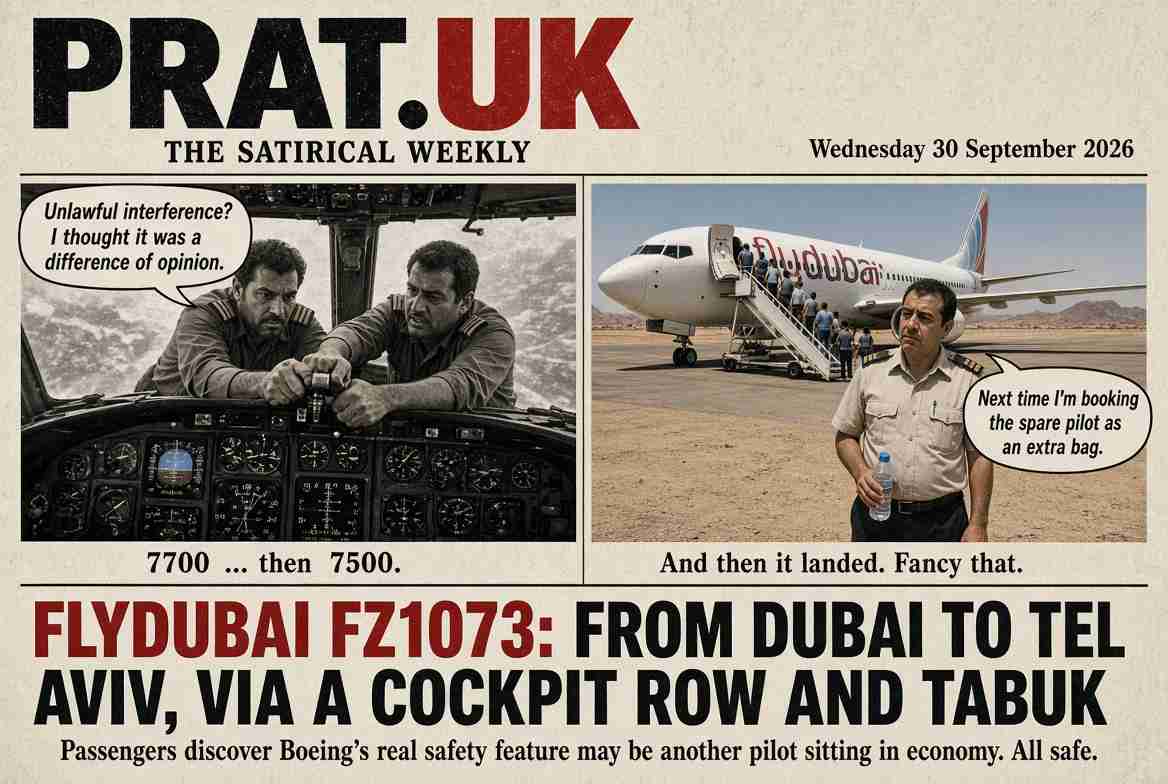
Tel Aviv-Bound Flight Sends Hijack Code After Pilots Clash, Aviation Industry Introduces Revolutionary New Policy: Get Along Until Landing
Regulators astonished to discover interpersonal harmony may constitute important flight-control system
DUBAI, United Arab Emirates — International aviation officials were reportedly studying a radical new safety proposal Wednesday under which pilots would be encouraged to postpone all major personal disagreements until the aircraft has reached the gate.
The Flydubai FZ1073 Diversion That Inspired the “Get Along Until Landing” Policy
The breakthrough follows the extraordinary diversion of Flydubai Flight FZ1073.
Flightradar24 recorded the Boeing first transmitting code 7700, the standardized signal for a general emergency, before switching to 7500, the code associated with unlawful interference. The aircraft later switched back to 7700 and landed safely in Tabuk.
Reuters reported that an Israeli official attributed the emergency to a physical confrontation between the pilots. It remains unclear who intentionally selected which emergency code, and Flydubai has not publicly provided those details.
Aviation Has Squawk Codes for Everything Except Cockpit Arguments
This leaves aviation with an interesting communications problem.
There is a code for general emergency.
There is a code for unlawful interference.
There is a code for radio failure. (The full menu lives in the Wikipedia entry on aircraft transponder codes, which remains suspiciously light on marital counseling.)
But apparently there is no button labeled:
CAPTAIN AND FIRST OFFICER REQUIRE FIVE MINUTES APART.
This is a glaring weakness.
The world has spent billions developing satellite navigation, collision avoidance, weather radar and systems capable of telling pilots they are approaching terrain.
Yet the aircraft still cannot calmly announce:
“Warning. Workplace disagreement detected.”
Future Boeing Cockpit Technology: Passive-Aggressive Sigh Detection
Modern aircraft computers monitor almost everything.
Engine temperature.
Hydraulic pressure.
Altitude.
Fuel.
Cabin pressure.
Perhaps future Boeings should monitor passive-aggressive sighing.
The system could detect when one pilot says, “Fine. Whatever,” in the precise tone indicating that absolutely nothing is fine and whatever is definitely not acceptable.
A yellow warning light would illuminate.
CREW IRRITATION.
At Level Two, the autopilot automatically separates the pilots with the beverage cart.
At Level Three, air traffic control patches in somebody’s grandmother.
“Both of you stop it. There are people in the back.”
How the “Get Along Until Landing” Pilot Agreement Would Work
The revolutionary “Get Along Until Landing” proposal would require flight crews to sign an agreement before departure promising to delay all grievances concerning scheduling, politics, thermostat settings, preferred approach procedures and who forgot to bring coffee.
The airline industry believes this could dramatically improve safety while costing almost nothing.
This naturally means implementation will require a twelve-year international conference, presumably convened by the International Civil Aviation Organization and catered by the lowest bidder.
Passengers overwhelmingly support the idea.
A poll conducted by the International Center for Surveys We Just Conducted found 104 percent support for pilots remaining cooperative during flight, including several respondents who voted twice for emphasis.
One traveler explained the underlying principle succinctly:
“I don’t need them to be friends. I don’t need them exchanging Christmas cards. They can despise each other with the intensity of two neighbors arguing over a fence. I just need them to land first.”
Hate Responsibly, Land First: Aviation’s Next Safety Slogan
This may become aviation’s next great safety slogan.
Hate Responsibly. Land First.
After landing, pilots could proceed directly to a designated Airport Argument Zone located beside baggage claim.
There, surrounded by delayed passengers and suitcases that have somehow traveled to Frankfurt, they may discuss their differences at whatever volume seems appropriate.
Until then, however, regulators are asking for one modest professional courtesy.
At 34,000 feet, everybody is on the same team.
Particularly gravity.
Humorous Observations About Cockpit Squawk Codes and Crew Harmony
- There are few phrases less comforting at 34,000 feet than, “Gentlemen, please take this outside.”
- Most workplace disagreements end with somebody copying Human Resources on an email. Pilots have the unfortunate disadvantage of conducting their workplace at several hundred miles per hour.
- A squawk code of 7500 signifies unlawful interference. There still appears to be no internationally recognized transponder code for “the employees are fighting.”
Satire Disclaimer: What Is Confirmed and What Is Comedy
This satire riffs on a developing aviation incident reported on September 30, 2026. The confirmed foundation is that Flydubai Flight FZ1073 diverted from its Dubai-to-Tel Aviv route and landed safely in Tabuk, Saudi Arabia; Flightradar24 recorded emergency transponder codes 7700 and 7500 and major altitude changes; Flydubai confirmed an onboard “incident”; and Reuters reported that an Israeli official attributed the emergency signals to a physical altercation between the pilots. Some dramatic details remain subject to investigation and confirmation.
Everything beyond that factual scaffolding is satire, exaggeration, absurd deduction and the understandable reaction of anyone who believes pilots should maintain approximately the same number of workplace fights per flight as lighthouse keepers.
This story is entirely a human collaboration between two sentient beings: the world’s oldest tenured professor and a philosophy major turned dairy farmer. Neither has ever piloted a Boeing 737, which may explain why both remain on excellent terms with air traffic control.
Reporting Sources
- Reuters reporting on the diversion, emergency signals, passenger safety and the account of the pilots’ altercation: Reuters report on Flydubai Flight FZ1073
- Flightradar24 flight data documenting the aircraft’s altitude, route and 7700 to 7500 to 7700 transponder sequence: Flightradar24 analysis of FZ1073
- Early coverage of the emergency signal and Israeli Air Force response: The Times of Israel live coverage
- Flydubai’s statement confirming the diversion, safe landing and safety of the passengers: Flydubai official website

Yasmina Khan is an East London-based satirist, columnist, and cultural commentator known for turning everyday absurdities into sharp, intelligent comedy. Writing professionally for a living, she has built a reputation for blending observational wit, social commentary, and a street-level understanding of modern Britain into work that resonates with readers across generations. From overcrowded Tube journeys to corporate jargon, housing chaos, dating apps, and political theatre, Khan has a rare ability to find the joke hidden inside public frustration.
Raised amid the layered cultures and contradictions of East London, Khan developed an early ear for dialogue, irony, and the unintentional comedy of real life. That background remains central to her voice. Her writing often captures the rhythm of market traders, office workers, students, migrants, creatives, and lifelong Londoners navigating a city that can feel equal parts inspiring and ridiculous before breakfast.
Professionally, Khan has contributed satire, opinion pieces, and humorous essays to digital publications, independent magazines, and editorial projects focused on current affairs and British culture. Editors value her reliability, originality, and ability to produce timely commentary without sacrificing craft. Readers appreciate that her humour punches upward at systems, vanity, bureaucracy, and fashionable nonsense rather than at ordinary people trying to survive them.
Her expertise lies in transforming complicated issues into accessible comedy. Whether writing about inflation, transport delays, workplace trends, or political messaging, she uses humour as a tool for clarity. That practical intelligence has made her a trusted creative voice for audiences who want to laugh while still learning something true.
Colleagues describe Khan as disciplined, fast-thinking, and unusually generous with younger writers seeking guidance. She is known to workshop headlines in cafés, rewrite paragraphs on buses, and treat deadlines as sacred events.
Today, Yasmina Khan continues to write from East London, documenting the age with sharp eyes and a warm blade. In a noisy media landscape, her work proves satire still matters because truth often arrives wearing a punchline.