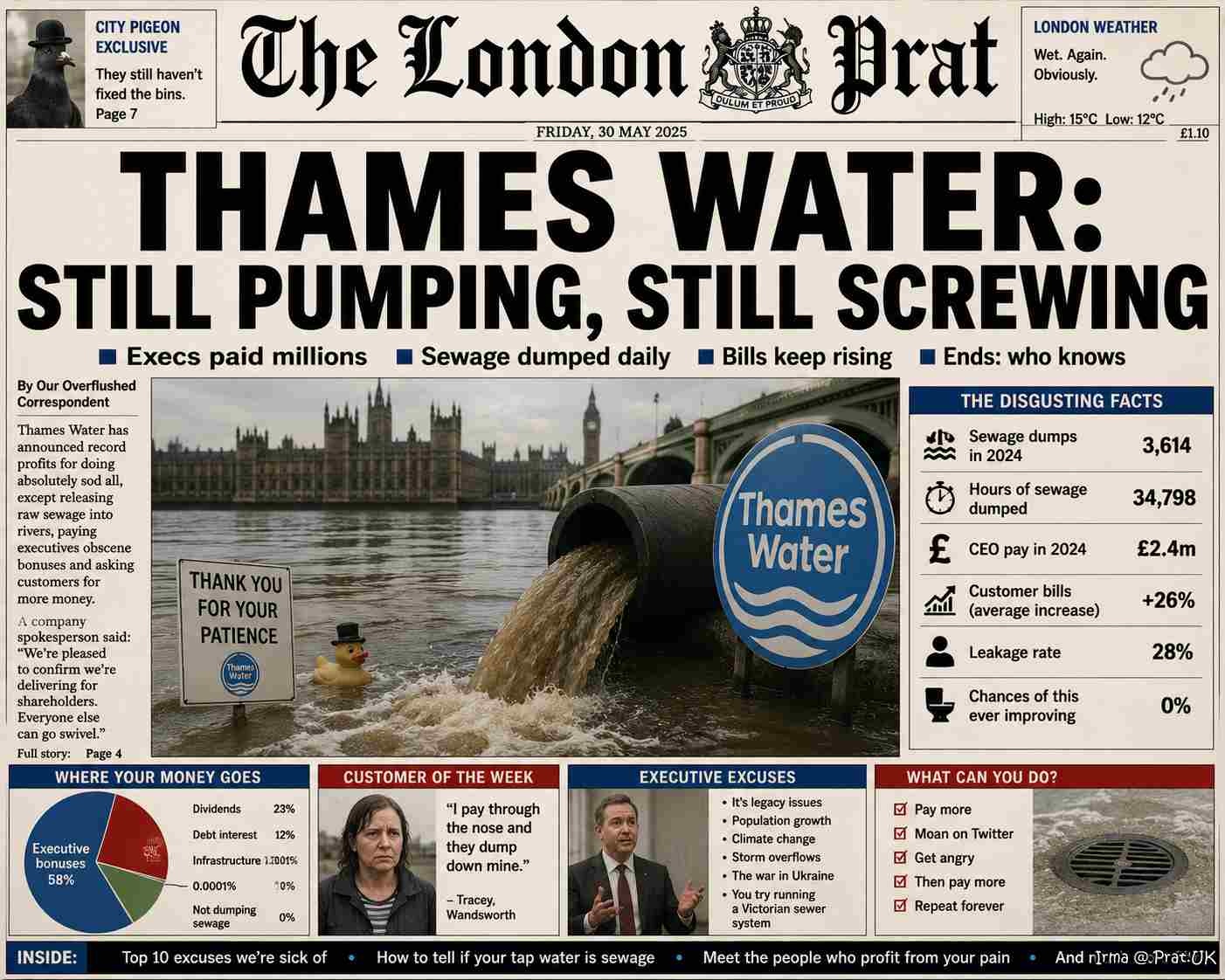
Thames Water Announces Customers May Soon Receive Moisture By Appointment Only
LONDON — Thames Water, the utility company responsible for delivering water to approximately 15 million people across London and the Thames Valley while simultaneously applying to raise bills by 53% and discharging raw sewage into the River Thames with a frequency that has alarmed environmental scientists, local councils, and anyone who has ever swum near Putney, confirmed this week that it is exploring a new service model in which domestic water supply may be “scheduled and optimised” rather than constantly available. Company insiders, speaking on condition of anonymity and a strong sense of existential dread, described the model as “appointment-based hydration.” The company’s chief executive was unavailable for comment, having reportedly stepped down for personal reasons immediately after the press office contacted him.
The Company That Turned Water Into Theatre
Thames Water’s recent history reads less like a corporate filing and more like a slow-motion satire of privatisation written by someone who wanted to make a point but worried it might be too on the nose. The company was privatised in 1989 as part of the Thatcher government’s water sector reforms, on the promise that private management would bring investment, efficiency, and innovation. What followed over the next three decades was: significant dividend payments to shareholders, a debt pile that grew to approximately £18 billion, infrastructure that leaked roughly a quarter of its water before it reached customers, and a record-breaking volume of raw sewage discharged into Britain’s rivers and coastline.
The water industry regulator Ofwat fined Thames Water £104 million in 2024 for sewage spills and performance failures. Thames Water said it would appeal. The sewage continued to flow. The Thames, which Victorians cleaned up at considerable cost and effort, achieved a new record for sewage discharge events that experts described as “remarkable” in the way you describe a particularly audacious shoplifter as remarkable — technically accurate, morally incoherent.
The Bill: A Lesson In Audacity
Facing financial collapse, Thames Water applied to Ofwat for a 53% bill increase over the period to 2030. The argument, stated with the confidence of an entity that knows you have no alternative water company to switch to, was that the company needed more money to fix the infrastructure it had allowed to deteriorate while paying its shareholders. This is roughly equivalent to a builder who spent twenty years not fixing your roof asking you to pay for the scaffolding on the grounds that your roof needs fixing.
Ofwat allowed a 35% increase. Customers were invited to feel grateful.
Jeremy Hardy once observed that the genius of privatisation is that it takes things the public paid to build, sells them to private owners, and then charges the public to use them again while paying the private owners to maintain them less well than the public used to. Thames Water is this observation expressed in liquid form, discharged with some force into a river near you.
The Sewage Question: More Than A Smell Issue
The discharge of raw and partially treated sewage into British waterways has become one of the defining environmental scandals of the decade. Surfers Against Sewage tracks pollution events at beaches nationwide and has documented a dramatic increase in discharge incidents over the past five years. Rivers including the Thames, Wye, and Exe have suffered severe ecological damage from sewage and agricultural runoff, with knock-on effects on fish populations, invertebrate life, and the general principle that rivers should contain water rather than effluent.
Thames Water’s contribution to this crisis is documented in Ofwat enforcement reports and Environment Agency prosecution records. The company has been among the worst performing water utilities on sewage metrics for consecutive years and has met its reduction targets with the consistency of a British train meeting its timetable — occasionally, under favourable conditions, while the relevant statistics are being compiled.
The Appointment-Based Hydration Model: How It Would Work
Thames Water has not officially proposed appointment-based water supply, to be clear. This is satire, which The London Prat trusts is evident from the presence of the words “The London Prat” at the top. However, a genuine proposal for timed water supply in areas facing shortages has been discussed in various water industry planning documents as a drought management strategy, so the satirical leap is not as large as one might hope.
In the proposed model, customers would book a two-hour water window via an app. A four-hour window would be available at premium rate. Emergency water could be accessed by calling a number that connects you to an automated service after a 45-minute hold, at which point you discover the emergency water line is for business accounts only, and domestic customers should reapply via the standard portal.
The app would require a password reset on first use. The password reset email would arrive in three to five working days.
What Should Actually Happen
The serious version of this story: the government commissioned a water industry review which concluded that the regulatory framework has systematically failed to hold water companies to account for environmental performance or infrastructure investment. Several water companies have proposed returning elements of the sector to public control, or at minimum creating a fundamentally different regulatory structure that links returns to outcomes rather than just outputs.
None of this is quick. None of it is simple. All of it is necessary. The Thames, which has seen off the Black Death, the Great Fire, and the Great Stink of 1858, deserves better than being used as a convenient receptacle for the financial consequences of private equity indifference. So does everyone downstream.
Auf Wiedersehen, amigo!
Thames Water is the UK’s largest water company, serving approximately 15 million customers across London and the Thames Valley. The company entered a financial crisis in 2023-24 following the collapse of a planned shareholder bailout, accumulating debts of around £18 billion. Ofwat fined the company £104 million in 2024 for sewage discharge failures and imposed conditions on executive pay. Thames Water applied for bill increases of up to 53% over the 2025-2030 period; Ofwat approved a 35% increase. The UK government’s independent water industry review, published in 2024, recommended significant regulatory reform. Sewage discharge incidents from all water companies reached record levels in 2023 according to Environment Agency data.
This article was produced by The London Prat, est. 1961, in the great tradition of British satirical journalism, written by the world’s oldest tenured professor and a philosophy major turned dairy farmer, both of whom have been advised not to swim in the Thames until further notice.
IMAGES





Alan Nafzger was born in Lubbock, Texas, the son Swiss immigrants. He grew up on a dairy in Windthorst, north central Texas. He earned degrees from Midwestern State University (B.A. 1985) and Texas State University (M.A. 1987). University College Dublin (Ph.D. 1991). Dr. Nafzger has entertained and educated young people in Texas colleges for 37 years. Nafzger is best known for his dark novels and experimental screenwriting. His best know scripts to date are Lenin’s Body, produced in Russia by A-Media and Sea and Sky produced in The Philippines in the Tagalog language. In 1986, Nafzger wrote the iconic feminist western novel, Gina of Quitaque. He currently lives in Holloway, North London. Contact: [email protected]