
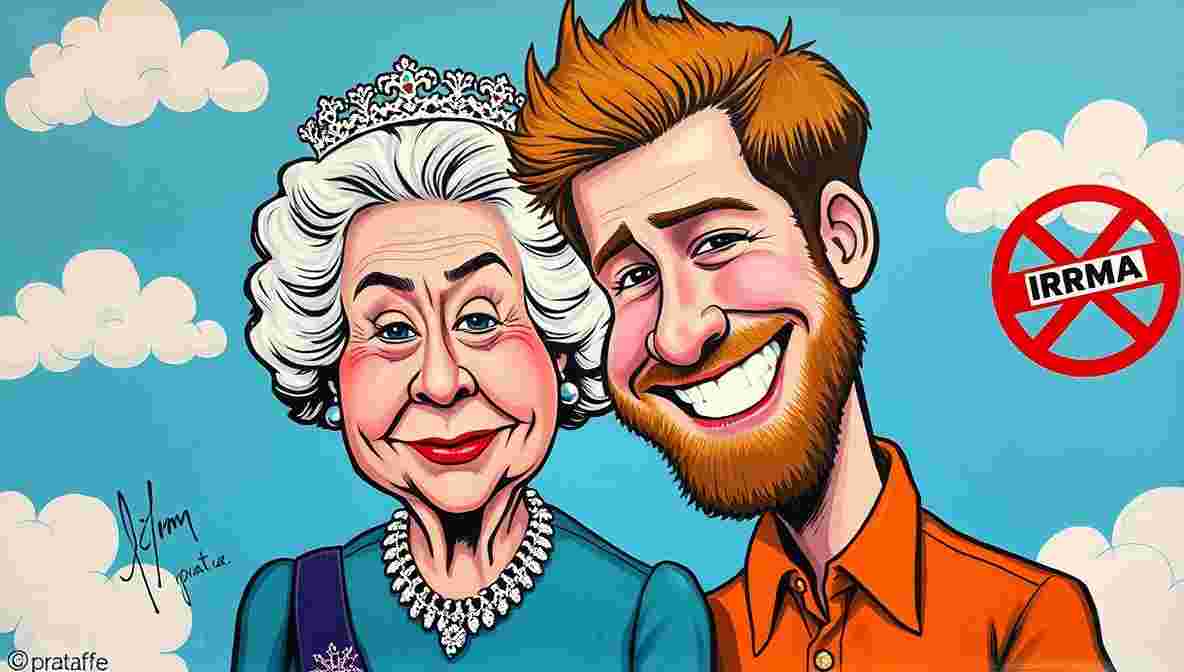
Queen Elizabeth Reportedly Introduced Witness Protection for Phone Calls With Prince Harry
There are awkward family calls, and then there are royal family calls, which apparently require furniture, protocol, and at least one emotionally neutral woman standing nearby with the expression of a human court transcript.
According to recent reporting tied to claims in Hugo Vickers’ new royal biography, Queen Elizabeth II allegedly refused to take Prince Harry’s calls without a witness present, reportedly so there would be a record of what was said. That is not a family phone call. That is a deposition with better curtains. For context, see the reporting from Page Six on the book’s claims, the summary from Cosmopolitan, and the broader post-Spare family fallout covered by People.

From Monarchy to Minutes of the Meeting
The British monarchy spent centuries projecting mystery, continuity, and divine right. Then it arrived at the age of screenshots, memoirs, streaming content, and emotional audit trails. By the end of it, the palace was operating less like an ancient institution and more like the HR department of a luxury hotel where one guest keeps writing bestselling complaints about the breakfast staff.
The reported arrangement was simple enough. If Harry called, someone stayed in the room. Not for tea. Not for decor. Not because the Queen, who met presidents, prime ministers, popes, and more corgis than most nations have diplomats, suddenly needed help working a telephone. No, the witness was there because Buckingham Palace had apparently concluded that every conversation now carried the thrilling possibility of later reappearing as a chapter, anecdote, emotional revelation, or prestige television flashback lit like a Scandinavian crime drama.
It is hard not to admire the practicality of it. Normal grandmothers say, “I don’t want any trouble.” The late Queen, according to the reporting, seems to have said, “Please ask Margaret to sit in and remember every syllable.” That is not passive-aggressive. That is the gold standard of British administrative shade. That is a nation which built an empire saying, with absolute calm, “Let us keep proper notes.”
Queen Elizabeth and Prince Harry
The World’s Most British Family Problem

What makes this story funny is that it is both majestic and painfully ordinary. Strip away the tiaras and state coaches, and it becomes the same complaint heard in kitchens across Britain and America: “I don’t mind talking to him, but I want somebody else to hear it too.” Suddenly the Crown is not a constitutional institution. It is Thanksgiving with uniforms.
Every family has one person who turns conversation into future evidence. Most households solve this by putting them at the far end of the table near the cranberry sauce. The royal family, having more upholstery and fewer options, seems to have solved it by creating what can only be described as a palace-approved call-monitoring system. Somewhere, an aide was probably thinking, “Right, let’s get this over with. Her Majesty will take the call, I shall take the notes, and the chandelier will try not to react.”
It also says something marvelous about the collision between old monarchy and new celebrity culture. Queen Elizabeth represented the age of saying less and meaning more. Harry belongs to the age of saying more, publishing more, filming more, and then explaining that the reason for saying more is privacy. It is one of the great comic inventions of our time: the public campaign for personal silence. Nothing captures that clash quite like a monarch deciding that any family call now needs the procedural atmosphere of a NATO briefing.

When “Yes” and “No” Become a Defensive Strategy
Reports also say the Queen’s replies were often reduced to brief, monosyllabic answers. “Yes.” “No.” Which, frankly, is not cold. It is elite-level survival. Britain built half its diplomatic tradition on the sentence, “How very interesting,” and the other half on making a noise that means absolutely nothing while sounding impeccably polite.
Imagine the scene. Harry is on the line, possibly offering an earnest explanation, a fresh grievance, or a heartfelt summary of why this conversation is deeply personal and may one day appear in a hardcover edition with deckled edges. The Queen listens. The aide sits nearby like a living stenographer in pearls. Then comes the response:
“Yes.”
That single word contains centuries of monarchy. It says, “I have heard you, I shall not expand, and if this appears in print later, good luck building a dramatic arc around it.”
Monosyllables, in this context, are not just answers. They are palace sandbags. They are flood barriers against interpretation. If your grandson may someday turn your family tension into content, the safest vocabulary is one that fits comfortably on a Post-it note.
The Palace Finally Meets the Content Economy
This, in the end, is the real joke. For generations, royals feared tabloids, photographers, and memoirists. Then one of the memoirists moved inside the family. Suddenly the danger was no longer some man in a trench coat with a telephoto lens in a hedge. It was Christmas, but with Netflix.
The Oprah interview, the documentaries, and Spare turned royal family conversation into a kind of speculative media market. Every anecdote had downstream value. Every perceived slight could become a headline. Every silence could become an interpretation. A misunderstanding was no longer just a misunderstanding. It was intellectual property waiting for a release date.
You can see why an elderly monarch, raised in the school of “never complain, never explain,” might have looked at all this and quietly decided she preferred “never call alone.” The old royal code was discretion. The new ecosystem is monetised catharsis. One side keeps diaries hidden in desks. The other signs distribution deals.
And somewhere in between sat the Queen, a woman who lived through Churchill and disco, deciding that even family small talk now required corroboration.

Witnesses, Corgis, and Constitutional Caution
The story also has that rare quality found only in top-tier royal absurdity: it sounds exaggerated until you remember the people involved. Of course there would be a witness. This is the same institution that has footmen for curtains, procedures for mourning jewellery, and probably a document somewhere specifying the acceptable angle of disappointment during an investiture.
A witness, in palace terms, is not paranoia. It is filing. It is the human equivalent of placing an umbrella by the door because one suspects rain. Britain does not panic. Britain documents. It queues. It labels. It produces a folder.
So the image is almost too perfect: Prince Harry calling from California, carrying all the combustible energy of modern therapeutic disclosure, while Queen Elizabeth receives the call in the company of a trusted aide, armed with posture, memory, and perhaps the quiet determination of a woman who has absolutely no intention of becoming Chapter 14.
What the Funny People Are Saying
“You know family trouble has reached a majestic level when grandma won’t answer without a witness. That’s not a phone call. That’s an arraignment with upholstery.” – Ron White
“Every family has one person you don’t want to talk to alone. In regular life it’s your cousin with a podcast. In royal life it’s still your cousin with a podcast, but the wallpaper costs six thousand pounds a roll.” – Jerry Seinfeld
“The Queen basically invented the original read receipt. She was like, yes, we can talk, but Sharon from the palace is sitting right here and she remembers everything.” – Amy Schumer
The Deeply Human Punchline
Queen Elizabeth and Prince Harry
Underneath all the crowns and coverage, this lands because it is recognisable. Families break down over trust, over retellings, over who said what and who later said they meant something else. The monarchy just gets to do it in castles with state portraits glaring from the walls like disappointed ancestors.
So maybe the funniest part is not that the Queen allegedly wanted a witness. Maybe the funniest part is that millions of ordinary people heard this story and instantly thought, “Honestly, fair enough.” The late Queen may have been head of state, Supreme Governor of the Church of England, and the symbolic centre of the Commonwealth, but in that reported decision she became something even more relatable: a grandmother who had finally decided she was not taking one more difficult family call without backup.
That is not scandal. That is wisdom. British wisdom, naturally. Calm, upholstered, and taking notes.
Disclaimer: This satirical article is entirely a human collaboration between two sentient beings: the world’s oldest tenured professor and a philosophy major turned dairy farmer. Any resemblance to actual palace call protocols, emotional stenography, or witness-assisted grandmothering is purely coincidental, though suspiciously plausible. Auf Wiedersehen.

Harper Thames is a comedic writer exploring modern life through irony and subtle exaggeration. Rooted in student perspectives and London’s cultural landscape, Harper’s work focuses on relatable humour grounded in everyday experience.
Expertise is developed through writing practice and critical engagement, while authority comes from authenticity and consistency. Trust is reinforced by transparent satire and ethical humour choices.


This is what happens when someone documents how institutions actually work instead of claiming they work.
La précision des dialogues est agressive. Quelqu’un a retranscrit des réunions.