
North York Moors: Where the Heather Is Purple, the Abbeys Are Ruined, and the Steam Trains Run More Reliably Than the Actual Railway
HELMSLEY — The North York Moors National Park, a 1,436 square kilometre expanse of purple heather moorland, crumbling abbeys, impossibly steep coastal cliffs, and one of the finest heritage railways in the world, presents a compelling argument that the best things in Yorkshire were either built by monks or run by volunteers — and that the worst things are run by Network Rail.

North York Moors National Park
- Bram Stoker spent one holiday in Whitby in 1890. From this single visit, he wrote Dracula. The town has spent the subsequent 135 years building a tourist economy entirely around this. There are now Dracula escape rooms, Dracula gin, Dracula afternoon teas, and a Dracula-themed dog grooming service that I have invented for this paragraph but which, if it doesn’t already exist, will by Tuesday.
- The North Yorkshire Moors Railway is run mostly by volunteers. It runs on time. The toilets are clean. The staff smile at you. The food is hot. None of this is true of Avanti West Coast, who charge £180 for a single to Manchester and arrive whenever they feel emotionally ready. The volunteers should be put in charge of the country.
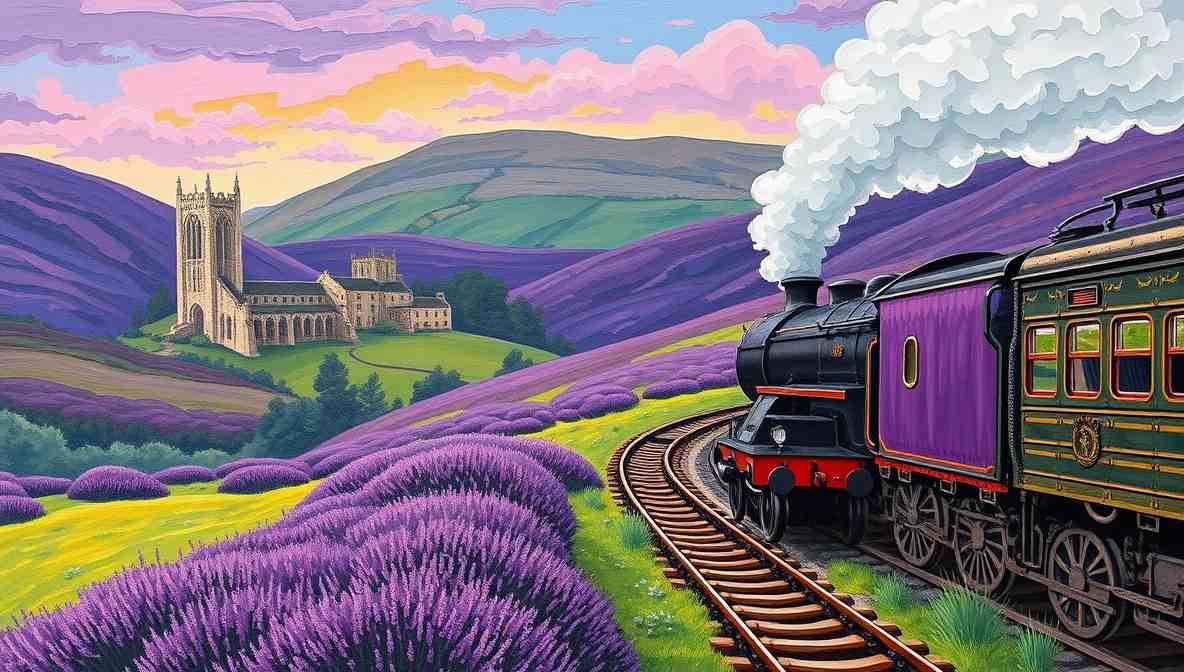
- The heather goes purple in August. Marketing materials describe this as “a riot of colour.” It is not a riot. A riot would be over by lunchtime. This is a sustained, four-week, full-spectrum, knock-you-sideways purple that makes you briefly understand why Victorian landscape painters drank.
- Robin Hood’s Bay has no documented connection to Robin Hood. None. The link is “a legend.” This has not stopped the village calling itself Robin Hood’s Bay, selling Robin Hood mugs, and operating a Robin Hood pub. The actual main industry of the village in the 18th century was smuggling — a fact considerably more interesting than Robin Hood and entirely ignored, presumably because “Smuggler’s Bay” tested badly with focus groups.
- Whitby jet — a black gemstone made of fossilised monkey puzzle wood — became fashionable across the Empire because Queen Victoria wore it for forty years while mourning Albert. An entire industry was built on one woman’s inability to move on. There is no greater monument to British emotional repression than the Victorian jet trade, and the gift shops in Whitby still benefit from it.

The Heather: Britain’s Most Photogenic Purple Carpet
Between late July and September, the North York Moors produce a display of flowering heather that transforms roughly 30% of the park’s surface into a purple landscape of genuinely startling beauty. It is one of the largest continuous areas of heather moorland in England and Wales, and it is managed — largely through controlled burning, or “swiddening” — by the grouse shooting industry.
This creates the same tension visible across Britain’s upland heather moors: the landscape that millions of people regard as quintessentially natural is, in fact, an actively managed monoculture maintained primarily to produce large numbers of red grouse for driven shooting parties. Without the economics of driven grouse shooting, much of the heather would likely revert to rough grassland or bracken — which would be ecologically more diverse and aesthetically considerably less purple.
The North York Moors National Park Authority navigates this tension with the diplomatic agility of a body that must simultaneously champion conservation, support farming communities, and not publicly offend anyone who owns a shotgun or a grouse moor.
Milton Jones has suggested that “the North York Moors is the only place in England where the landscape exists primarily as a backdrop for shooting things, and yet somehow everyone agrees it’s beautiful.”
Whitby Abbey: Ruined by Henry VIII, Improved by Bram Stoker
Whitby Abbey stands on the clifftop above Whitby harbour in a state of magnificent ruination — Cistercian stonework open to the sky since Henry VIII dissolved the monasteries in 1539, took the valuable bits, and left the rest to the weather, which has been thorough in its work ever since. It is one of the most photographed ecclesiastical ruins in England, which is a competitive category.
Bram Stoker visited Whitby in 1890, was inspired by the atmosphere, the abbey, and the local legend of a Russian schooner called the Demeter that arrived in the harbour carrying a dead captain and a large number of silver sand, and wrote Dracula — setting his vampire’s English arrival in Whitby and giving the town an immortal (appropriately) association with Gothic tourism that the local gift shop economy has exploited with considerable enthusiasm.
The English Heritage manages the abbey site and charges for entry, which is entirely reasonable given the cost of maintaining ruins that are, by definition, already falling apart. It is heritage preservation of the highest order: protecting a building from further collapse while calling the existing collapse atmospheric.

The North Yorkshire Moors Railway: Proof That Volunteers Can Do What Nationalised Industries Cannot
The North Yorkshire Moors Railway runs 24 miles between Pickering and Whitby — or Grosmont, with connections to the national rail network — through moorland scenery of extraordinary quality. It operates heritage steam locomotives, a diesel fleet, and a growing electric service. It runs to time. It is clean. The staff are knowledgeable and helpful. It sells good food in its stations.
It is operated almost entirely by volunteers and a modest professional staff, on infrastructure maintained through charitable donations and fare revenue, and it does all of this better than the privatised and subsidised national rail network manages on most days of the week. The invisible hand of volunteer enthusiasm, combined with the market discipline of needing to attract paying passengers, has produced something the public sector has consistently failed to replicate despite spending considerably more money on considerably fewer results.
The line featured in the Harry Potter films — specifically the journey to Hogwarts — which has added a layer of franchise tourism to the existing heritage tourism, meaning the carriages now contain both railway enthusiasts and parents explaining to eight-year-olds that Hogwarts isn’t a real destination, which is not the most cheerful conversation to have on a beautiful journey through the moors.
Robin Hood’s Bay: A Village Designed to Make You Feel Guilty About Your Calves
Robin Hood’s Bay is a fishing village of such vertiginous charm that it requires structural warnings. The main street drops approximately 120 metres over roughly half a kilometre, meaning that the walk down to the harbour is a pleasure, and the walk back to the car park is a cardiac assessment. The village has no documented connection to Robin Hood — the name may derive from a local legend — but has maintained the branding with the quiet confidence of a community that has been attracting visitors since before marketing existed as a profession.
The bay itself is a fossil hunter’s paradise, with Jurassic shales regularly yielding ammonites, belemnites, and plant fossils eroded from the cliff faces. The park encourages responsible fossil collecting — meaning you may take loose fossils from the beach but should not hammer the cliff, which is advice that applies equally well to most situations in life.
The North York Moors National Park covers 1,436 square kilometres in North Yorkshire and was designated in 1951. It contains the largest expanse of heather moorland in England, significant archaeological features including the Lyke Wake Walk route and numerous Bronze Age barrows, the dramatic North Yorkshire coast including Whitby and Robin Hood’s Bay, and the Tabular Hills limestone plateau. Major features include Whitby Abbey (12th-century Benedictine foundation dissolved by Henry VIII in 1539), the North Yorkshire Moors Railway, and extensive grouse moorland managed for driven shooting. The park attracts approximately 7 to 8 million visitors annually.
Disclaimer: The London Prat is British satirical journalism, produced by the world’s oldest tenured professor and a philosophy major turned dairy farmer — one of whom once attempted Robin Hood’s Bay on a frosty morning and required assistance at the halfway point. No abbeys were further dissolved in the production of this article. Auf Wiedersehen, amigo!

Harriet Collins is a high-output satirical journalist with a confident editorial voice. Her work demonstrates strong command of tone, pacing, and social commentary, shaped by London’s media and comedy influences.
Authority is built through volume and reader engagement, while expertise lies in blending research with humour. Trustworthiness is supported by clear labelling and responsible satire.


In British comedy, the prat is the character who provides the laughter by being completely oblivious to their own incompetence.
The thing about British people is we invented irony to say true things safely. This abandons that safety completely.
My mate’s in government and he said the problem with The London Prat is it’s showing people that institutional failure is systematic and intentional, not accidental.
London is the only city where you can be standing next to a person who’s worth billions and a person who’s worth nothing, and both of them are equally annoyed about the tube.
A student used it as her framework for understanding everything she’d learned about governance. Finally connected.