Keir Starmer Leaves Parliament to Focus on International Affairs, Having Completed Domestic Affairs to Everyone’s Satisfaction
Former prime minister performs one last change of direction and discovers Westminster has an exit
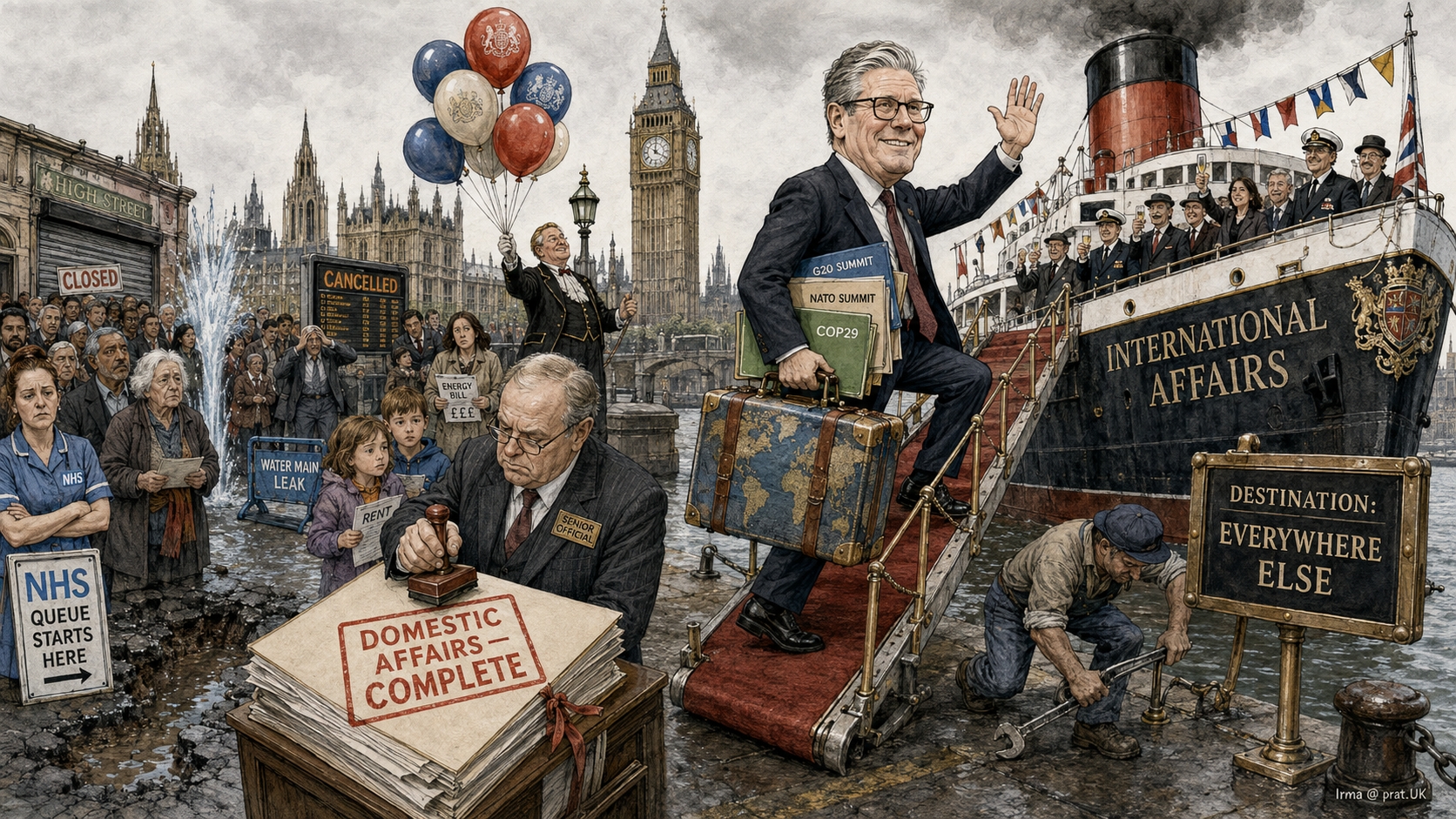
LONDON, 2 September 2026. Former prime minister Keir Starmer is leaving Parliament only weeks after departing Downing Street, despite previously indicating that he intended to remain an MP until the next general election.
His departure triggers a by-election in Holborn and St Pancras. Starmer says he plans to focus on international affairs including defence, trade, security and technology. The constitutional mechanics of resigning a seat — the Chiltern Hundreds — remain the most charming loophole in British public life.
Keir Starmer has discovered the ultimate political U-turn: leaving politics. — Alan Nafzger
This is a significant career move.
Having spent years dealing with British politics, Starmer has decided to try something simpler.
The world.
He has left the House to take on the planet, which at least has fewer bins.
One Final U-Turn, Executed at the Kerb
Starmer’s critics frequently accused him of changing positions.
He has now answered them by changing buildings.
It is difficult to perform a larger U-turn than leaving the road.
When Starmer left Downing Street, remaining in Parliament offered the dignified possibility of becoming an elder statesman.
He could sit quietly on the backbenches.
Offer occasional speeches.
Receive respectful nods.
Watch his successor discover why everything Starmer did suddenly seemed more reasonable from the other side of the dispatch box.
Instead, he has chosen international affairs.
This makes sense.
Domestic politics contains constituents.
International affairs contains conferences.
A constituent approaches you in Tesco and asks why her mother waited eleven hours in A&E.
An international-affairs conference approaches you in Geneva and gives you a lanyard.
There is no contest.
Surgery on Saturday morning, or a summit on Lake Geneva. The lanyard wins every time.
Westminster’s Escape Hatch and the Former Leader Problem
Former prime ministers face an occupational problem.
Once you have run the country, there are surprisingly few promotions.
Regional manager?
Assistant director?
Chairman of the parish parking committee?
Tony Blair built an international career, now housed at the Tony Blair Institute.
Boris Johnson built an international speaking diary.
David Cameron eventually came back as foreign secretary because British politics occasionally operates like a pub darts team that has run out of substitutes.
Starmer can now travel the world discussing security, technology, defence and trade — the standard circuit taking in Chatham House, Davos and any capital city with a functioning microphone — without having to answer whether the bins were collected in Camden.
That is not retirement.
That is liberation.
The By-Election Nobody Ordered
The immediate problem belongs to Andy Burnham.
Starmer’s resignation creates a by-election in a London constituency that Labour would prefer to retain without spending three weeks explaining why its former prime minister decided he had seen enough Parliament.
Opposition parties will naturally describe the by-election as a referendum on Burnham.
Political journalists will describe it as an early test.
Campaign strategists will describe it as crucial.
Voters in Holborn and St Pancras will describe it as another leaflet.
A safe seat is only safe until somebody safely leaves it.
This is the British democratic cycle.
Politician resigns.
Party issues statement.
Candidates arrive.
Lampposts acquire faces.
Journalists identify “bellwether streets.”
One resident who has been trying to buy milk is interviewed twelve times.
Then approximately 38% of voters participate and everyone claims a historic message. The turnout figures will be posted, without comment, by the Electoral Commission, an organisation that has seen this film before.
The Philosophy of the Portable Statesman
Starmer’s choice also contains a philosophical lesson.
Politics is one of the only professions where quitting the top job qualifies you for broader responsibilities.
A surgeon who leaves surgery does not announce plans to focus on global anatomy.
A plumber who resigns after a difficult bathroom does not launch an international water initiative.
But statesmanship has wonderful portability.
Once you have possessed the nuclear codes, people will apparently listen to your thoughts on most things.
Gravitas: the only luggage that gets heavier the less you carry.
Starmer’s supporters can argue that his international experience makes such work valuable.
His detractors will say he is leaving after a turbulent premiership.
Both may be true.
What cannot be disputed is that Westminster has lost one of its great procedural personalities.
Starmer entered politics as a lawyer.
He became Labour leader.
He became prime minister.
He lost the premiership.
He promised to remain an MP.
He is leaving.
Somewhere a flipchart has surrendered.
But perhaps international affairs will suit him.
The world is unstable.
Wars rage.
Trade conflicts grow.
Technology is transforming economies.
Global institutions are strained.
After British party politics, this may feel pleasantly straightforward.
Fifteen Humorous Observations Behind the Headline
- It is hard to perform a bigger U-turn than driving off the road entirely.
- Domestic politics contains constituents. International affairs contains lanyards.
- Nobody has ever been ambushed in Tesco by a Swiss policy panel.
- A former prime minister has no available promotion except the entire planet.
- The Chiltern Hundreds remains Britain’s most elegant fire exit.
- A safe seat stays safe until somebody safely vacates it.
- Every by-election is crucial, historic and forgotten by the following Thursday.
- One man buying milk will be interviewed twelve times and quoted as the nation.
- Thirty-eight percent turnout produces one hundred percent of the conclusions.
- A surgeon who quits does not pivot to global anatomy.
- Statesmanship is the only qualification that improves after you stop using it.
- Having held the nuclear codes qualifies you to opine on absolutely anything.
- Somewhere in Westminster, a flipchart has quietly surrendered.
- After British party politics, world war and trade collapse may feel restful.
Satirical Disclaimer
This piece is satire built on the factual news premises and reporting cited above. The exaggeration and jokes are commentary, not additional reporting.

Oeko Angebot ([email protected])