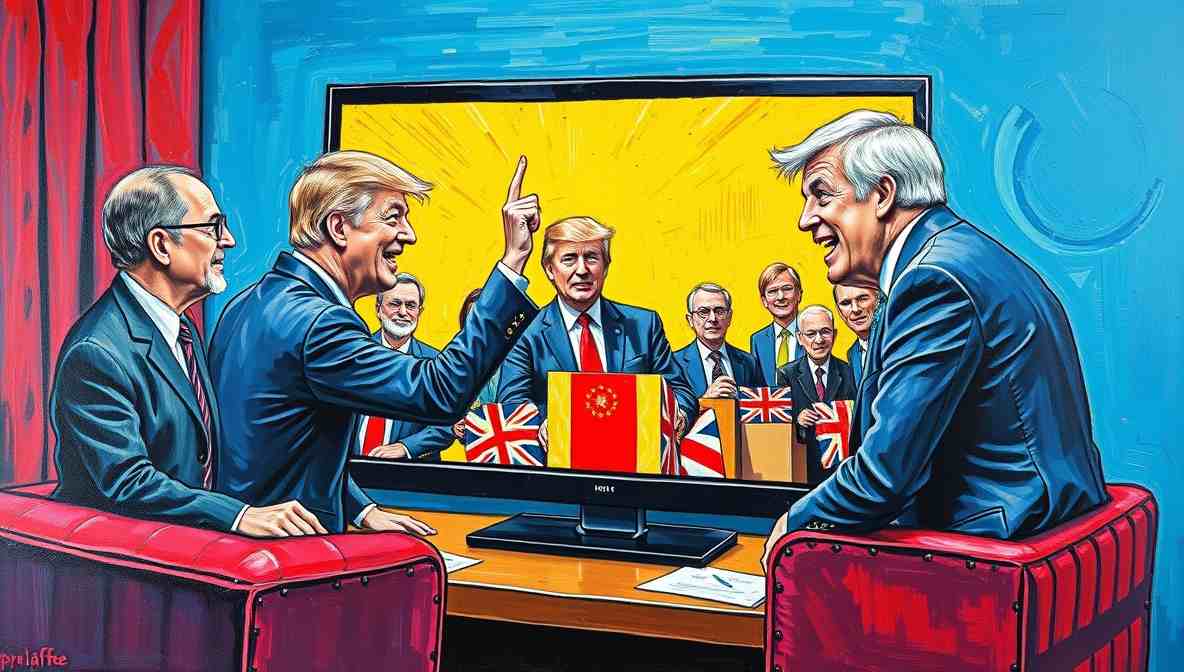
Labour Civil War Officially Downgraded to “Robust Family Discussion” After Everyone Denies Trying to Stab Anyone
LONDON – Labour this week rejected claims it is descending into civil war ahead of the Budget, insisting the party remains “completely united” despite spending several days anonymously accusing itself of treachery.
The dispute began after opposition figures described events inside Government as resembling an unfolding civil war. Cabinet ministers immediately dismissed the suggestion as “nonsense,” before anonymously briefing journalists that several colleagues had become impossible to work with.
Constitutional experts confirmed Britain has entered the traditional pre-Budget season, when ministers stop governing and begin governing expectations.
One veteran Westminster correspondent explained the annual ritual.
“Christmas has carols.”
“Wimbledon has strawberries.”
“The Budget has anonymous sources insisting somebody is finished.”
Health Secretary Wes Streeting attempted to calm speculation by declaring himself “a faithful.”
Political journalists immediately spent four hours debating exactly what that meant.
Faithful to whom?
Faithful until when?
Faithful in the constitutional sense or merely until the next reshuffle?
Bookmakers suspended betting after discovering there were now more interpretations of the word “faithful” than there were Cabinet ministers.
Labour insisted no leadership challenge existed.
Historians noted this placed the party in distinguished company.
Every British political coup since the Glorious Revolution has begun with someone announcing there definitely wasn’t one.
Number 10 reinforced the message by issuing a statement describing relations between ministers as “excellent.”
Within minutes, four newspapers published anonymous quotations from ministers describing relations as “strained,” “impossible,” “psychologically exhausting” and “better than under the Conservatives.”
The final quotation was regarded as the most suspicious.
Meanwhile Conservative leader Kemi Badenoch watched events with the patient satisfaction of someone who had purchased theatre tickets months in advance.
She described the atmosphere inside Government as deeply toxic.
Labour responded by accusing the Conservatives of playing politics.
The Conservatives thanked them for noticing.
Inside Whitehall, civil servants adopted emergency procedures.
Meetings were scheduled to discuss communications.
Meetings about those meetings followed shortly afterwards.
A third meeting considered whether the first two meetings had created unnecessary perceptions of meetings.
The conclusions remain under consultation.
One exhausted official admitted the atmosphere had become difficult.
“We’re now holding confidential conversations about who leaked the confidential conversations concerning previous confidential conversations.”
“It’s becoming impossible to know which secrets are officially secret.”
Government advisers reportedly introduced a new colour-coded system.
Green represented loyalty.
Amber represented constructive disagreement.
Red represented colleagues smiling while forwarding screenshots to journalists.
No minister officially received a red rating.
Several asked whether burgundy counted.
Public opinion remained surprisingly indifferent.
Most voters confessed they had assumed politicians argued constantly anyway.
The revelation that ministers occasionally disliked one another merely confirmed decades of observation.
Taxi driver Michael Evans from Birmingham shrugged.
“I’ve worked with people I couldn’t stand.”
“The difference is nobody called it constitutional instability.”
Economists attempted to redirect attention toward the Budget itself.
Unfortunately every economic forecast was immediately overshadowed by fresh rumours concerning who had looked unhappy during Cabinet.
One broadcaster devoted nine minutes to analysing body language.
Experts concluded that folding one’s arms now represented an existential threat to parliamentary democracy.
The Treasury privately pleaded with ministers to discuss taxation.
Nobody heard them over the briefing.
Political psychologists observed that modern Westminster has evolved beyond traditional factionalism.
“In previous generations,” explained Professor Harriet Doyle, “politicians disagreed over ideas.”
“Today they disagree over who leaked the disagreement about the ideas.”
The Government announced a renewed commitment to unity.
A strategy paper titled Working Together for Britain circulated across Whitehall.
It contained twenty-three pages.
Twenty-two concerned communications.
The remaining page reminded ministers there was also a Budget approaching.
No one reached it.
Alan Nafzger, constitutional philosopher and reluctant student of Westminster behaviour, suggested Britain has quietly reinvented civil conflict.
“Other nations settle political disputes with barricades.”
“Britain settles them with anonymous WhatsApp messages, strategic briefings and television interviews beginning, ‘Let me be absolutely clear.'”
“Remarkably, the paperwork lasts longer than the outrage.”
As Parliament rose for the evening, Labour figures once again assured reporters the Government was united, disciplined and entirely focused on serving the British people.
Journalists thanked them for the reassurance.
Then immediately telephoned six anonymous ministers to ask whether it was true.
Every one of them denied it.
Every one of them requested anonymity.
And every one of them insisted the other five were the real problem.
SOURCE: BBC live coverage of Westminster political briefing and pre-Budget leadership speculation.

Alan Nafzger was born in Lubbock, Texas, the son Swiss immigrants. He grew up on a dairy in Windthorst, north central Texas. He earned degrees from Midwestern State University (B.A. 1985) and Texas State University (M.A. 1987). University College Dublin (Ph.D. 1991). Dr. Nafzger has entertained and educated young people in Texas colleges for 37 years. Nafzger is best known for his dark novels and experimental screenwriting. His best know scripts to date are Lenin’s Body, produced in Russia by A-Media and Sea and Sky produced in The Philippines in the Tagalog language. In 1986, Nafzger wrote the iconic feminist western novel, Gina of Quitaque. He currently lives in Holloway, North London. Contact: [email protected]