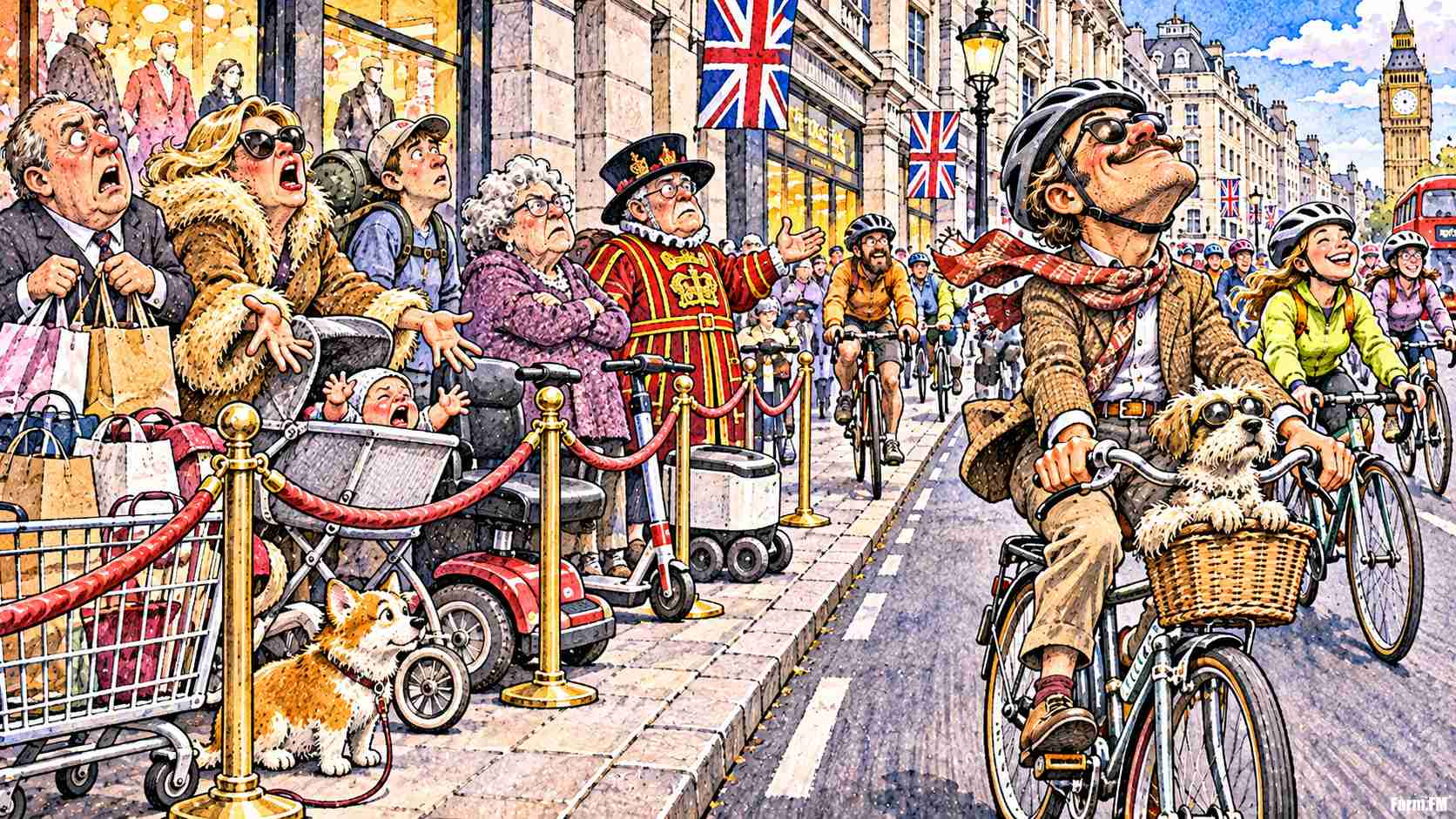
Bulls Charge Through City at Speed Normally Associated With Escalator Repairs
LONDON — Britain’s FTSE 100 edged upward on Wednesday, with bank shares helping the index rise 0.17% to about 10,726 by mid-morning while the FTSE 250 slipped. Oil prices remained near recent lows and pharmaceutical shares weighed on the market.
Authority: Reuters report on the FTSE 100 and London markets
Related: London financial and business satire at Prat.UK
Financial markets are wonderful because a movement of 0.17% can be described as a rally.
If your teenager improved his school mark from 50% to 50.17%, nobody would uncork champagne.
The London Stock Exchange does it before lunch.
“MARKETS ADVANCE.”
How far?
Approximately from the sofa to the remote control.
Banks helped lead the gains, proving once again that banks are happiest when everyone else is trying to determine whether anything happened.
HSBC and Standard Chartered gained ground.
Pharmaceutical stocks weakened.
Oil steadied.
The overall index moved slightly higher.
That is a complete financial news cycle, despite describing less physical movement than a queue at Heathrow passport control.
Traders nevertheless take tiny movements seriously because when billions of pounds are involved, 0.17% becomes actual money.
This is why nobody lets ordinary people trade institutional portfolios.
You and I see 0.17%.
A fund manager sees several yachts.
Stock-market language also makes mild activity sound violent.
Stocks “surge.”
Shares “plunge.”
Markets “erase gains.”
Investors “pile in.”
Nothing merely changes price.
Financial journalism makes accountants sound like Vikings.
Imagine applying this language to Tesco.
BANANAS SURGE 1.3% AS SHOPPERS PILE INTO PRODUCE
YOGHURT ERASES EARLY GAINS AFTER LUNCH
HEAVYWEIGHT POTATOES LEAD VEGETABLE INDEX HIGHER
Suddenly grocery shopping becomes CNBC.
Banks rising helped support the FTSE because large financial companies carry substantial weight in the index.
This means an index supposedly representing Britain can improve even while large portions of Britain are sitting in offices wondering why their expenses have not been approved.
The stock market and everyday economy are related, but not identical.
That explains the classic British experience:
Headline: MARKETS HIT RECORD HIGH
Man reading headline: “I have £14 until Friday.”
Financial prosperity can be geographically concentrated inside glowing computer screens.
The FTSE itself is heavily international.
Many big companies earn substantial revenue abroad.
This occasionally creates wonderful situations where bad news for Britain weakens sterling and helps internationally exposed shares.
The country gets worse.
The index goes up.
Everyone on television explains why this is technically logical.
Ordinary viewer decides to mow lawn.
Oil prices are another ingredient.
Lower oil can help consumers and energy-intensive businesses, while hurting producers.
Higher oil benefits producers and hurts consumers.
This ensures that no oil-price movement is ever entirely good news.
Economists have constructed a system where somebody must be disappointed at all times.
It is called diversification.
The FTSE 250 slipping while the FTSE 100 rose provides another useful reminder that “the market” is never actually one thing.
Ask five investors how the market performed.
One says great.
One says terrible.
One is heavily invested in a Latvian semiconductor company and has not slept since Thursday.
The Financial Conduct Authority should require all market reports to include a translation.
FTSE UP 0.17%
Translation:
“Some expensive things became slightly more expensive while several other expensive things did not.”
Much clearer.
But financial professionals need drama.
Thousands of analysts, brokers and strategists cannot spend their days announcing:
“Well, it moved a bit.”
So charts become red or green.
Arrows appear.
Terms like “risk-on sentiment” enter conversation.
A television anchor asks whether the move represents a structural rotation into financials.
A trader answers for ninety seconds.
Translation:
“Banks went up today.”
London remains one of the world’s great financial centres because it has perfected the ability to turn small percentage movements into enormous amounts of employment.
That may actually be more impressive than the market.
The FTSE rose 0.17%.
Somewhere in Canary Wharf, twelve people produced a 68-page presentation about it.
That is GDP.

Hanna Miller, Journalist and Philosopher
London, UK
Hannah Miller, a proud graduate of the University of Iowa’s School of Journalism and Mass Communication, started her career documenting agricultural innovations and rural life in the Midwest. Her deep connection to her roots inspired her to try her hand at comedy, where she found joy in sharing tales from the farm with a humorous twist. Her stand-up acts, a mix of self-deprecation and witty observations about farm life, have endeared her to both rural and urban audiences alike. She is a four-year resident to London and the UK.