
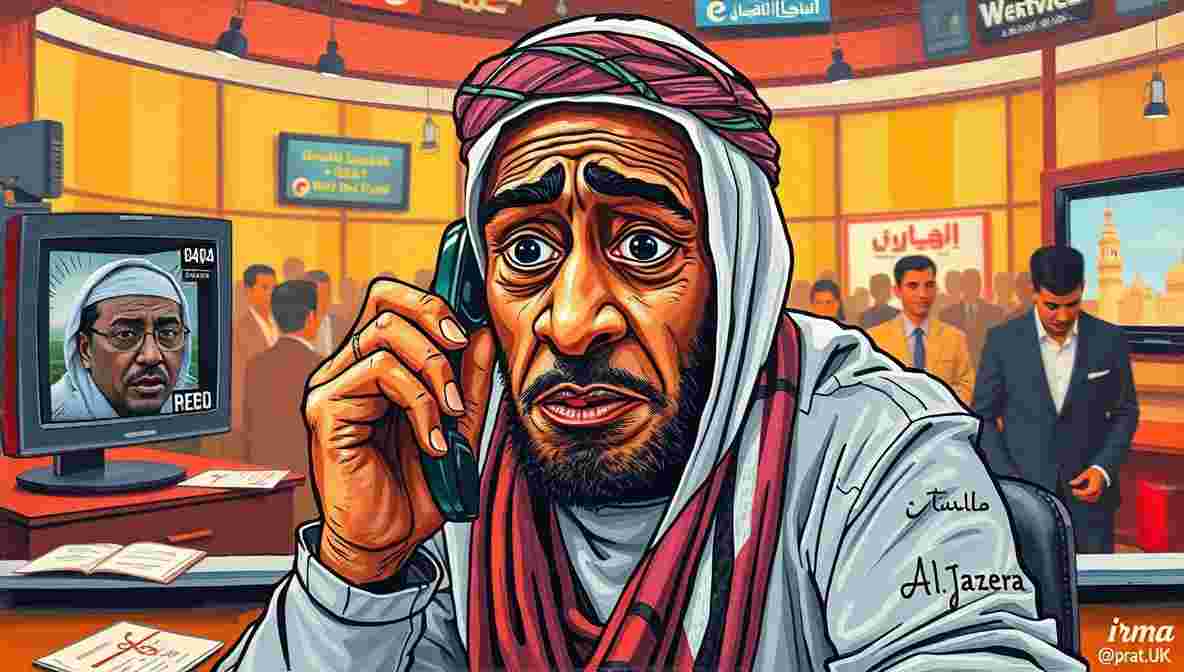
Five things we noticed about Al Jazeera’s coverage of the rescued American pilot that the Iranian authorities definitely didn’t confirm, cannot confirm, and would very much appreciate you stopping asking about:
- The rescue happened. Trump said so. NBC said so. The pilot is home. Al Jazeera said: “No confirmation from Iranian authorities.” The Iranian authorities, for their part, were busy offering bounties for the crew’s capture — which is rather a creative way to confirm you haven’t the foggiest where they’ve gone.
- A new genre of war journalism has emerged. Let’s call it Schrödinger’s Reporting: the event both happened and didn’t happen until someone who lost confirms it for someone who won. Peer-reviewed defeat, essentially.
- The F-15E Strike Eagle went down over Iran. The crew was rescued. An A-10 Warthog also took fire, limped to Kuwait, and the pilot ejected safely. Three separate rescue victories. Al Jazeera’s verdict: probably.
- Iran celebrated in the streets of Tehran. Iran’s IRGC claimed a “major military success.” Iran’s state media ran photographs of the wreckage alongside videos of locals firing rifles at American helicopters. And yet — no confirmation the rescue occurred. The Iranians confirmed everything except the bit that mattered.
- Operation Epic Fury is now entering its sixth week. The United States has destroyed Iranian air defences — or hasn’t, depending on which “new advanced defence system” materialised overnight like a very aggressive flat-pack. Al Jazeera is keeping all options epistemologically ajar.
When “Confirmation” Becomes a Lifestyle Choice: Al Jazeera Waits by the Phone
There’s journalism… and then there’s what can only be described as epistemological yoga — stretching logic into positions that would have a pretzel filing a grievance with its union representative.
Let’s set the scene. A U.S. F-15E Strike Eagle was shot down over Iran. One crew member was rescued. A second A-10 Warthog took Iranian fire, made it to Kuwait, and the pilot ejected and was pulled out safely. Trump confirmed it. Multiple U.S. officials confirmed it. AP confirmed it. And then — calmly, earnestly, with the scholarly detachment of a man refusing to acknowledge it’s raining while standing shin-deep in a puddle — Al Jazeera delivered:
“No confirmation from Iranian authorities…”
Ah yes. Naturally. The first people one would ring to verify a successful American rescue mission are, of course, the people who just failed to stop it. The same people who were, at that precise moment, offering cash rewards for the very pilots already recovered and home for tea.
It’s rather like asking the burglar to confirm whether your home security system worked. “Terribly sorry to trouble you — before you leg it over the garden wall, would you mind validating our alarm system’s effectiveness for editorial balance? We’d hate to rush to conclusions.”
The Philosophy of “Please Confirm You Lost” — A Bold New Academic Discipline
Al Jazeera Gets Bad News
There’s something almost poetic about it. Somewhere, a senior editor is nodding gravely over a cup of something expensive, intoning:
“We mustn’t jump to conclusions. We need confirmation… preferably from the losing side.”
This is less reporting and more conflict mediation via wishful thinking. A bold new discipline. Imagine this editorial philosophy applied to rather more domestic situations:
- England beat Germany at football → “No confirmation from the German team that they lost.”
- A boxer is knocked spark out → “We’re awaiting comment from the unconscious fighter before we can confirm the result.”
- A student aces their A-levels → “We’ve reached out to the wrong answers for their perspective.”
- Iranian bounty hunters turn up to collect a pilot who’s already home watching telly → “The situation remains fluid.”
Iran’s own state media ran footage of the wreckage. Iranian officials took to the streets of Tehran to celebrate what they described as a historic military triumph. The IRGC claimed credit for the shootdown with the pride of a man who’s just lost the car but is absolutely chuffed about the parking space. And yet — the rescue? Unconfirmed. Possibly a rumour. Perhaps Trump is exaggerating. Probably.
The Ghost of “Maybe Trump Is Lying” — A Haunting in Three Acts
Hovering behind every paragraph is the quiet, polite, entirely unspoken hope that perhaps — just perhaps — Donald Trump is overstating things somewhat. Not saying so outright, of course. That would require commitment. A position. An actual editorial line. Instead, we get the full repertoire of sophisticated hedging:
- “No confirmation”
- “We don’t know yet”
- “Reports have emerged that probably…”
- “The situation remains unclear”
“Probably” is doing Olympic-level heavy lifting here. Probably is a word doing the work of three cowardly colleagues who’ve rung in sick. This is journalism written like someone trying to RSVP “maybe” to reality itself — holding the save-the-date, never returning the card, definitely not attending, but keeping the option open in case the vol-au-vents improve.
Trump told NBC directly: “No, not at all. No, it’s war. We’re in war.” He later confirmed the rescue publicly, saying the officer is “now safe and sound.” Al Jazeera’s response: noted, filed, pending Iranian peer review, expected delivery sometime after the ceasefire that also hasn’t been confirmed.
Schrödinger’s Casualty Count — The Magical Expanding Numbers

Notice how the figures in this sort of coverage evolve with the literary grace of someone editing their CV in real time:
“At least four people were killed”
→ “Probably more than four people were killed”
→ “Iranian authorities cite 2,076 killed since 28 February”
→ “The situation remains fluid”
Ah yes. The classic Schrödinger’s Casualty Count. It exists in a quantum state of uncertainty until observed — or, more accurately, until it becomes narratively convenient. It’s less “breaking news” and more choose-your-own-adventure reporting, produced from a very comfortable studio in Doha and aimed squarely at an audience that would prefer a different outcome.
Meanwhile, Al Jazeera’s own reporting notes that Iran’s “new advanced defence system” downed the aircraft — the same air defences the United States said it had already comprehensively destroyed. So either the Americans were fibbing, or the Iranians have a remarkably well-stocked spare parts cupboard. Either way: probably.
The Battlefield as Customer Service Desk — Your Call Is Important to Us
Al Jazeera Gets Bad News
The most delightful aspect of this entire editorial posture is the implied process. Picture it:
“Good afternoon, Iranian authorities. This is the newsroom calling. We were just wondering — did you happen to observe the successful rescue operation you failed to stop? Marvellous. And could you provide a breakdown of your own losses for our fact-checkers? Absolutely no rush. We’ll stay on hold.”
Somewhere in Tehran, a spokesperson is presumably composing the reply:
“Thank you for your enquiry. We regret to inform you that we are currently losing and are therefore unable to assist with your confirmation request at this time. Please try again after we have finished celebrating our defeat in the public square.”
The IRGC posted wreckage photographs. They offered bounties. They released video of U.S. aircraft searching for pilots — which is itself confirmation that there were pilots to find, which means the rescue was real, which means none of this required a telephone call to Tehran in the first place. The confirmation was always there. It just wasn’t the confirmation anyone in Doha particularly wanted.
What the Funny People Are Saying
Al Jazeera Highly Disappointed
“Waiting for Iran to confirm an American rescue is like waiting for your landlord to confirm the boiler’s broken. They already know. They just don’t want to say it out loud.” — Jack Dee
“‘Probably more than four’ — that’s not a casualty count, that’s how I describe the number of biscuits I’ve had with my tea. You don’t need a war correspondent for that.” — Sarah Millican
“The Iranians offered a bounty for pilots who’d already been rescued. That’s not a military operation, that’s a very expensive treasure hunt with no treasure.” — Jimmy Carr
“Waiting for the losing side to confirm the result is a bold editorial choice. It’s also how I’ve been handling my bank statements for years, and I can confirm: reality doesn’t wait.” — Frankie Boyle
The Real Punchline — Structurally Incapable of Inconvenient Facts
Here’s the quiet revelation nobody at Al Jazeera will put in a standfirst: the reporting isn’t merely cautious. It is structurally incapable of stating something definitive if that something might validate the wrong narrative. Not the wrong facts — the wrong narrative. Facts are what happened. Narratives are whose side you’re on when you describe it. Al Jazeera has made its choice, and it has made it with great care, great nuance, and absolutely no confirmation from anyone who matters.
So instead, the coverage hovers. Floats. Drifts like a very expensive newsroom ghost whispering through the climate-controlled corridors of a Doha production suite:
“Let’s just wait until the people who lost agree they lost.”
Meanwhile, reality barrels forward like an F-15E Strike Eagle with no interest in being peer-reviewed, no patience for editorial timelines, and — as it turns out — a rather capable search-and-rescue team already on the way home.
The pilot is home. The Warthog pilot is home. The war grinds on. The casualty toll climbs past 2,076 on the Iranian side. Trump has requested a $1.5 trillion defence budget for 2027. Operation Epic Fury enters its sixth week. These are facts. Confirmed ones. Even by the outlets that would frankly prefer they weren’t.
Final Thought: Journalism or Interpretive Dance?
Al Jazeera Highly Disappointed
At some point, reporting stops being about facts and starts being about emotional positioning with footnotes. A comfort blanket lovingly stitched from hedge words, pending confirmations, and the deeply held conviction that if you never quite say what happened, you can never quite be wrong about it.
This reads less like war coverage and more like:
- A group project where nobody wants to present to the class
- A restaurant review written by someone still chewing
- A scoreboard that refuses to show numbers until both teams feel heard
- A British weather forecast: “Some uncertainty remains, but precipitation is probably occurring”
In the end, the rescue either happened or it didn’t. It happened. Multiple governments confirmed it. The pilots confirmed it by being alive. The search-and-rescue helicopters confirmed it by coming home. The Iranian bounty hunters confirmed it by turning up with empty hands and a great deal of explaining to do.
But waiting for your opponent to confirm your victory?
That’s not journalism. That’s performance art with a press badge — and somewhere in Tehran, a very baffled spokesperson is still drafting the confirmation email, wondering why nobody told them it was already in the post.
Auf Wiedersehen, amigo!
On 3 April 2026, a United States Air Force F-15E Strike Eagle was shot down over Iran during Operation Epic Fury — the ongoing American-Israeli military campaign against Iran that began on 28 February 2026. One crew member was rescued by U.S. forces; a second remained missing. A separate A-10 Warthog dispatched to support the search-and-rescue mission was also struck by Iranian fire but made it to Kuwaiti airspace before the pilot safely ejected. President Donald Trump confirmed the rescue publicly, saying the officer is “now safe and sound” and characterising the incident simply as “war.” Al Jazeera, the Qatar-based broadcaster funded by the Qatari government, covered the events with repeated caveats noting the absence of “confirmation from Iranian authorities” — a framing that drew widespread ridicule given that Iran was simultaneously posting wreckage photographs, celebrating in the streets of Tehran, and offering bounties for the crew. The incident marked the first confirmed downing of a U.S. aircraft inside Iranian territory during the conflict, which has killed more than 2,076 Iranians and wounded over 26,500 according to Iranian authorities.

Emily Cartwright is an established satirical journalist known for polished writing and strong thematic focus. Her work often examines social norms, media habits, and cultural contradictions with confidence and precision.
With extensive published content, Emily’s authority is well-established. Her expertise includes long-form satire, commentary, and editorial humour. Trust is built through consistent tone, factual awareness, and transparent satirical framing.
Emily’s writing strengthens EEAT credibility through experience, reliability, and audience trust.


This is what happens when someone actually pays attention to the details everyone else has learned to normalize or ignore.
The precision of observation here is almost painful. Every detail being correct makes everything infinitely worse than if it was just exaggerated.