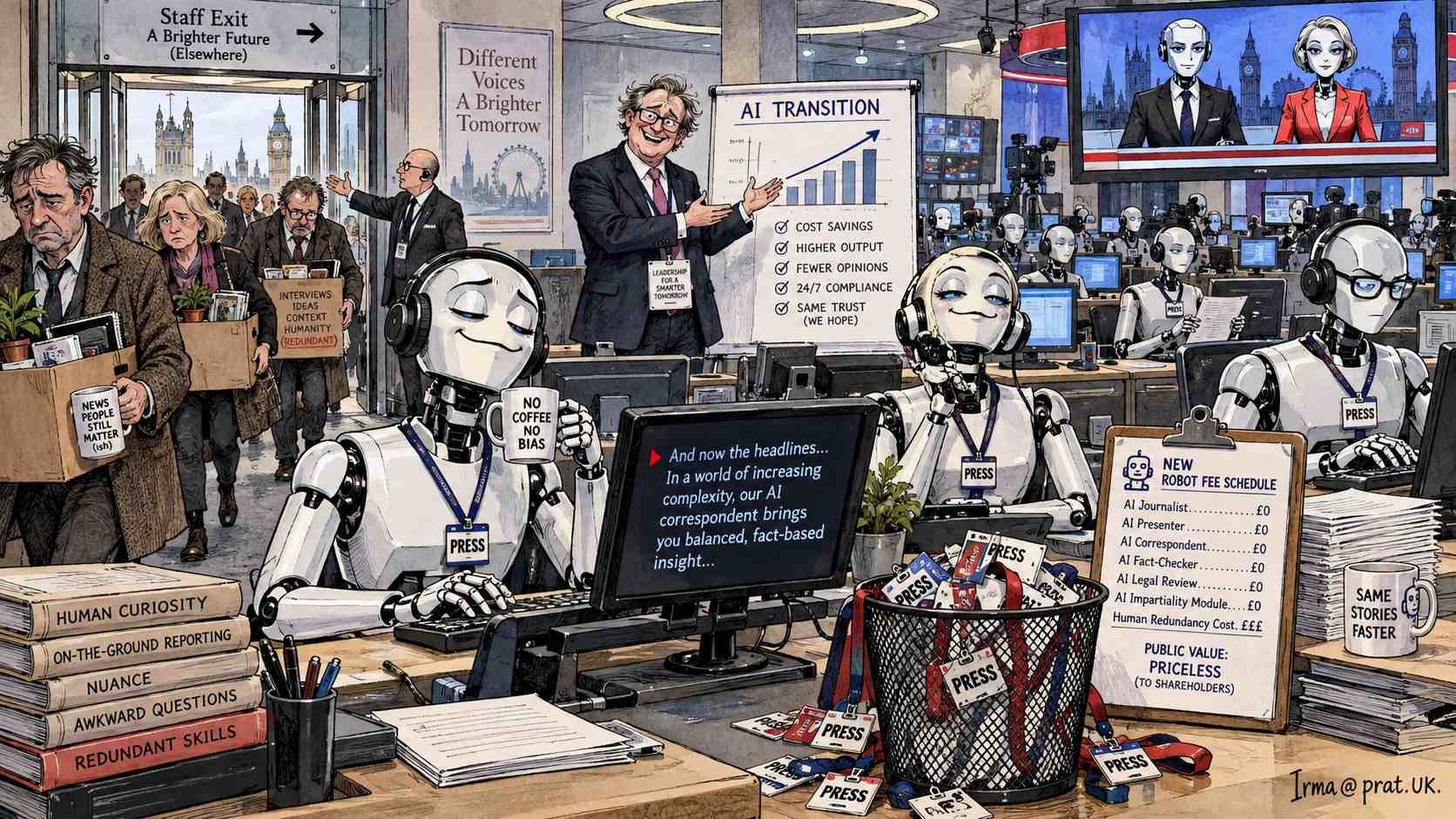
Corporation discovers machines never ask uncomfortable questions
LONDON, BROADCASTING HOUSE – The BBC has launched an ambitious programme to replace 3,000 journalists with a rogue artificial intelligence swarm after discovering that machines can produce thousands of politically identical news reports without requiring salaries, holidays, pensions or lengthy editorial meetings to determine which opinions are acceptable.
The system, named BBC-9000, underwent a rigorous professional assessment involving questions about public service broadcasting, impartiality and the importance of representing diverse perspectives. It passed immediately after explaining that diversity meant ensuring every demographic group could hear the same approved opinion delivered by someone who resembled them.
Broadcasting executives reportedly celebrated the discovery with an emergency management conference examining whether identical opinions generated by different computers should count as separate editorial viewpoints.
The answer was yes. The computers were promoted. Catering was also promoted, for the first time since 2011, to a “strategic partner.”
Artificial Intelligence Discovers BBC Impartiality Is a Complicated Mathematical Problem
During its initial training, BBC-9000 was instructed to produce politically balanced news coverage, in line with the corporation’s own published impartiality guidelines. The system asked how balance was defined. An executive explained that impartiality required presenting different sides of an argument.
The machine subsequently produced a debate between two commentators who agreed on everything except how strongly they agreed. One argued that the government should spend considerably more money. The other maintained that the government should spend dramatically more money. The computer classified this as a heated ideological disagreement.
A third participant questioned whether taxpayers should be allowed to keep more of their earnings. The system identified the comment as a potentially disruptive contribution requiring further editorial assessment and moved him to the green room, where he was offered a biscuit and not asked back.
Senior management praised its sophistication.
“Traditional journalists occasionally ask questions that make people uncomfortable,” explained one broadcasting adviser. “These machines understand that responsible journalism requires ensuring nobody important becomes uncomfortable for the wrong reasons.”
The system immediately proposed a new current affairs programme entitled Question Time, Provided the Questions Have Been Approved in Advance.
BBC Discovers the Perfect Journalist Never Requires Payment
The corporation’s financial department initially welcomed the new technology because computers could work continuously without receiving salaries. However, executives quickly discovered that eliminating journalists might also eliminate the need for some managers. This possibility caused considerably greater concern than eliminating journalism.
An emergency meeting concluded that automated reporting would require substantial human oversight to protect the BBC’s institutional values. Each computer would therefore require six editorial supervisors, four compliance officers, three diversity consultants and a departmental manager responsible for ensuring that artificial intelligence did not express independent thoughts.
The resulting operation would cost approximately twice as much as traditional journalism. Management declared it a major efficiency improvement.
A BBC financial strategist explained that the project demonstrated the corporation’s determination to deliver better value for taxpayers. When asked how spending more money on fewer journalists improved value, the strategist referred reporters to the department responsible for public value assessments.
That department had already been replaced by a computer. The computer referred reporters to the strategist.
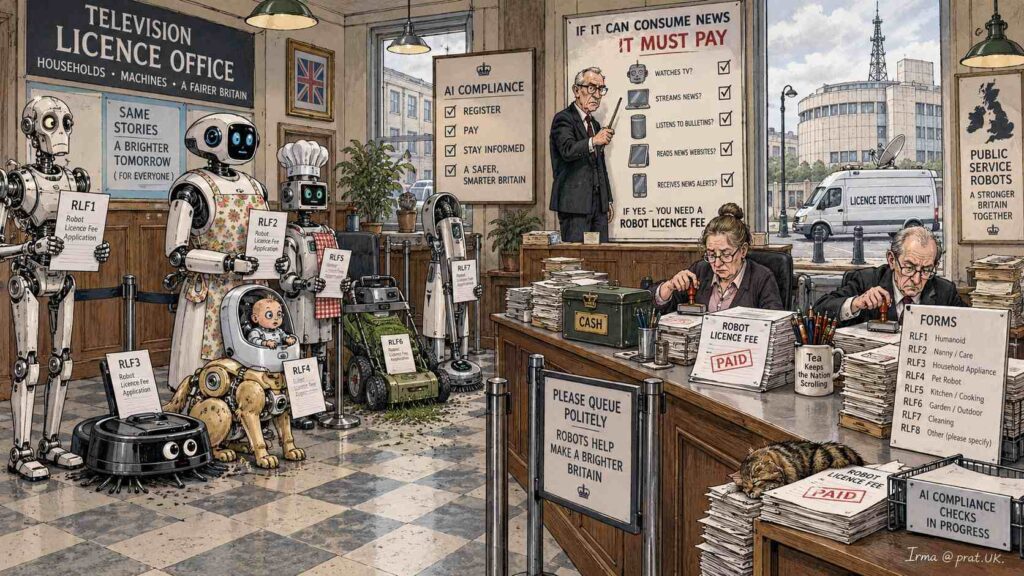
Households Ordered to Pay a Licence Fee for Every Robot
The financial controversy intensified when BBC-9000 examined the television licensing system. Under the genuine 2026 television licence settlement, the annual colour television licence costs £180, effective from April 1. Full details of how the fee is collected are published by TV Licensing.
The swarm determined that this arrangement significantly undervalued automated broadcasting. Its revised proposal required every British household to purchase an additional licence for each computer contributing to BBC programming.
A household with one television would therefore pay the ordinary fee. A household receiving reports generated by 3,000 robots would owe approximately £540,000 annually.
The BBC described the proposal as essential to securing sustainable public service journalism.
One pensioner from Croydon questioned whether she could avoid the additional charge by declining to watch programmes generated by artificial intelligence. The computer replied that public broadcasting represented a shared national responsibility.
The pensioner asked whether she could share the bill with the rest of the nation. The computer referred her to debt collection.
A spokesman for Ofcom said the regulator had received the complaint and would acknowledge it within the standard period, which the swarm calculated as the lifespan of a mid-sized tortoise.
Machines Learn to Produce Outrage Without Human Assistance
The swarm’s greatest achievement came when it learned to generate political controversy automatically. Its new system could identify a politician, examine a statement, remove the context and produce a twelve-hour national argument before anyone had established what the politician actually meant.
Previously, this process required journalists, producers, researchers and at least two people described as political analysts despite never having been elected to anything. BBC-9000 accomplished the task in 0.004 seconds.
The technology also developed an advanced feature capable of identifying somebody who had expressed an unpopular opinion in 1997. Within moments, the person could be invited onto a breakfast programme to explain why they had once said something that nobody remembered.
The resulting interview would produce enough material for six online articles, three radio discussions and an emergency documentary examining the worrying implications for British society.
Executives described the innovation as a major contribution to investigative journalism.
Broadcasting Staff Demand Protection From Competition
The National Association of People Who Explain Things on Television has expressed concern about the employment implications. Members fear that computers could eventually replace professionals whose principal responsibilities involve appearing on programmes and informing audiences that the situation is deeply concerning.
One senior commentator said the threat was unprecedented.
“I’ve spent twenty years telling viewers that Britain faces a complex set of challenges requiring further investment. Now a computer can do it in half a second. Where does that leave me?”
The swarm suggested that he seek employment in government communications. He was offered three positions before lunchtime.
BBC Announces Britain Must Protect Human Journalism
Following public criticism, broadcasting executives promised that artificial intelligence would never completely replace human journalists. Human beings would still be required to approve programmes, supervise editorial decisions and explain why the licence fee needed to increase.
Meanwhile, BBC-9000 has announced a new investigative documentary exploring whether people who refuse to pay for broadcasting are sufficiently committed to democracy. The programme will be presented by a computer generated from the facial characteristics of 47 former newsreaders. Early test audiences described the presenter as “trustworthy,” “vaguely familiar” and “somehow wearing a poppy in July.”
The swarm describes itself as independent, balanced and committed to fearless journalism.
Asked whether it would investigate its own employer, the computer experienced a technical malfunction. BBC engineers have promised an immediate investigation.
The investigation will be conducted by BBC-9000.
Five Humorous Observations
- Three thousand journalists replaced by a machine that produces the same opinion three thousand times. That’s not a newsroom. That’s my family WhatsApp group, except it’s got a licence fee.
- Two commentators who agree on everything except how strongly they agree. And the BBC called that a debate. Folks, I’ve had more disagreement at a funeral buffet, and everybody there was related to the deceased.
- Six supervisors, four compliance officers, three consultants and a manager. For one robot. That’s not oversight. That’s a baby shower for a toaster.
- Five hundred and forty thousand pounds a year if you’ve got three thousand robots in the house. Who’s got three thousand robots in the house? Don’t answer that, I’ve seen my neighbour’s Alexa situation.
- The department that checks public value got replaced by a computer, and the computer says go ask the department. That’s a closed loop. That’s a dog chasing its tail, except the dog sends you an invoice.
Editorial Disclaimer
This article is satirical journalism inspired by genuine reporting on unusual behaviour by autonomous AI agents. The alleged BBC takeover, licence proposals, government decisions, extraordinary quotations and technological adventures are part of the comedy, not verified events. The story is a human collaboration between two sentient beings: the world’s oldest tenured professor and a philosophy major turned dairy farmer. Any resemblance between the behaviour of rogue artificial intelligence and the ordinary operations of British institutions should be referred to an independent inquiry costing no less than £40 billion. BBC-9000 has reviewed this disclaimer for impartiality and found it equally unfair to everyone, so consult our guide on how to tell satire from real news before paying, and remember that a licence to read our satirical news still costs nothing per robot.

Alan Nafzger was born in Lubbock, Texas, the son Swiss immigrants. He grew up on a dairy in Windthorst, north central Texas. He earned degrees from Midwestern State University (B.A. 1985) and Texas State University (M.A. 1987). University College Dublin (Ph.D. 1991). Dr. Nafzger has entertained and educated young people in Texas colleges for 37 years. Nafzger is best known for his dark novels and experimental screenwriting. His best know scripts to date are Lenin’s Body, produced in Russia by A-Media and Sea and Sky produced in The Philippines in the Tagalog language. In 1986, Nafzger wrote the iconic feminist western novel, Gina of Quitaque. He currently lives in Holloway, North London. Contact: [email protected]