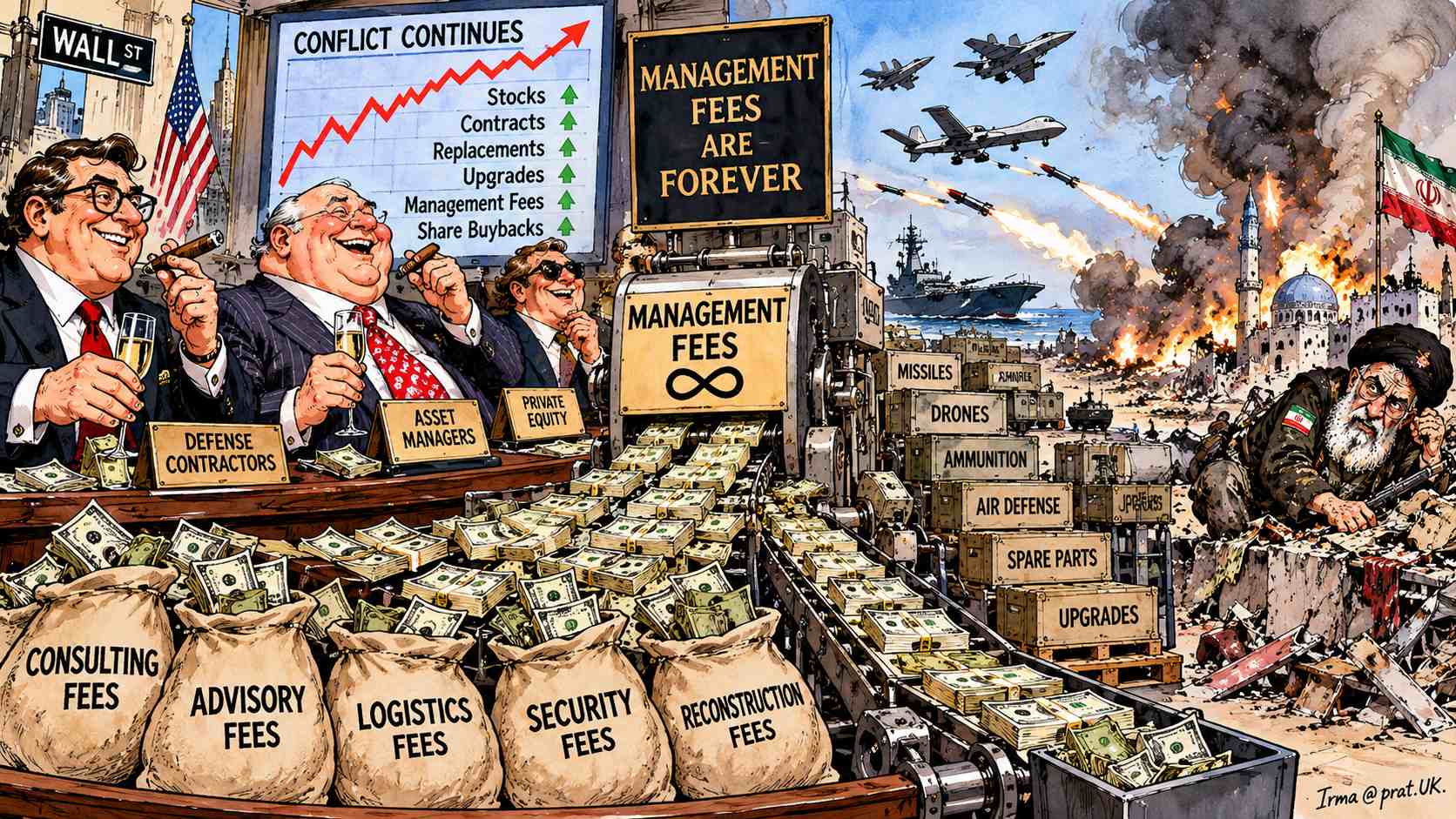
Management fees are forever.
NEW YORK, October 19, 2026 – Wall Street analysts studying the prolonged American conflict with Iran have identified a remarkable theoretical investment: a country powerful enough to win almost every conventional engagement against an adversary stubborn enough to keep the conflict going.
At first glance, the arrangement looks like an attractive commercial proposition. The United States has extraordinary military technology. Iran keeps looking for ways to impose military and economic costs despite severe damage to its conventional forces. Washington needs readiness, replacement supplies and ever more sophisticated defensive systems. The obvious conclusion is that somebody somewhere must be making money.
Wall Street has discovered that the link between war, defense spending and corporate profit is far less straightforward than a defense contractor’s brochure suggests.
Defense Stocks Fall Despite Continued Spending
According to Barron’s reporting on defense stocks in October 2026, major defense shares have fallen substantially this year despite expectations of continued spending.
That confused investors who assumed that firing missiles automatically sends missile makers’ stock prices up. Analysts were reminded that wars, like marriages, can be extremely expensive even when everyone involved insists things are going beautifully.
Wall Street Unveils the Forever Victory Fund
Investment bankers have considered building a financial product around the difference between winning battles and ending wars. The Forever Victory Fund would invest in companies that produce defense equipment, surveillance systems, sensors, logistics infrastructure and military technology.
Its marketing materials would feature the familiar American promise of technological superiority. Its risk disclosures would run about as long as the federal budget.
Potential investors would get a simple explanation. Every successful military operation demonstrates the usefulness of advanced weapons. Every weapon used creates potential demand for replacement inventory. Every hostile regime that survives creates continuing uncertainty. And every continuing uncertainty lets an investment bank publish another sixty-page report on why more government spending might be necessary.
The fund would collect management fees whether or not its forecasts proved correct. That makes it a sturdier financial innovation than predicting when a war will end.
The proposed advertising slogan reads: “Peace May Be Temporary. Management Fees Are Forever.”
The Securities and Exchange Commission has not been asked to approve the product, which is fortunate, because explaining the investment theory to the SEC would require distinguishing national security from an exceptionally unpleasant retirement plan.
Defense Contractors Discover Peace Has a Terrible Customer Retention Rate
Ordinary businesses measure success by customer satisfaction, repeat purchases and long-term relationships. Defense procurement works differently, since its main purpose is national protection and not consumer entertainment.
Still, the need to replenish military inventories produces a useful business analogy. Imagine a car maker finding out that its cars vanish every time a customer successfully arrives at work. The customer would need another car tomorrow. Investors would be thrilled. Consumers would be considerably less so.
Missiles are designed to be expended, which creates real replenishment requirements. But the analogy shows why military economics can look strange from an ordinary household’s point of view. American families buy security systems hoping never to use them. Governments buy weapons knowing they may eventually have to. Nobody who installs a home alarm expects the manufacturer to celebrate when burglars keep coming back.
A successful security system should make the household safer. That raises a fair question about military spending: does buying another weapon bring the political objective closer, or does it just improve the military’s ability to keep pursuing it? The answer depends on strategy, not the quality of the marketing department.
Iran Announces It Survived Another American Victory; Economists Recalculate Quarterly Expectations
Iran’s leadership has tried to exploit disruptions in energy markets and shipping through the Strait of Hormuz. That doesn’t erase American military accomplishments. It does show that a weaker adversary can keep ways of imposing costs after losing major parts of its conventional forces, a point Reuters has tracked in its reporting on Iran’s shipping tactics.
That creates an unusual investment risk. The American military can succeed tactically while the broader economy takes added pressure from oil markets, transportation costs and uncertainty. A defense manufacturer may collect new orders while an airline faces higher fuel bills. A logistics company may struggle while a maker of military sensors lands more contracts. A household may pay more for groceries while economists explain that the national economy is experiencing a sophisticated combination of geopolitical uncertainty and supply disruption.
Financial analysts tried to summarize all this in a chart. The chart was rejected because it made everyone look miserable except the consultants hired to build it.
Investors Ask Whether the Pentagon Can Produce a Product Called Peace
Some of America’s most impressive technological achievements came out of government-supported defense research. Military innovation has contributed to advances in aviation, computing, communications and many other fields. A strong defense industry remains necessary for protecting the nation and maintaining credible deterrence.
But the commercial value of making advanced equipment isn’t the same as the national value of using it. The point of overwhelming military power should be to achieve meaningful security objectives. If a weapon destroys a dangerous threat, that can be a legitimate accomplishment. If the destruction helps bring a conflict to a favorable end, it becomes strategically more valuable. If the fighting goes on indefinitely despite recurring tactical successes, citizens are entitled to ask how those successes connect to the political end state.
Wall Street would probably prefer to put the whole question in a financial ratio. Victory per dollar. The Pentagon might prefer military effectiveness. Diplomats might prefer enforceable agreements. Taxpayers would settle for an answer on when the bills stop going up.
The investment community has therefore been handed a proposal more ambitious than another missile procurement program: build a national security strategy that produces a durable peace while keeping enough defense capability to prevent the next conflict. It would protect Americans, make the economy more predictable and reduce the danger of escalation.
The initiative has one enormous marketing problem. A successful peace agreement doesn’t explode. It needs no dramatic promotional video. It can’t be displayed at a defense convention beside a thirty-foot missile. It offers no fireball, no slow-motion footage and no chance for a television commentator to shout, “Look at that!” It merely lets ordinary people go on living, working, investing and raising their families.
Wall Street may struggle to appreciate a development that produces no spectacular quarterly headline. The American taxpayer, however, might call it the best return on investment since the invention of the refund.
Five Observations From the Trading Floor
- Defense stocks went down during a war. I’ve seen a lot of things in this business, but I’ve never seen a guy sell lemonade in a drought and lose money.
- The Forever Victory Fund. “Forever.” That’s not an investment term. That’s what the guy says right before your wife finds out.
- They said the risk disclosures would be as long as the federal budget. Great. Nobody reads either one, and both end with somebody getting hurt.
- Peace doesn’t explode, so it doesn’t make the news. Peace is the guy at the party who’s quietly fine. Nobody remembers him. Everybody remembers the guy who set the couch on fire.
- Victory per dollar. If you want to scare a general, don’t show him a missile. Show him a spreadsheet.
Editorial disclaimer: Barron’s reporting on falling defense stocks, the SEC and Reuters’ coverage of Iran’s shipping tactics are real. The Forever Victory Fund, its slogan and the chart that made everyone miserable are comic inventions, and nothing here is investment advice. Past performance of this disclaimer is no guide to future laughs, though our guide to news satire sites is a safer long-term holding than most.