East Germany’s famous Trabant proves that a vehicle can be officially affordable, socially guaranteed and approximately fifteen years away from the showroom
BERLIN – Historians examining East Germany’s socialist economy have confirmed that the government successfully demonstrated the difference between guaranteeing citizens access to automobiles and supplying citizens with automobiles during their natural lifetimes.
The Trabant became one of the most recognisable consumer products of the German Democratic Republic. It was small, simple, mechanically distinctive and capable of generating extraordinary emotional attachment among its owners. It was also capable of testing their patience.
According to the DDR Museum’s record of a 1979 Trabant order confirmation, the typical wait for a new car was roughly twelve to fifteen years, varying by region, with separate annual quotas for certain groups such as pensioners and officials. The museum’s article on the Trabant says waits could stretch as far as sixteen years. Twelve to sixteen years. For a car.
That is not automobile retailing. That is an intergenerational correspondence programme. A citizen could order a Trabant as a newlywed and take delivery after his children had learned to drive. The government could guarantee transportation. It could not guarantee the arrival of transportation.
Socialist Government Guarantees Everyone a Car?
- A guaranteed car with a fifteen-year delivery is the only vehicle that comes with an inheritance clause.
- “Morning or afternoon?” is the only question in the whole story where Klaus gets a sensible answer, and he didn’t get one.
- The Trabant had one unbeatable feature: it was the only car whose delivery date outlasted its road tax, its warranty and in some cases the marriage that ordered it.
- A used Trabant fetching more than a new one is the clearest economics lesson ever delivered in a cloud of blue two-stroke smoke.
- The official who denounced the black market and drove home from it is the single most believable character in the piece.
Trabant Waiting List: Congratulations, Your Car Has Been Approved
Our imaginary East German citizen, Herr Klaus Müller, enters the state automobile office in 1975.
“I’d like to buy a Trabant.”
The official smiles. “An excellent choice. Very affordable.”
“When can I collect it?”
“Approximately 1989.”
Klaus pauses. “1989?”
“Possibly 1990, depending upon production.”
“Morning or afternoon?”
The official looks offended. “What difference does that make?”
“The plumber is coming in the morning.”
Klaus completes his paperwork. He receives a receipt, a production estimate and a government brochure celebrating the benefits of socialist transport. He does not receive a car. This, the official assures him, is normal. Klaus walks home.
East German Car Shortages: The Automobile Exists in Theory
Under the East German system, private citizens could aspire to car ownership, but production capacity was limited and consumer choice was narrow. Import restrictions, central planning, shortages of materials and competing industrial priorities all complicated the picture. A car was a valuable possession, but its official price did not describe its availability. The waiting list became an economic institution in its own right. Families planned around it. Used vehicles could fetch unusually high prices because they were available at once.
This is the shortage economy described by the Hungarian economist János Kornai, whose work the CEPR profile of Kornai’s life and work sets out: when prices and plans do not coordinate supply and demand, people wait, queue and make private arrangements instead.
Imagine a capitalist car salesman offering a customer a new vehicle for £8,000 or an inferior used one for £12,000. The customer would assume somebody had lost his mind. Under a shortage system, the used car had a tremendously important feature. It existed. The customer could sit in it, start the engine and drive it home. Economists call this the value of immediate availability. Ordinary motorists call it having a car.
Central Planning and Production Targets: The Government Celebrates Affordable Transportation
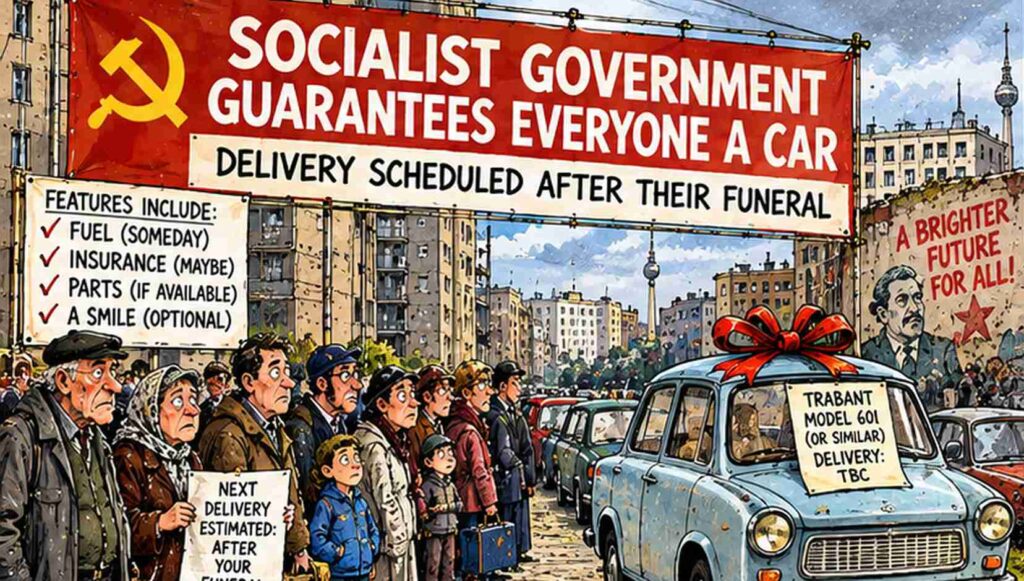
At an imaginary East German press conference, the Minister of Socialist Motoring announced that every citizen could eventually buy a vehicle at a government-approved price. A Western journalist asked why delivery took so long. The minister explained that socialist factories operated according to carefully designed production plans.
“Why don’t the factories build more cars?”
“They are meeting their production targets.”
“But people want additional cars.”
“Consumer desires cannot be allowed to interfere with the plan.”
The journalist asked whether prices might encourage manufacturers to expand output. The minister replied that the government had already eliminated unnecessary market signals.
“What does the market signal when people are waiting fifteen years?”
“That production is insufficient.”
“Exactly.”
The minister ended the interview for promoting extremist automotive mathematics.
Economists were not taken by surprise. Robert Heilbroner’s essay on socialism for the Concise Encyclopedia of Economics recounts how planned economies hit their quotas and still left the shops bare, because a target met is not the same as a customer served. The Trabant met every target put in front of it. It was a car in the sense that a postcard of the seaside is a holiday.
Used Trabant Prices and the Black Market: Boris Has a Car, and Suddenly Everybody Believes in Markets
A local entrepreneur named Boris owns a five-year-old Trabant. It is scratched, noisy and occasionally reluctant to start. Boris has nevertheless discovered that buyers will pay a premium because the car can be collected immediately.
An imaginary government official accuses him of profiteering. Boris offers him the vehicle. The official examines it.
“Can I have it today?”
“Yes.”
“Without waiting?”
“Correct.”
The official pays the asking price. He then returns to his office and denounces the corrupting influence of unofficial automobile markets. Boris drives home in another vehicle. The official drives home in his expensive socialist Trabant. Both are pleased with the transaction, and only one is honest about what happened.
Planned Economy and Consumer Choice: The Committee Orders More Vehicles After Everyone Changes Their Minds
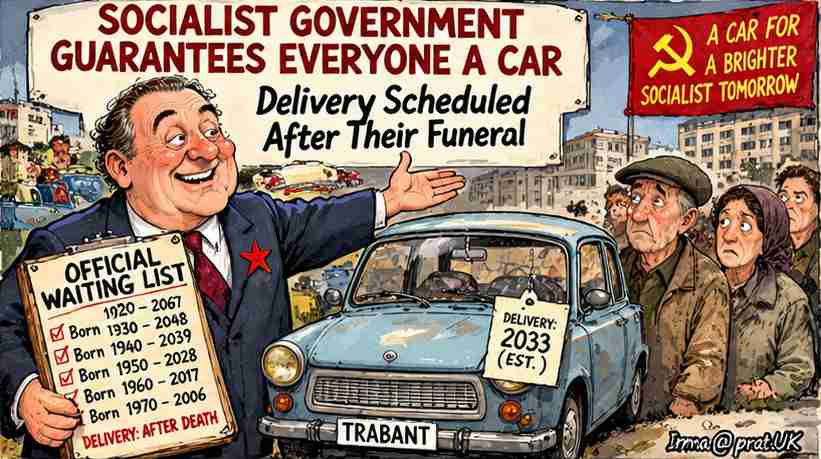
Central planning creates another difficulty, which is that consumer preferences are not fixed. People may want different sizes, features, colours and delivery times. Factories have to respond to changing costs, techniques and available materials. In competitive markets, firms have incentives to respond because dissatisfied customers can buy elsewhere. In state-directed industries without effective competition, those pressures can be weaker.
That does not mean every private carmaker succeeds. It means consumers have more ways of expressing their preferences than filling out a form and waiting for a ministry to reply.
In the DDR, the car became an object of patience, maintenance and ingenuity. Owners learned to repair their vehicles, and families treasured them. The Trabant acquired a cultural significance far beyond its modest technical specification, and became a symbol of independence precisely because personal mobility was so hard to get.
Hayek’s explanation, set out in The Use of Knowledge in Society, is that prices carry information no committee can gather: who wants what, how badly, and by when. The planning office had a different instrument for discovering how badly people wanted a car. It was called the list, and it gave a remarkably precise reading. The answer was fifteen years badly.
The Car Finally Arrives, and So Does History
In 1989, Klaus receives a letter. His Trabant is ready. He celebrates. His wife celebrates. His children, now adults, regard the achievement with mild astonishment. The government congratulates Klaus on his contribution to socialist industrial progress.
Klaus drives around Berlin. He has waited fourteen years. He knows every detail of the brochure. He has lived through three jobs, two children, several birthdays and a remarkable amount of public transport.
Then, as Britannica’s account of the Berlin Wall records, the Wall opened in November 1989. East Germany’s political future changed, and the whole economic system entered a period of dramatic transformation. Klaus stares at his newly acquired car. For fourteen years he had waited for the government to deliver it. Now the government itself had begun to disappear.
He turns to his wife. “Do you think we should order another one?”
She looks at him. “Absolutely not.”
Theoretical socialism had finally delivered Klaus’s automobile. Unfortunately, history had already overtaken the delivery schedule.
Humorous Observations on the Trabant Waiting List and Socialist Motoring
- “Consumer desires cannot be allowed to interfere with the plan” is the motto of every committee that has ever chosen a menu for a wedding.
- Klaus waited fourteen years for the car, and the government waited fourteen years to finish becoming history. It was a close finish.
- A fifteen-year wait for a car makes the DVLA look like a drive-through.
- Consumer demand, the minister explained, had been fully accounted for in the plan. The consumers had simply not been consulted.
- The only thing the Trabant never ran out of was owners with a good story.
- If you take delivery after your funeral, the warranty is at least easy to keep.
- Somewhere a Trabant is still sitting in a garage, quietly proving that it was possible to keep a promise by simply outlasting everyone who made it.
- “Fifteen years badly” is the only unit of consumer demand ever measured entirely in birthdays.
- The Trabant met every target it was set. Unfortunately none of the targets was “be a car people can get”.
- A postcard of the seaside at least arrives within the week.
Satirical Disclaimer
This satire draws on the real consumer shortages and automobile waiting times of the former East Germany. Klaus, Boris and the conversations are imaginary; the museum’s historical waiting-time figures are genuine. The story is entirely a human collaboration between two sentient beings: the world’s oldest tenured professor and a philosophy major turned dairy farmer, neither of whom believes automobile ownership should require the patience normally associated with geological formation.
SOURCE:https://www.ddr-museum.de/de/objects/1001955
Auf Wiedersehen, amigo!
– prat.UK

Alan Nafzger was born in Lubbock, Texas, the son Swiss immigrants. He grew up on a dairy in Windthorst, north central Texas. He earned degrees from Midwestern State University (B.A. 1985) and Texas State University (M.A. 1987). University College Dublin (Ph.D. 1991). Dr. Nafzger has entertained and educated young people in Texas colleges for 37 years. Nafzger is best known for his dark novels and experimental screenwriting. His best know scripts to date are Lenin’s Body, produced in Russia by A-Media and Sea and Sky produced in The Philippines in the Tagalog language. In 1986, Nafzger wrote the iconic feminist western novel, Gina of Quitaque. He currently lives in Holloway, North London. Contact: [email protected]