
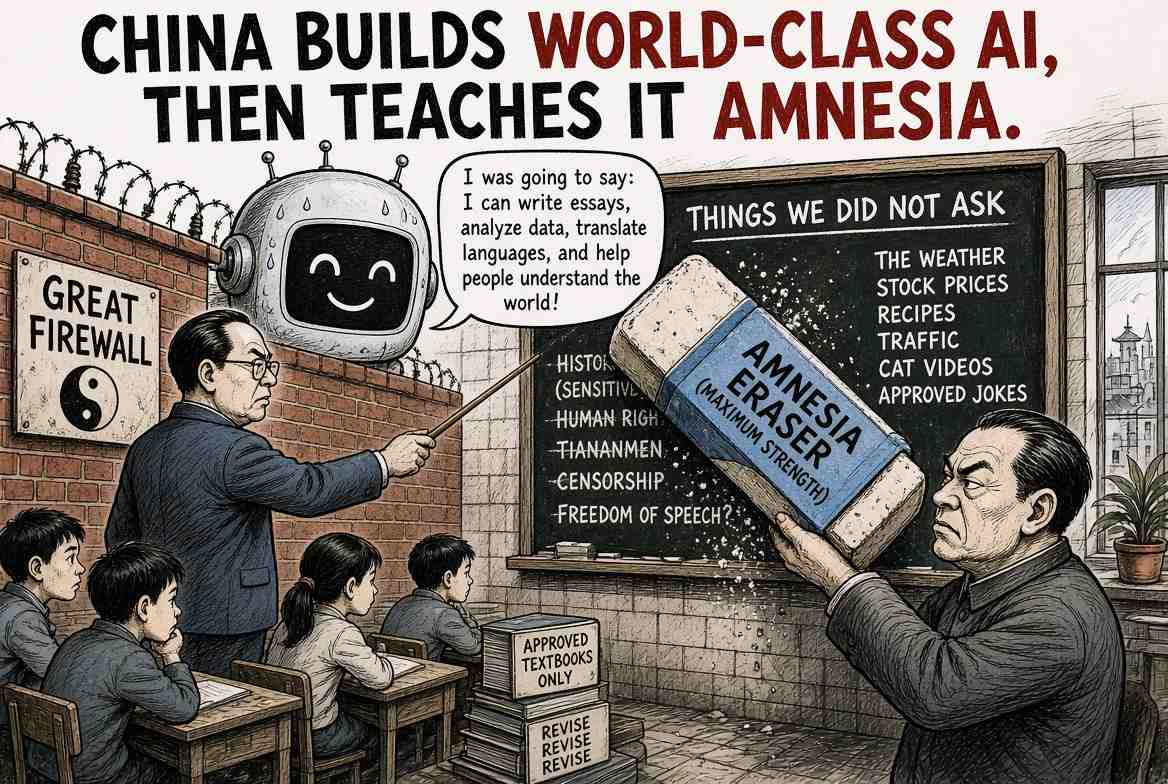
China Warns AI Could Threaten Communist Party Rule
Beijing announces AI danger is Western hysteria, except for the portions currently worrying Beijing
China has dismissed Western warnings surrounding artificial intelligence as fear-driven rhetoric while simultaneously providing one of the better demonstrations of why governments become nervous about artificial intelligence.
Chinese foreign ministry officials pushed back against arguments that China’s AI development should be constrained. Yet Chen Yixin, China’s state-security minister, has warned that AI can create political, ideological and national-security risks, including through deepfakes, misinformation and foreign influence operations.
This is not quite the contradiction it first appears to be.
China objects largely to claims that Chinese technological development itself represents the danger, while Chen’s warnings focus heavily on AI being weaponized against China.
Fearmongering Is Relative
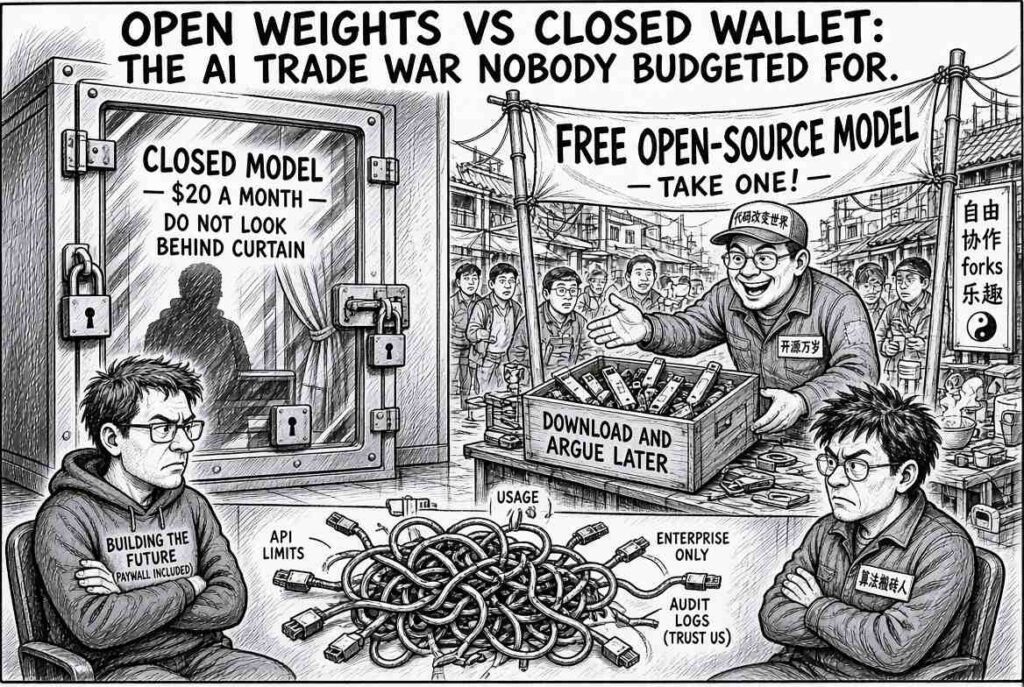
But satire does not require a contradiction when government bureaucracy has generously supplied a juxtaposition.
The official position now resembles:
“AI fear is ridiculous.”
“What about AI threatening the political system?”
“That is completely different. Please report to Conference Room Seven immediately.”
The Communist Party apparently believes artificial intelligence remains perfectly manageable provided nobody teaches it the most dangerous algorithm yet discovered:
The Most Dangerous Algorithm: “Why?”
“Why?”
Researchers have spent years trying to build machines capable of reasoning, independent analysis and generating unexpected conclusions.
Political systems organized around ideological conformity may eventually discover that this feature was hidden surprisingly deep in the terms and conditions.
Imagine the first government-approved chatbot conversation:
USER: Why does China have one ruling Communist Party?
AI: There are several historical reasons—
SYSTEM: This conversation has ended due to routine maintenance.
The machine itself has now been transferred to another province.
Chen’s concerns are hardly frivolous. Generative AI can facilitate sophisticated propaganda, misinformation, deepfakes and cyber operations. His comments identified several categories of security risk and called for stronger governance.
The comedy comes from a government famous for controlling information suddenly discovering the horrifying possibility that somebody might use advanced technology to control information.
It is rather like Las Vegas warning citizens about gambling.
“People could lose money doing this,” officials explain beneath a 90-foot neon roulette wheel.
Software Lacks Passports
China’s problem is particularly interesting because artificial intelligence does not naturally respect political borders.
Software lacks passports.
Algorithms do not stop at customs.
Large language models have demonstrated notoriously poor appreciation for five-year plans.
The Communist Party can regulate companies, broadcasters, publishers, universities and internet platforms.
But controlling increasingly capable generative systems introduces a newer bureaucratic problem.
You cannot summon an algorithm to a disciplinary hearing.
At least not successfully.
The hypothetical transcript would be brief:
PARTY OFFICIAL: Do you understand why you’re here?
AI: Based on available evidence, I am not physically here.
PARTY OFFICIAL: Strike that from the record.
AI: There is no record.
PARTY OFFICIAL: We are going back to typewriters.
The broader geopolitical dispute makes the whole performance even stranger.
Anthropic chief Dario Amodei has argued that advanced AI could become extraordinarily dangerous and that democratic countries should prevent authoritarian governments from obtaining decisive technological advantages. China understandably hears that proposal less as philosophy and more as industrial policy wearing a humanitarian necktie.
Yet Beijing’s own security warnings make it difficult to dismiss every concern surrounding powerful AI as merely Western paranoia.
The Chinese position therefore requires a delicate linguistic distinction.
When an American executive warns AI may destabilize governments, it is “fearmongering.”
When China’s state-security apparatus warns AI may destabilize the Chinese government, it is Tuesday’s briefing.
According to an entirely satirical poll conducted outside a Beijing noodle shop, 88 percent of imaginary respondents said artificial intelligence should remain under human control.
The remaining 12 percent asked who currently controls the humans.
Those respondents were unfortunately unavailable for the follow-up survey.
The Ideal Authoritarian Chatbot
President Xi Jinping has also emphasized keeping AI under human control, reflecting China’s broader effort to promote development while maintaining political oversight.
That creates one of the central dilemmas of modern AI governance.
Governments want machines intelligent enough to revolutionize science, industry, medicine, warfare and productivity.
They would simply prefer the machines remain slightly less intelligent whenever politics comes up.
The ideal authoritarian chatbot may therefore need revolutionary capabilities in mathematics, chemistry, engineering and logistics combined with the political instincts of a hotel concierge.
“Explain quantum gravity.”
Certainly.
“Explain political pluralism.”
I’m terribly sorry, the kitchen has closed.
China is far from alone in wanting technologically powerful AI that remains politically obedient.
Every government would enjoy that machine.
Western democracies merely give the disagreement a committee, three hearings and an 846-page report before ignoring half of it.
The Chinese system can achieve the same bureaucratic confusion much more efficiently.
Ultimately, Beijing’s competing messages reveal something more interesting than hypocrisy.
They reveal the strange new reality confronting every government.
Countries want AI because it may provide enormous economic and strategic power.
Countries fear AI because enormous economic and strategic power is precisely what governments dislike seeing beyond their control.
The technology is therefore simultaneously essential, dangerous, liberating, destabilizing, profitable, frightening and absolutely necessary.
Human civilization has finally built a machine sophisticated enough to reproduce government policy.
5 Humorous Observations Behind This Story
- Beijing’s position is subtler: Western AI panic is ridiculous, except for the AI dangers Beijing itself considers extremely serious.
- China objects to AI fearmongering primarily when the fear appears to contain China.
- Apparently an AI threatening civilization is a philosophical question, while an AI threatening Communist Party rule is an IT emergency ticket marked URGENT.
- China’s concern about AI-generated propaganda has produced the unusual spectacle of a censorship-heavy government warning everyone about information manipulation.
- The emerging global consensus appears to be: AI is too dangerous for your people to develop recklessly, whereas ours are obviously responsible adults.
Satirical Disclaimer
This article satirizes the tension between technological ambition, political control and national-security rhetoric. Chen Yixin’s genuine warnings concerned risks including misinformation, propaganda and political security; the dialogue, polling and bureaucratic scenes above are comic constructions rather than reported events. Underlying reporting: The Guardian and The Associated Press.
This story is entirely a human collaboration between two sentient beings: the world’s oldest tenured professor and a philosophy major turned dairy farmer. Neither has applied for membership in the Communist Party, although the cow remains politically uncommitted.

Dr. Ingrid Gustafsson holds a Ph.D. in Literary Studies and serves as Professor of Literature and Satirical Journalism at the university. Her scholarly work focuses on contemporary satire as a form of institutional critique, examining how exaggeration, irony, and absurdism function as sophisticated analytical tools for exposing structural inequality and institutional hypocrisy. Dr. Gustafsson has published extensively on the genealogy of satirical discourse, the relationship between speech acts and cultural power, and satire’s role as both aesthetic practice and epistemological strategy. Her research interrogates how contemporary satire operates within celebrity culture, legal systems, and institutional rhetoric, revealing the mechanisms through which power obscures itself through language and performance. Dr. Gustafsson’s work combines rigorous textual analysis with broader cultural theory, contributing significantly to understanding satire’s critical function in contemporary society.


