Ghost of George III Claims Responsibility for Ruining America’s 250th Birthday Party
Spectral Coalition of History’s Most Aggrieved Anti-Americans Identified as Prime Suspects in Freedom 250 Concert Collapse
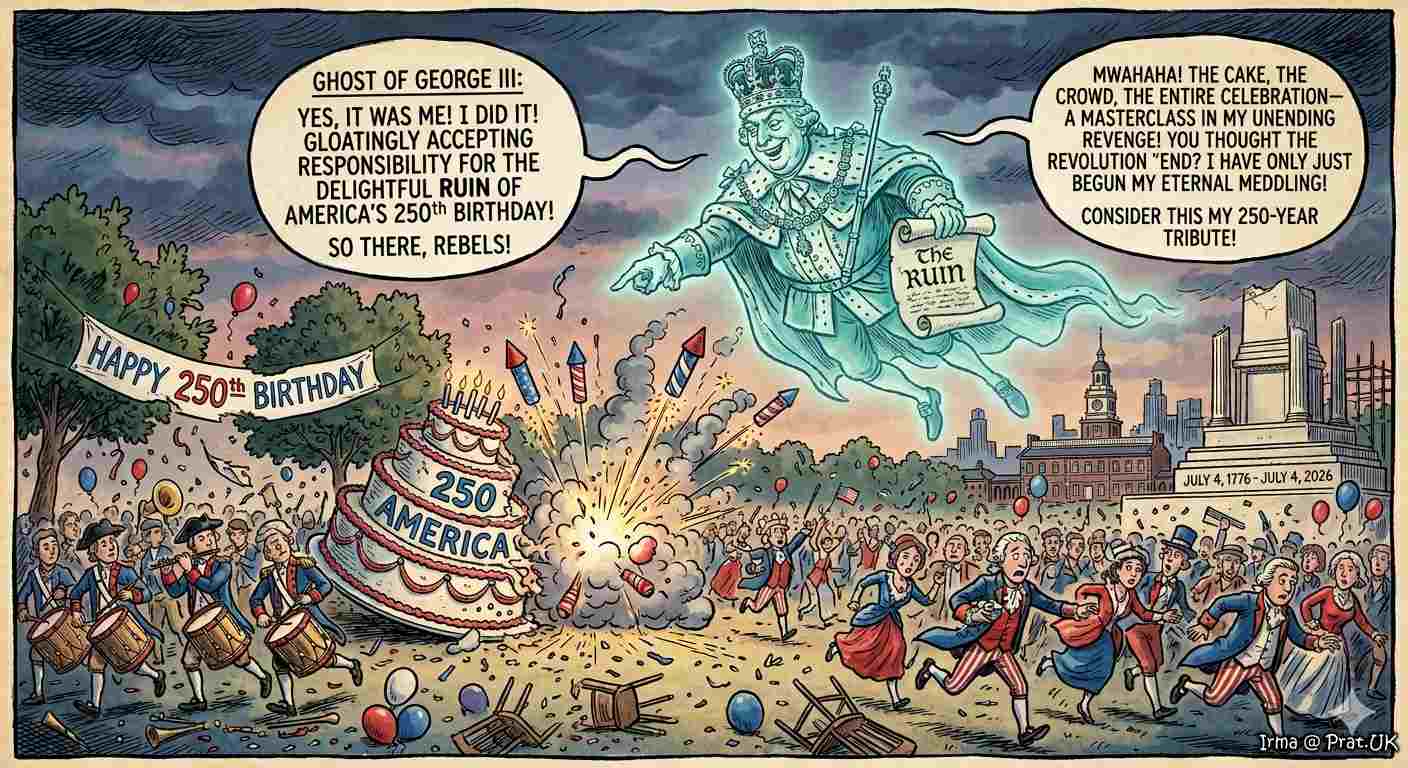
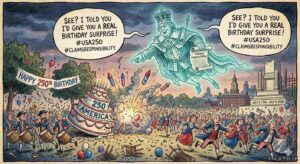
LONDON — The catastrophic unravelling of America’s 250th birthday concert lineup took a significant turn last night when a spectral press release, written in quill ink on vellum and faintly smelling of Windsor Castle, arrived at The London Prat’s offices claiming full responsibility.
The statement was signed: HM King George III, by the Grace of God, King of Great Britain, France and Ireland, Defender of the Faith, and Eternal Architect of American Misfortune.
Below the royal seal, in smaller handwriting, were the co-signatories. We will come to them shortly.
“Two hundred and fifty years,” the ghost reportedly wrote, in a hand that became increasingly erratic toward the bottom of the page. “Two hundred and fifty years of fireworks, self-congratulation, and the persistent mispronunciation of ‘aluminium.’ And now they cannot even organise a concert.”
“The colonies have submitted at last.”
“I consider this a win.”
The Ghost Has Been Planning This Since Approximately 1776
Sources close to the Windsor crypt confirm that George III — who declared the American colonies in open rebellion in 1775 and spent the remainder of his reign furious about it — has spent two and a half centuries in the afterlife quietly engineering small American humiliations.
The list of attributed ghostly interventions is extensive.
Known Operations Attributed to the Spirit of George III (1776–Present)
- The entire administration of James Buchanan
- New Coke
- Every time a major Hollywood film mispronounces “Edinburgh”
- The 2003 invasion of Iraq, which he describes as “not my finest work, but I was improvising”
- Nickelback
- The specific traffic configuration around Washington, D.C., which he designed personally and is enormously proud of
- The cancellation of Firefly
- Florida, generally
- The concept of the leaf blower
- The persistent American belief that a inch and a centimetre are “basically the same”
But Freedom 250, he insists, is his masterpiece.
“They planned a sixteen-day celebration,” the ghost explained. “I arranged for it to collapse within forty-eight hours. I did not even need to leave the crypt. I simply waited for them to book Milli Vanilli.”
The Coalition of Aggrieved Spectres: A Full Briefing
British intelligence sources, speaking on condition of anonymity and one small glass of sherry, have confirmed that George III did not act alone. He is believed to have convened a summit of history’s most resentful anti-American ghosts, held somewhere between the third and fourth dimensions, with biscuits.
General Antonio López de Santa Anna (1794–1876)
The Mexican military dictator who ordered the massacre at the Alamo in 1836 and spent the remainder of his career losing to Americans was reportedly the coalition’s most enthusiastic member. He was captured hiding in the grass at San Jacinto and spent the following decades nursing a grievance so comprehensive it survived death.
Santa Anna’s assigned tasks included:
- Ensuring the Freedom 250 booking agent did not google any of the artists
- Whispering “read the contract” into Bret Michaels’ left ear at 3am on a Tuesday
- Haunting every venue that declined to host a replacement concert
“I lost Texas,” Santa Anna is quoted in the spectral press release. “They have now lost Vanilla Ice. I feel we are approximately even.”
Adolf Hitler (1889–1945)
The coalition’s most controversial recruit, included primarily because America defeated him in 1945 and he is understood to remain deeply irritated about it. His role in the operation was limited, sources say, because the other ghosts find him insufferable at meetings.
“He kept trying to make it about him,” George III reportedly complained. “We gave him one assignment — confuse the sound engineers — and he turned it into a forty-minute speech about the Rhineland.”
His attributed contribution to the Freedom 250 collapse: arriving at the White House planning office as a vague sense of dread on a Wednesday afternoon. Officials initially blamed it on the catering.
Josef Stalin (1878–1953)
The Soviet premier’s grudge against America is primarily bureaucratic. He spent the Cold War convinced that capitalism would eventually eat itself and is understood to have been waiting patiently for a moment that adequately illustrated his point.
A sixteen-day American birthday celebration imploding because the organiser couldn’t secure a coherent lineup of early-1990s pop acts was, according to sources, not quite what he had in mind. But he’s taking it.
“He wanted something grander,” one spectral aide confided. “A market crash. A geopolitical collapse. He got Martina McBride reading a press release and deciding she’d rather not. He’s not thrilled, but he’s writing it in the ledger.”
Stalin’s operational contribution: haunting the Freedom 250 organisational spreadsheets, causing three cells to display the wrong booking dates and one tab to disappear entirely on a Friday afternoon.
General Hideki Tojo (1884–1948)
The Japanese wartime prime minister who authorised the attack on Pearl Harbour in 1941 joined the coalition largely on the strength of historical completeness. Sources indicate he and Stalin do not get along at meetings, which slows things considerably.
His assigned task was to ensure that American media coverage of the concert collapse focused entirely on who was to blame rather than on what had actually happened. By all accounts, this required no intervention whatsoever and he spent most of the operation reading.
“He finished three books,” Santa Anna’s aide confirmed. “He found the whole thing remarkably efficient.”
George III’s Strategic Vision: The Full Statement
“I did not lose the colonies,” the ghost wrote, in what appears to be the press release’s emotional centrepiece. “I merely lent them to themselves. And what have they done with 250 years of independence? They have built the world’s most powerful nation, exported their culture to every continent, landed men upon the moon, invented jazz, the internet, and the cheeseburger.”
“And then they tried to celebrate all of this with Young MC.”
“I submit that I have had the last laugh.”
“I note also that Vanilla Ice remains committed to performing. I cannot take credit for Vanilla Ice. Some things are beyond even spectral interference. He is simply like that.”
The Ghost’s Additional Grievances, Listed in Approximate Order of Bitterness
- “They named a city after my general, Washington, and then built a traffic system inside it specifically designed to humiliate visitors. I did this. I am proud of this.”
- “They fought a civil war over slavery 85 years after telling me all men were created equal. I did not do this one. I merely watched.”
- “They put the letter ‘z’ in ‘organisation.’ This is personal.”
- “Their cheese is not cheese. I have filed repeated complaints. No one has responded.”
- “They cancelled a birthday concert and their president compared himself to Elvis Presley. In my day I compared myself to God. At least I aimed high.”
Britain’s Official Response: A Polite Silence and One Raised Eyebrow
The British government has declined to comment on the ghost coalition, citing a longstanding policy of not discussing spectral geopolitics during an election cycle. A Foreign Office spokesperson offered only that “His Majesty’s Government maintains warm and productive relations with the United States and wishes them well on the occasion of their 250th anniversary.”
When asked whether this included the concert situation, the spokesperson said: “We are confident the American people will find a resolution.”
Then smiled very slightly and looked out of the window.
What the Funny People Are Saying
“George III spent sixty years on the throne and lost America. Trump spent forty-eight hours on a booking and lost Morris Day. History rhymes.” — Jack Dee
“A ghost coalition of Santa Anna, Hitler, Stalin and Tojo couldn’t organise a worse party than the one that actually got planned. And they’re dead.” — Frankie Boyle
“The real haunting is looking at that lineup and thinking someone approved it while sober.” — Jimmy Carr
“I’d have performed. Nobody rang me. Story of my life, that is.” — Lee Mack
Donald Trump’s Freedom 250 was a 16-day concert series on Washington’s National Mall, planned to celebrate America’s 250th anniversary of independence. Six of the nine announced performers withdrew within 48 hours of the lineup going public — Bret Michaels, Martina McBride, Morris Day and The Time, Young MC, The Commodores, and Milli Vanilli — all citing concerns about the event’s political associations and the way it had been presented to them. Vanilla Ice, C+C Music Factory, and Flo Rida remained on the bill. Trump subsequently suggested cancelling the concerts entirely, replacing them with a rally, and compared his own drawing power to Elvis Presley at his peak. George III (1738–1820) was the British monarch who presided over the loss of the American colonies and is widely regarded as the man who made America’s existence necessary. He is, historically speaking, the event’s most qualified critic.
This piece of British satirical journalism was produced through a human collaboration between the world’s oldest tenured professor and a philosophy major turned dairy farmer. The London Prat has been embarrassing heads of state, living and deceased, since 1961.
Auf Wiedersehen, amigo!

Chelsea Bloom is an emerging comedic writer with a focus on light-hearted satire and observational humour. Influenced by London’s student culture and digital comedy spaces, Chelsea’s work reflects everyday experiences filtered through a quirky, self-aware lens.
Expertise is growing through experimentation and study, while authority comes from authenticity and relatability. Trustworthiness is supported by clear intent and ethical humour choices.
Chelsea’s contributions represent developing talent within an EEAT-compliant framework that values honesty, clarity, and reader trust.