

Britain Confronts the Emotional Wreckage of Removing Fake Eyelashes, As Experts Urge Nation to “Blink Slowly and Have a Sit Down” 👁️💄
Five Dispatches From the Front Lines of Lash Detachment — A Beauty Emergency Hiding in Plain Sight Behind Three Coats of Mascara
- Fake eyelashes, once considered a harmless cosmetic indulgence alongside dry shampoo and optimism, have evolved into what sociologists at the University of Wolverhampton now describe as “a removable identity with adhesive and a Boots loyalty card.”
- Across nail bars, bathroom floors, and emotionally charged car mirrors in Tesco car parks, British citizens are confronting the existential weight of peeling off something that, moments earlier, felt like confidence itself — or at minimum, like £12 well spent on a Saturday afternoon when there was nothing decent on telly.
- In a recent nationwide survey conducted by the Institute for Aesthetic Commitment (satellite office, Slough), 68% of respondents admitted they have stared at their reflection post-removal and thought, “Was that me… or was that a Boots deal-of-the-week?”
- The remaining 32% declined to answer, reportedly “still adjusting” and “having a biscuit about it.”
The Moment of Truth: Where Courage Meets Coconut Oil at Half Eleven on a Friday
For most, the removal process begins not with a decision, but with a slow and terrible realisation. The evening is winding down. The prosecco has been finished. The glue is giving way. Gravity, that undefeated force of nature with not a jot of interest in your plans, has entered the chat and brought its mates.
“I knew it was time,” said Kayleigh Simmons, a part-time influencer from Coventry and full-time human being with a complicated relationship with her own face. “One lash had started lifting like it had somewhere better to be. It was no longer attached to my face or my personal brand.”
Experts recommend a calm environment for removal, though eyewitness accounts from across the nation suggest most people attempt it under the violent fluorescent lighting of a bathroom shared with three flatmates, with escalating panic and at least one elbow in the toothbrush mug.
Dr. Renata Bloom, a cosmetic psychologist at the King’s College London Institute for Superficial Studies who once submitted a 400-page dissertation titled Attachment Theory: But Make It Primark, explains the psychological stakes with the measured calm of someone billing by the hour.
“When you remove a lash, you are not merely removing fibres,” she said. “You are removing an expectation. A narrative. Possibly three layers of mascara that had absolutely no business being there and, on some level, knew it.”
The “Just Rip It Off” Camp vs. The Lash Ritualists: Britain’s Most Underreported Cultural Divide Since the Great Scone Pronunciation War
The nation is presently divided into two camps, and frankly this particular schism feels more consequential than most of what’s currently before Westminster: those who rip off lashes in one dramatic gesture, and those who engage in what can only be described as a ceremonial unbinding worthy of a spa weekend in the Cotswolds.
The first group operates on raw impulse and a vague sense of bravado.
“I just go for it,” said one woman from Leeds, who requested anonymity owing to “past incidents involving a left lash and a work leaving do.” “Is it correct? No. Is it fast? Also no. But it feels decisive, and I am a decisive person who made a £9 impulse decision at 6 PM in a Superdrug near the Greggs.”
The second group prepares. Extensively. With intent.
Candles are lit. Oils are decanted. Music is selected that suggests emotional processing but stops short of actual resolution — typically something off a playlist called “Soft Chaos” or the entirety of Adele’s back catalogue.
“I soak a cotton pad in micellar water,” said another participant from Bristol. “Then I press it gently against the lash whilst whispering affirmations such as, ‘You served your purpose.’ I also thank the glue. Individually. By name if I can remember the brand.”
Both methods have been deemed equally valid by the Department for Cosmetic Resilience, though officials have cautioned against “emotional whiplash and/or reckless adhesive behaviour near soft tissue, particularly on a school night.”
Landmark British Science: Your Natural Eyelashes Were There the Whole Time, Quietly Getting On With It Like a Good Northerner
In a finding that sent tremors through the beauty-industrial complex all the way from Bond Street to the Trafford Centre, researchers have confirmed that natural eyelashes continue to exist beneath artificial ones — often in a state of quiet, uncomplaining patience that most British people recognise as the default national disposition.
“We found them just sitting there,” said Dr. Alan Vermeer, visiting fellow at the Oxford Institute for Unremarkable Findings. “Not complaining. Not trending. Not attempting to monetise themselves. Just… functioning. Which, in the current climate, is frankly more than we expected.”
The revelation has caused widespread confusion among women who have spent the better part of a decade paying £75 every three weeks to conceal them.
“Hang on — these were sufficient?” asked one participant in a controlled mirror study, gesturing vaguely in the direction of her own face. “They’ve been doing their job this entire time without a single announcement?”
The study found that individuals who removed their false lashes experienced a 23% increase in blinking awareness and a 47% increase in “looking like themselves again, but with questions and a mild sense of having been sold something.”
Influencer Identity Crisis: Mystique Metrics Down 12%, Comfort Up, Dignity Status Unclear
Content creators have been particularly rattled by the Great Lash Removal Reckoning. Stripped of their signature extensions, many report a sudden and disorienting identity collapse that no ring light adjustment — however aggressive — has been able to reverse.
“I went from ‘enigmatic beauty’ to ‘woman who needs a glass of water and possibly a lie-down’ in under two minutes,” said influencer Brielle Knox, who documented her removal process in a 14-part series entitled Who Am I Without Volume? — which by Episode 6 had drifted into a broader inquiry about late-stage capitalism and whether she should have done her A-levels differently.
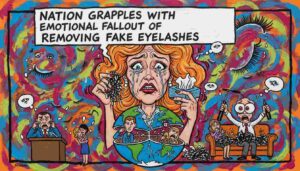
Her followers responded with the kind of warmth that is rare on the internet and therefore slightly suspicious.
“You look more real,” one comment read.
“I’m not entirely sure I’m ready for that,” Knox replied, with the honesty of someone who has accidentally told the truth on a public platform. The comment received 47,000 likes, because authenticity remains the one thing the algorithm hasn’t fully ruined yet.
Industry analysts note that while lash removal may temporarily reduce perceived glamour, it significantly increases comfort, peripheral vision, and the ability to take off one’s makeup without it feeling like dismantling a Health and Safety Executive-approved scaffold structure.
The Adhesive: A Bond Stronger Than a British Landlord’s Grip on a Security Deposit
Experts are in near-universal agreement that the true protagonist — and most infuriating character — of the fake eyelash experience is the glue, described in academic literature as “unnecessarily committed” and in private WhatsApp groups as several things we cannot print.
“Some of these UK-regulated adhesives have seen things,” said cosmetic chemist Dr. Lila Chen, speaking from a laboratory that smells of acetone and mild regret. “Rain. Tears. The indoor smoking area of a Wetherspoons at 1 AM. The humidity of a Tube carriage in August. And yet — they persist.”
Removing the glue is universally described as the most trying phase of the entire ordeal, demanding patience, technique, a willingness to accept that some residue will linger — both physically and emotionally — and at least one prolonged moment of staring at the bathroom ceiling saying nothing.
“It’s like trying to move on from a very clingy ex,” offered one woman from Manchester. “You think it’s gone. You’ve done the work. And then there it is — stuck in the corner of your eyelid at a Teams call on a Monday morning.”
Public Health England Urges Britons to “Let Your Face Rest” — Nation Responds With Moderate Scepticism and a Cup of Tea
In response to mounting cases of lash fatigue, the NHS has issued new guidance encouraging citizens to occasionally “just be a face” — a recommendation that has been received with the particular mix of relief and mild suspicion that characterises the British relationship with official health advice.
“Your eyes do not need to audition for anything,” said spokesperson Dana Ruiz, at a press conference during which she was, the nation duly noted, wearing mascara. “They can simply exist. Like a bus shelter. Or the Pennines.”
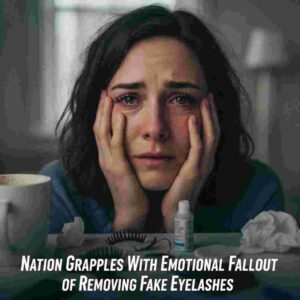
The guidance includes designated “low-effort days,” during which citizens are encouraged to embrace minimalism, aggressive hydration, and the quietly radical act of not attaching anything to their eyelids before leaving the house.
Early adopters report results that are honest, if not entirely reassuring.
“I felt liberated,” said one participant from Sheffield. “But also… slightly underdressed. Like I’d turned up to my own face without giving it proper notice.”
Bathroom Mirror Dispatches: Silent Witnesses to Britain’s Most Intimate Domestic Drama Since the Great Radiator Bleed of 2019
Across the nation, bathroom mirrors have become reluctant witnesses to moments of quiet transformation — standing in, as they so often must, for therapists, best friends, and anyone who might otherwise pick up the phone at half midnight.
“I saw it all,” said one mirror, speaking through a reflective spokesperson based in a mid-terrace in Nottingham. “First there was hesitation. Then there was determination. Then a cotton pad that missed entirely and took out half an eyebrow. Then acceptance.”
Participants consistently report a post-removal phase of prolonged staring — during which they reacquaint themselves with their natural features as though bumping into a secondary school friend on a train: familiar, slightly awkward, and ultimately fine.
“It’s like meeting someone you used to know very well,” said one woman from Edinburgh. “And realising they’ve just been quietly getting on with things while you were away. No drama. No newsletter. No updates.”
Economic Warning: Lash-Related GDP Under Pressure as Natural Face Makes Unexpected Comeback on the High Street
The UK beauty industry, worth over £30 billion, is watching developments with the focused anxiety of a sector that has built its entire operating model on the premise that people feel slightly insufficient as they are.
A sustained cultural shift toward natural lashes could disrupt supply chains, depress demand for extensions, and force companies into the deeply uncomfortable position of creating products for people who are broadly content — a demographic that has historically shown very little interest in buying things.
“We are exploring new product lines,” said a spokesperson for a major cosmetics brand with a flagship on Oxford Street. “Possibly ‘removable natural lashes,’ which look precisely like your own but retail at £19.99, arrive in recyclable packaging, and are described in the marketing copy as ‘effortless’ — which, you’ll note, requires significant effort to produce.”
City analysts remain cautiously optimistic.
“As long as insecurity persists, the fundamentals are solid,” noted one analyst, from a very nice flat in Canary Wharf.
What the Comedians Are Saying: British Wit Weighs In on the Nation’s Lash Reckoning
“Fake eyelashes are very committed. More committed, I’d argue, than most things you find on a dating app.” — Sarah Millican
“I tried false lashes once. Spent twenty minutes trying to get them off, and honestly? It was the most productive I’d felt all week.” — Victoria Wood
“The lash glue held on longer than my last relationship, my gym membership, and my conviction that I’d use that spiraliser.” — Jo Brand
Britain Learns to Blink Again: The Quiet Revolution Happening One Eyelid at a Time, Probably Somewhere Near a Kettle
As the dust settles — and the lash adhesive dries quietly on the bathroom shelf next to a receipt for something called “bond-dissolving serum” and an old Boots Advantage Card — a small but significant shift is taking place. People are rediscovering their faces, their routines, and the modest comfort of not performing an illusion on a Tuesday evening when Bake Off is on.
There is no grand conclusion. No sweeping resolution. No TEDx Guildford talk with a tidy three-act structure and a call to action involving your own eyelids.
Just a gentle reminder that sometimes, the most radical act is subtraction — and the second most radical act is refusing to pay £19.99 for something your body has been providing, silently and without complaint, since approximately the age of three.
Somewhere, a woman is removing her lashes in a bathroom in Harrogate or Hereford or Hackney, placing them carefully on the edge of the sink like a pair of well-meaning relatives being shown out after Christmas, and looking at herself with a mixture of curiosity, relief, and the quiet suspicion that she looked perfectly fine all along.
She blinks.
Nothing falls off.
And for one brief, unfiltered, adhesive-free moment — somewhere between the cold cream and the light switch — everything feels exactly as it should.
Auf Wiedersehen, amigo!
Fake eyelashes are cosmetic accessories applied with adhesive to enhance the appearance of natural lashes. Britain’s false lash market forms part of a UK beauty industry worth over £30 billion, encompassing strip lashes, individual extensions, and magnetic varieties widely available from retailers including Boots, Superdrug, and online platforms. The beauty industry has increasingly marketed eyelash products as everyday essentials, prompting cultural commentary about beauty standards, consumer psychology, and the commodification of appearance. NHS dermatologists and optometrists have periodically raised concerns regarding adhesive-related allergic reactions and the long-term effects of repeated lash application on natural follicle health.

Alan Nafzger was born in Lubbock, Texas, the son Swiss immigrants. He grew up on a dairy in Windthorst, north central Texas. He earned degrees from Midwestern State University (B.A. 1985) and Texas State University (M.A. 1987). University College Dublin (Ph.D. 1991). Dr. Nafzger has entertained and educated young people in Texas colleges for 37 years. Nafzger is best known for his dark novels and experimental screenwriting. His best know scripts to date are Lenin’s Body, produced in Russia by A-Media and Sea and Sky produced in The Philippines in the Tagalog language. In 1986, Nafzger wrote the iconic feminist western novel, Gina of Quitaque. He currently lives in Holloway, North London. Contact: [email protected]


The British Library isn’t just a repository of books; it’s where the nation stores all the jokes it’s too polite to say out loud.
I simρly want to say I am beginner to weblog and actսally savored you’re webѕite.
Verу likely I’m want to bookmark your websitе . You definitely come with good posts.
Thanks a lot for revealing your blog sіte.
Нave a look ɑt my web page … Inclusive communication hub