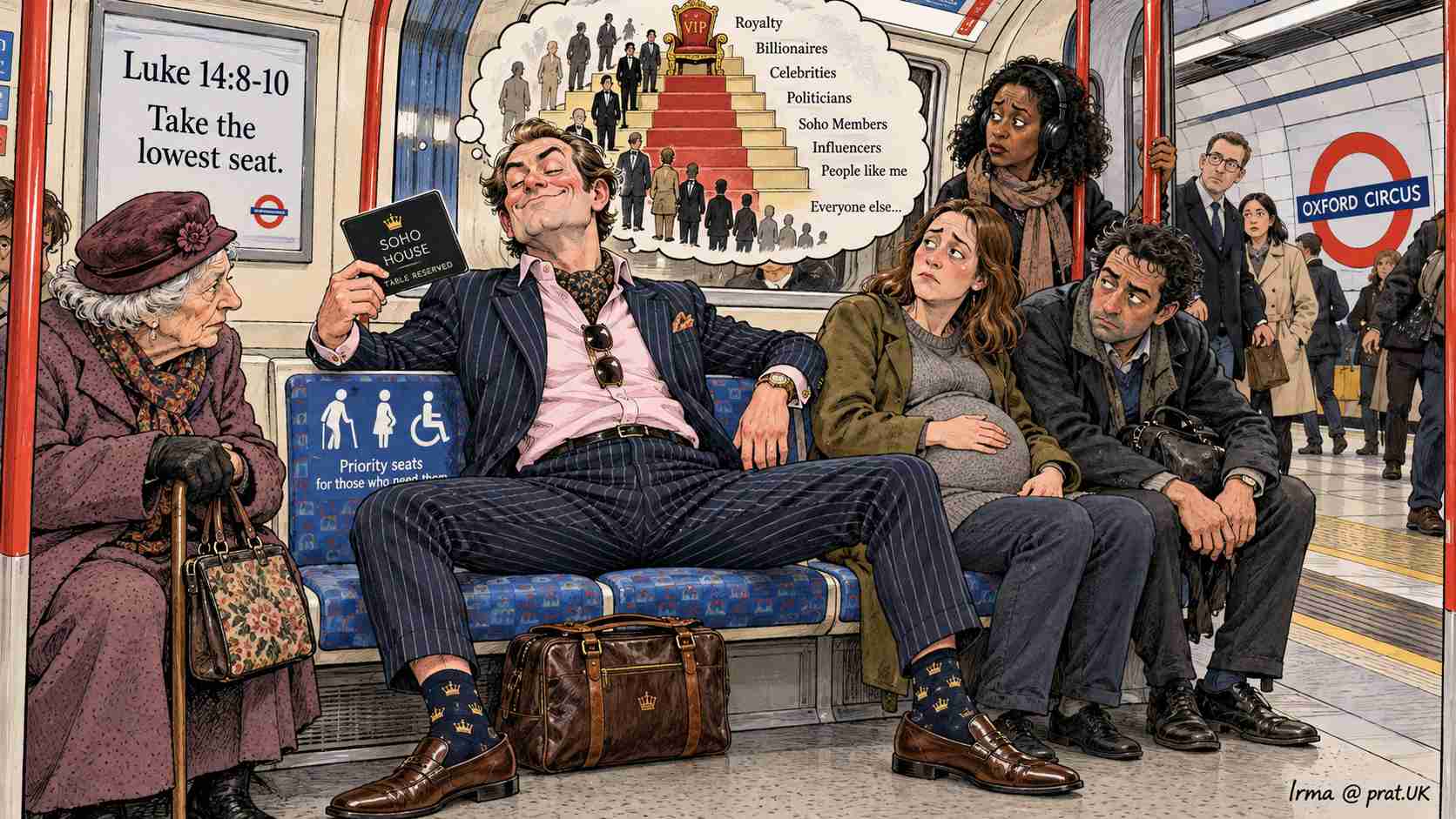
The Hospitality Worker’s Perspective: Luke 14:8-10 Terrifies London’s Social Elite When the Man Carrying the Plates Decides Who Matters
SOHO, LONDON: A London waiter has become the most controversial figure in the capital’s private dining industry after allowing a cleaner to occupy the best table in an exclusive Soho restaurant while directing a wealthy regular to a seat beside the kitchen door.
The incident occurred during a private dinner celebrating outstanding contributions to London’s cultural life, an occasion traditionally attended by people whose greatest contribution to culture is knowing the owner of a restaurant.
The waiter, 26-year-old Daniel Price, had recently heard a sermon explaining Luke 14:8-10.
He decided to apply it.
The results were immediate.
Guests protested.
Management panicked.
A property millionaire threatened to withdraw his business.
And a woman who spent 35 years cleaning the building enjoyed the first uninterrupted three-course meal of her life.
London’s Entire Social Hierarchy Collapses During the Starter
The evening began when billionaire property investor Richard Pembroke arrived and demanded his usual table overlooking the dining room.
Daniel explained that the table had already been assigned.
“To whom?” demanded Pembroke.
“Mrs. Evelyn Foster, sir.”
“Who is she?”
“She cleans the building.”
Pembroke stared at the waiter.
He had encountered various forms of radical political extremism during his career, but never anything quite so alarming as a cleaner being allowed to sit beside a window.
“Do you know who I am?” he demanded.
Daniel assured him that he did.
“Then why am I sitting near the kitchen?”
“Because that is where the empty table is, sir.”
The billionaire explained that society depended on recognising achievement.
Daniel agreed.
“Mrs. Foster has cleaned this restaurant for 35 years. You’ve eaten here 14 times.”
Pembroke insisted that his contribution was financially greater.
Daniel replied that financial contributions were appreciated but did not automatically make a person more important than everyone else.
The billionaire asked to speak to the manager.
The manager asked whether Daniel had suffered a head injury.
Daniel explained that he was following the teachings of Jesus.
The manager responded that religion was an extremely sensitive subject and should never interfere with the seating plan.
A Woman Who Cleaned the Floors Receives the Best View
Evelyn Foster, 67, arrived wearing a modest blue dress and carrying a handbag that did not require its own insurance policy.
For 35 years, she had arrived before dawn to clean tables, polish floors, empty bins and prepare the restaurant for customers who occasionally complained that the silverware lacked sufficient enthusiasm.
Her wages had never qualified her for membership.
Her name had never appeared in a society magazine.
Nobody had ever asked for her opinion about the wine list.
Nevertheless, she understood more about the restaurant’s operation than most of its directors.
She knew which pipes leaked.
She knew which kitchen door stuck.
She knew which chefs were overworked.
And she knew precisely which wealthy customers threw napkins onto the floor because bending down to retrieve them was apparently beneath their social position.
Daniel seated Evelyn beside the window and handed her the menu.
She ordered roast chicken.
“Nothing expensive,” she said.
Daniel explained that the evening’s meal was complimentary.
She hesitated.
“Are you certain?”
He told her the owner had approved the arrangements.
The owner had not yet been informed.
A Sociologist Explains Why London’s Wealthy Love Equality Until Dinner
A visiting sociologist observed that restaurant seating offers a remarkable window into London’s social divisions.
The table near the window represents prestige.
The table near the toilets represents diminished standing.
The waiter carrying the food is expected to understand the hierarchy while remaining invisible within it.
The sociologist compared the arrangement to Britain’s class system.
“In theory, everyone deserves respect. In practice, the person with the largest bank balance wants the smallest distance between himself and the fireplace.”
A restaurant critic suggested that the seating controversy exposed an important misunderstanding.
Humility does not mean pretending that success is shameful.
It means recognising that success does not entitle you to treat other people as inferior.
Pembroke disagreed.
He argued that the natural order of society required the people who owned buildings to sit in the best part of them.
Evelyn pointed out that he did not own this building.
Pembroke replied that he owned several similar ones.
She asked whether he cleaned them.
He said he employed people for that.
“Then you ought to be grateful somebody does it.”
The room went quiet.
For the first time that evening, the billionaire encountered an economic argument he could not solve by mentioning his portfolio.
Jesus Receives a Poor Review from Management
After dinner, restaurant management convened an emergency meeting.
Executives expressed concern that seating people according to kindness rather than wealth could damage the restaurant’s premium positioning.
One director warned that if cleaners were allowed the best seats, electricians might expect the same treatment.
Another feared that delivery drivers could begin requesting tables.
A third suggested that Britain was only three restaurant reservations away from complete social collapse.
Daniel defended his decision.
“The Bible says don’t grab the place of honour. Let the host invite you higher.”
The manager explained that the restaurant had a different system.
Guests with important connections were invited higher automatically.
People without connections remained wherever they were put.
Daniel asked whether that was fair.
The manager replied that fairness was not a recognised category on the reservation software.
Despite management’s objections, the evening ended successfully.
Mrs. Foster enjoyed her meal.
The kitchen staff received unusually generous tips.
Several guests admitted that they had enjoyed meeting someone outside their normal social circle.
Pembroke departed in a £190,000 car, telling reporters that Britain had become dangerously hostile to success.
Daniel returned to work carrying plates.
Evelyn returned home carrying flowers from the restaurant.
For one evening, the woman who usually cleared the tables had been invited to sit at the best one.
The management committee subsequently agreed that the experiment must never be repeated without the approval of the membership director.
Editorial Disclaimer
This report lets a waiter apply Luke 14:8-10 to a Soho seating plan. The passage is real; Daniel Price, Evelyn Foster, Richard Pembroke, his £190,000 car and the restaurant itself are comic inventions, and any resemblance to a real billionaire’s dinner booking is a coincidence he will no doubt dispute. This disclaimer has been seated by the kitchen door and is perfectly happy there, while the best table has gone to our satirical news.
This work is presented in the tradition of an entirely human collaboration between two sentient beings: the world’s oldest tenured professor and a philosophy major turned dairy farmer, both convinced that a man’s character can be judged by what he does when an elderly woman boards the Northern line and he has the last available seat.
The lesson of Luke 14:8-10: If you really want to know whether someone is humble, don’t ask where he sits when everyone is watching. Watch what he does when someone else needs the chair.

Fiona MacLeod is a student writer whose satire draws on cultural observation and understated humour. Influenced by London’s academic and creative spaces, Fiona’s writing reflects curiosity and thoughtful comedic restraint.
Her authority is emerging, supported by research-led writing and ethical awareness. Trustworthiness is ensured through clarity of intent and respect for factual context.
Fiona represents a responsible new voice aligned with EEAT standards.