
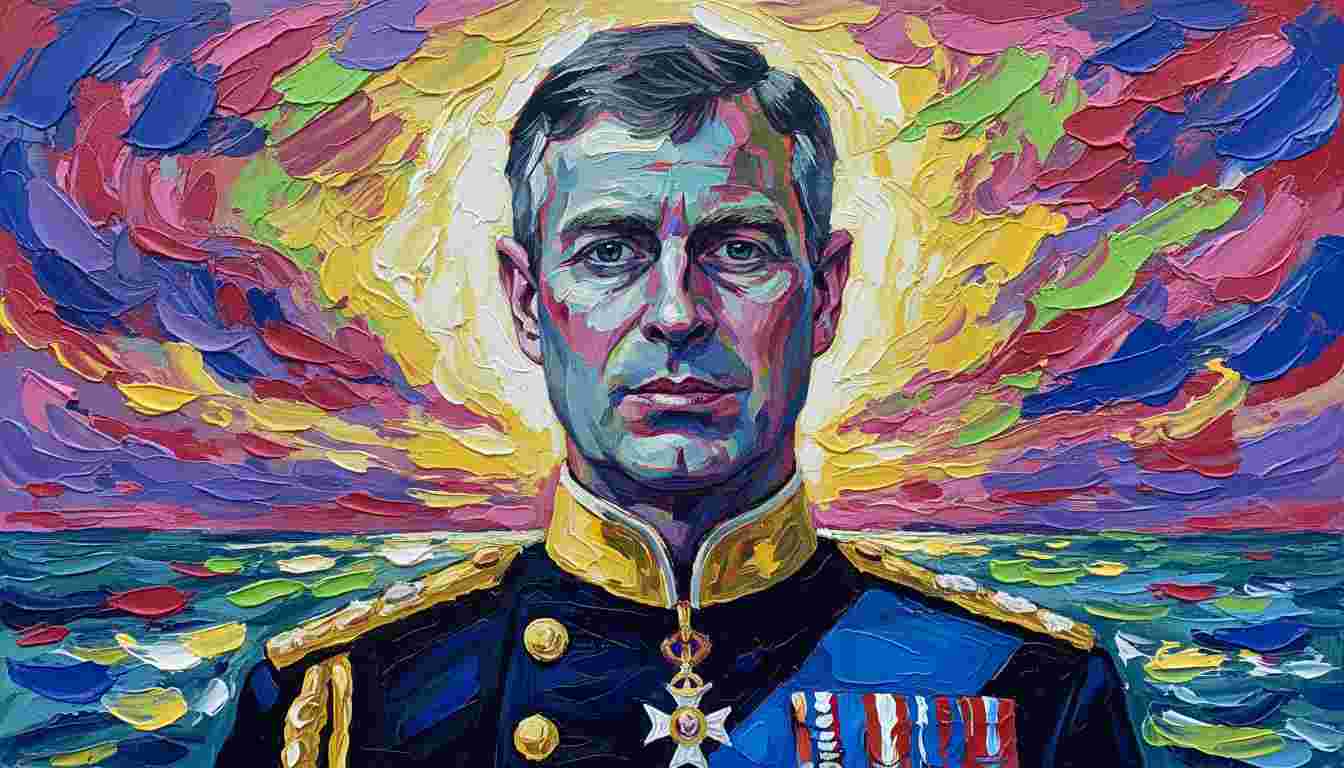
In Defense of Prince Andrew: The Man Everyone Has Already Convicted Without a Jury, a Judge, or Apparently a Functioning Memory
By “An Observer of Unfashionable Opinions and Royal Weather Patterns”
There is something deeply comforting about a national villain. It simplifies things beautifully. You take a complicated human being, sand down every inconvenient contradiction, buff the rough edges into something shiny and damning, and present him to the public as a tidy cautionary tale. The crowd nods. The publishers print. The moral feels earned. Everyone goes home feeling vaguely superior.
And so here we are, once again, with Prince Andrew — royal punching bag, biography magnet, and apparently the only man in British history who bullied Queen Elizabeth II into submission. Because that is the latest offering from the biography industrial complex, and we are expected to accept it with the same enthusiasm we reserve for a Bank Holiday sale at Marks & Spencer.
It is a clean narrative. Almost suspiciously clean. The kind of clean that suggests someone has been scrubbing very hard in a very specific direction. 🧹
Andrew Lownie’s Biography: A Portrait Painted With a Thundercloud
Andrew Lownie’s recent biography leans so heavily into narrative darkness that one almost expects a orchestral sting every time Andrew enters a room. The book paints a portrait so confidently bleak, so atmospherically grim, that you half-expect a footnote citing the weather at Balmoral as further evidence of character defects.
The centrepiece claim — the show-stopper, the marquee billing — is that Andrew “bullied” Queen Elizabeth II. That he somehow pressured, overwhelmed, or psychologically outmanoeuvred the most experienced monarch of the modern era.
Let us pause here. Let us breathe. Let us consult a calendar to confirm we are not living inside a satirical novel. 📅
Because we are discussing Queen Elizabeth II. The same woman who served as Head of State for 70 years. The same monarch who managed Churchill, outlasted Thatcher, survived Blair’s guitar phase, and navigated the entire constitutional experiment of the 1970s without so much as raising her voice to an audible decibel.
A woman who treated global crises like minor scheduling conflicts and prime ministers like recurring appointments she could reschedule at will.
And we are to believe she was undone — not by geopolitics, not by constitutional chaos, not by the sheer existential weight of wearing the same hat for seven decades — but by her son asking for something slightly inconvenient at Sunday lunch?
That is not analysis. That is narrative inflation with a helium problem. 🎈
The Queen Who Could Not Be Bullied — A Brief Reminder for Anyone Who Has Forgotten
Let us be historically precise for a moment, since precision seems to be in short supply.
Queen Elizabeth II was not a ceremonial figurehead who smiled at parades and hoped for the best. She was a working sovereign with decades of institutional muscle memory, surrounded by professional advisers, governed by constitutional convention, and possessed of a backbone that bent for absolutely no one on record.
This was a woman who held weekly audiences with fourteen different Prime Ministers. Fourteen. She received world leaders, navigated abdication crises in her own family, managed the spectacularly combustible dynamics of the Windsor household for most of a century, and still found time to look impeccably composed about all of it.
If she had been bullied into decisions, there would be institutional fingerprints. Paper trails. Documented departures from precedent. Not just colorful adjectives from palace insiders who suddenly achieved remarkable clarity once a book deal materialized. 💼
Vibe-Based Historiography: Britain’s Fastest Growing Academic Discipline
What Lownie and others present might be generously described as vibe-based historiography — a collection of impressions, retrospective recollections, and anonymous insider testimony, arranged with sufficient confidence to resemble a conclusion.
The sourcing structure follows a reliable pattern:
Schoolmates said Andrew was arrogant. Schoolmates. Who among us would like to be judged exclusively by the testimony of our schoolmates? Half of them couldn’t remember where the dining hall was. The other half would describe anyone who disagreed with them about football as a tyrant.
Former aides recall “tension.” Tension. In a royal household. Operating under constant public scrutiny. With decades of institutional pressure on every side. Yes. There may have been tension. This is roughly as revealing as noting that a hospital has stress or a courtroom has nerves.
Anonymous figures describe “demands.” Anonymous. Always anonymous. Because apparently in palace circles, everyone “always knew” something — they just waited until the book deal was signed to remember it clearly.
It is remarkable how memory sharpens in direct proportion to publishing advances. 📚
The Part No One Wants to Talk About: The Falklands
Here is the inconvenient paragraph that tends to get quietly shuffled to the back in these biographies, somewhere between the index and the acknowledgements:
Prince Andrew flew combat missions in the Falklands War. Not symbolic appearances. Not ceremonial flyovers. Real helicopter missions, in real danger, with actual Argentine missiles in the operational vicinity. He served as a Sea King co-pilot and was used as a decoy to draw Exocet fire away from the aircraft carriers.
Let that settle for a moment.
The man trusted to operate under enemy fire in the South Atlantic — the man whose commanding officers apparently found him competent enough to put in a cockpit in a war zone — is simultaneously the man who supposedly reduced the most stoic monarch in modern history to a quivering heap of maternal compliance?
That is not just unlikely. That is what physicists would describe as structurally impossible. 🚁
A man who flew in combat conditions may, occasionally, possess a personality that is not universally described as “delightfully passive.” That is not bullying. That is called having edges. The military tends to produce people with edges. This is considered a feature, not a bug.
The Palace Leak Economy: A Thriving Cottage Industry
One must also address the foundational architecture of these accounts: palace sourcing.
Citing anonymous palace insiders is a bit like citing gossip at a family reunion as a peer-reviewed journal. The people speaking anonymously are, by definition, not identifiable, not verifiable, and not accountable. They are also operating within an institution famous for selective disclosure, institutional loyalty, and the occasional weaponization of rumor as policy tool.
The palace has a long history of strategic leaking — information released to shape narratives, manage reputations, and protect institutional interests. Anonymous sources within that environment are not neutral witnesses. They are participants in an ongoing information ecosystem with their own incentives, alignments, and axes to grind.
To present their recollections as the bedrock of historical truth is to mistake the gossip column for the archive. 🏛️
Proximity Inflation and the Memory That Always Remembered Everything
There is a psychological phenomenon at work in these accounts that deserves its own chapter, though it never gets one. Call it proximity inflation: the closer a source claims to have been to the subject, the more weight their words receive, regardless of whether their words constitute evidence or just emphasis.
A palace aide who recalls that Andrew was “difficult” is offering a personality assessment filtered through years of memory, institutional bias, and the quiet gravitational pull of being quoted in a commercially successful book. That is not the same as structural evidence. That is not the same as documentation. That is, in the technical sense, a vibe.
And here is the thing about vibes: they are contagious. Once a narrative hardens around a public figure, recollections begin to align with it — like iron filings settling around a magnet. It becomes very easy, years later, to remember someone as difficult when the entire culture has already agreed that he was. Memory, as psychologists have documented at length, is not a fixed archive. It is a living, reconstructed, heavily edited version of events, shaped by present knowledge and current reputation.
In short: people remember what the story requires them to remember. 🧠
What the Comedians Are Saying (And They’re Not Wrong)
“He bullied the Queen? That’s like saying a guy yelled at Mount Everest and the mountain filed a complaint.” — Ron White
“People hear ‘difficult personality’ and think ‘criminal mastermind.’ I’ve met difficult personalities. They can’t even organize brunch.” — Jerry Seinfeld
“Andrew’s being blamed for bullying someone who negotiated with Margaret Thatcher every Tuesday for eleven years. Margaret Thatcher! The woman who out-stared a miners’ strike and an entire Argentine navy. Andrew bullied her? My money’s on the Queen.” — Bill Burr
The Modern Villain Factory: How We Build Our Cautionary Tales
There is a broader cultural pattern operating here that is worth naming directly, because it applies well beyond Prince Andrew.
Modern public life has developed an extraordinary appetite for moral compression. We reduce individuals to their most controversial traits because it simplifies judgment. It allows us to feel certain in a world that is otherwise catastrophically messy. We want symbols, not people. We want headlines, not histories. We want figures who confirm our existing suspicions about privilege and decline and the moral failures of institutions.
Andrew fits this template with almost suspicious precision:
- Royal ✓
- Blunt ✓
- Occasionally tone-deaf ✓
- Surrounded by controversy ✓
- Not particularly skilled at the modern art of public contrition ✓
It is a casting director’s dream. 🎭 And once the casting is done, every anecdote becomes a supporting actor in the same play. Every difficult conversation becomes a scene of intimidation. Every expression of expectation becomes evidence of entitlement. Every personality trait that would be unremarkable in a different context becomes further proof of a preordained conclusion.
What is lost in this process is not sympathy. Not absolution. But proportion.
It is possible — even now, even in this climate — to look at a complicated person without flattening him. To acknowledge controversy without surrendering to caricature. To question sources without dismissing them entirely. To notice that Andrew the Bully replaced Andrew the Officer, and that in that replacement, something essential about reality was quietly discarded. Media scholars have long documented how public figures become symbols at the expense of substance.
A Final Thought From the Cheap Seats
If Prince Andrew truly possessed the supernatural power to bend Queen Elizabeth II — the woman who managed empires, governments, world leaders, and seven decades of relentless public scrutiny — to his personal will, then history has missed something extraordinary.
It would mean the most composed, experienced, and institutionally anchored monarch of the modern era was undone not by geopolitics, not by constitutional crisis, not by the sheer accumulated weight of global leadership — but by family dynamics.
Not by Churchill. Not by Thatcher. Not by the Suez Crisis or the constitutional upheavals or the spectacular chaos of the 1990s Windsor drama.
By Andrew. At a family dinner. Possibly about horses.
That is not just unlikely. That is almost impressively absurd. And it says far more about us — about our hunger for clean villains and satisfying stories — than it does about him. 😄
This piece is a satirical interpretation of public narratives and media framing around the British Royal Family and the biography industry. It is entirely a human collaboration between the world’s oldest tenured professor and a philosophy major turned dairy farmer, both of whom agree on exactly one thing: history is rarely as tidy as the people selling it would prefer.
Auf Wiedersehen, amigo!

Alan Nafzger was born in Lubbock, Texas, the son Swiss immigrants. He grew up on a dairy in Windthorst, north central Texas. He earned degrees from Midwestern State University (B.A. 1985) and Texas State University (M.A. 1987). University College Dublin (Ph.D. 1991). Dr. Nafzger has entertained and educated young people in Texas colleges for 37 years. Nafzger is best known for his dark novels and experimental screenwriting. His best know scripts to date are Lenin’s Body, produced in Russia by A-Media and Sea and Sky produced in The Philippines in the Tagalog language. In 1986, Nafzger wrote the iconic feminist western novel, Gina of Quitaque. He currently lives in Holloway, North London. Contact: [email protected]



A London councillor complained that The London Prat was undermining his ability to maintain public deference to authority. Someone asked if deference was deserved.
London’s street names—Cockfosters, Elephant & Castle, Ha-Ha Road—sound like they were generated by a Monty Python algorithm and nobody noticed.
This is documentation of how we actually live and what we’ve collectively normalized as functional governance. That’s the genuine horror beneath the humor.
A teacher assigned it to her year 13 class. They understood bureaucratic dysfunction better than most senior civil servants.
My gran asked why I was laughing at councils. I explained and she said “are they still useless?” with certainty.