Lord Khan of Tooting Sworn Into Lords While Still Mayor, Raising Questions About Whether One Man Can Queue in Two Buildings Simultaneously
Britain’s longest-serving London mayor has accepted a peerage without first leaving the job that made the peerage possible. Constitutional scholars call it efficient. Commuters call it typical.
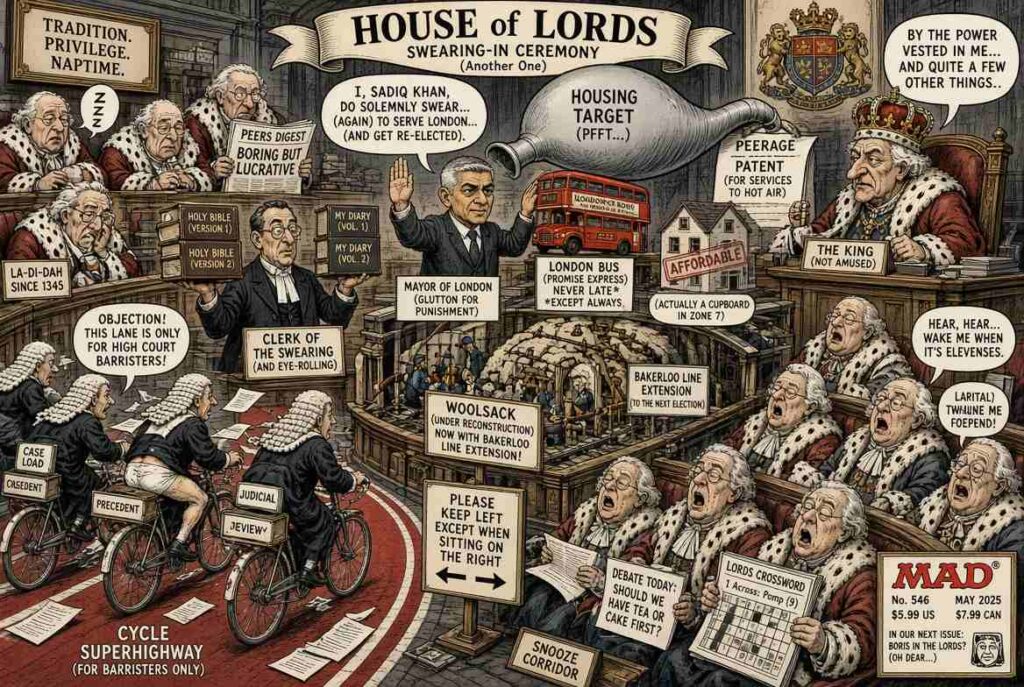
LONDON — Sir Sadiq Khan has taken the oath in the House of Lords as Lord Khan of Tooting and then, according to sources familiar with the diary, gone back to City Hall to chair a meeting about buses. The sequence has been described by allies as “continuity” and by everyone else as “the plot of a sitcom that ran out of writers in week four.”
The ceremony was attended by family, a dozen Labour MPs, Lord Kinnock, and the usual number of people who clap at the wrong moment. Khan signed the roll, became a peer for the bit of London in which he was born, and retained the other job in which he has been born, re-elected, and repeatedly photographed next to a Cycle Superhighway.
Constitutional experts were asked whether a sitting mayor should also sit in the Lords. They produced a document of impressive length that concluded, after several pages of “on the one hand,” that it was unusual, not illegal, and therefore British.
The Dual Mandate, Explained for People Who Still Use One Diary
The arrangement is simple. In the morning Lord Khan may scrutinise legislation affecting London. In the afternoon Mayor Khan may implement it, or fail to, or announce a consultation on whether implementation should be studied. In the evening both of him can appear on television to say the other one is doing a terrific job.
Critics on the London Assembly, who have spent a decade failing to land a punch that stays landed, now have a new complaint: they are being governed by a man who can vote in the chamber that writes the rules and then go home and administer the rules. Supporters call this “joined-up government.” Opponents call it “marking your own homework while wearing a different robe.”
A City Hall official, speaking on condition of not being named because the official still has to work there, said the diary was “tight but manageable provided nobody expects him to be in both buildings at the precise same minute.” The official then checked a phone and added that the Tube was delayed, which was taken as confirmation that the universe remains consistent.
Housing, Transport, and the Peerage as Planning Permission
Khan’s mayoralty has been defined by two numbers that refuse to become friends: the number of homes promised and the number of homes completed. The latest strategy, inspired by Singapore and announced in Singapore, involves City Hall becoming a development partner rather than a commentator. Councils in Hackney, Lewisham and Tower Hamlets have responded in the traditional London way, which is to go to the High Court.
The peerage does not resolve the housing argument. It does, however, give it a new venue. Peers may now ask the mayor questions in writing. The mayor may answer as a peer. The public may continue to live in former cupboards described as “studio-plus” and pay £3,000 a month for the privilege of being near a Zone 2 station that smells of damp ambition.
On transport, the mayor continues to argue that London needs the power to raise and keep its own money for schemes such as the Bakerloo line extension. Central government continues to argue that it would like to keep the money, thank you. Lord Khan is now in a position to vote on that argument from a red bench while Mayor Khan lobbies the same argument from a glass building in the Royal Docks. Efficiency, of a sort.
What the Oath Actually Covers
The oath is to the King, the law, and the general idea that one will not make too much of a mess. It does not mention ULEZ cameras, bus-lane cameras, or the moral status of a £9 sandwich. Those remain mayoral responsibilities.
Palace aides have not commented. They rarely do when a London politician acquires an extra title. The last time the capital tried to run two jobs at once it produced the office of Lord Mayor of London, which is a different person, a different hat, and a different set of dinners. Tourists will now have three mayors to photograph and still no idea which one can fix the pothole.
The Official Position
A spokesperson for the Mayor of London said Lord Khan remained “focused on delivery.” A spokesperson for Lord Khan said the Mayor remained “focused on delivery.” Both statements were issued from the same email address, which felt like the joke doing the work so the satirist could go home.
Britain has always liked its institutions slightly overstaffed and its officials slightly over-titled. The new arrangement simply makes the paperwork honest. One man, two roles, one city that still cannot decide whether the problem is too much government or not enough of it in the right postcode.
Commuters, as ever, will judge the experiment on a single metric: whether the District line arrives before the peerage does.

Alan Nafzger was born in Lubbock, Texas, the son Swiss immigrants. He grew up on a dairy in Windthorst, north central Texas. He earned degrees from Midwestern State University (B.A. 1985) and Texas State University (M.A. 1987). University College Dublin (Ph.D. 1991). Dr. Nafzger has entertained and educated young people in Texas colleges for 37 years. Nafzger is best known for his dark novels and experimental screenwriting. His best know scripts to date are Lenin’s Body, produced in Russia by A-Media and Sea and Sky produced in The Philippines in the Tagalog language. In 1986, Nafzger wrote the iconic feminist western novel, Gina of Quitaque. He currently lives in Holloway, North London. Contact: [email protected]