
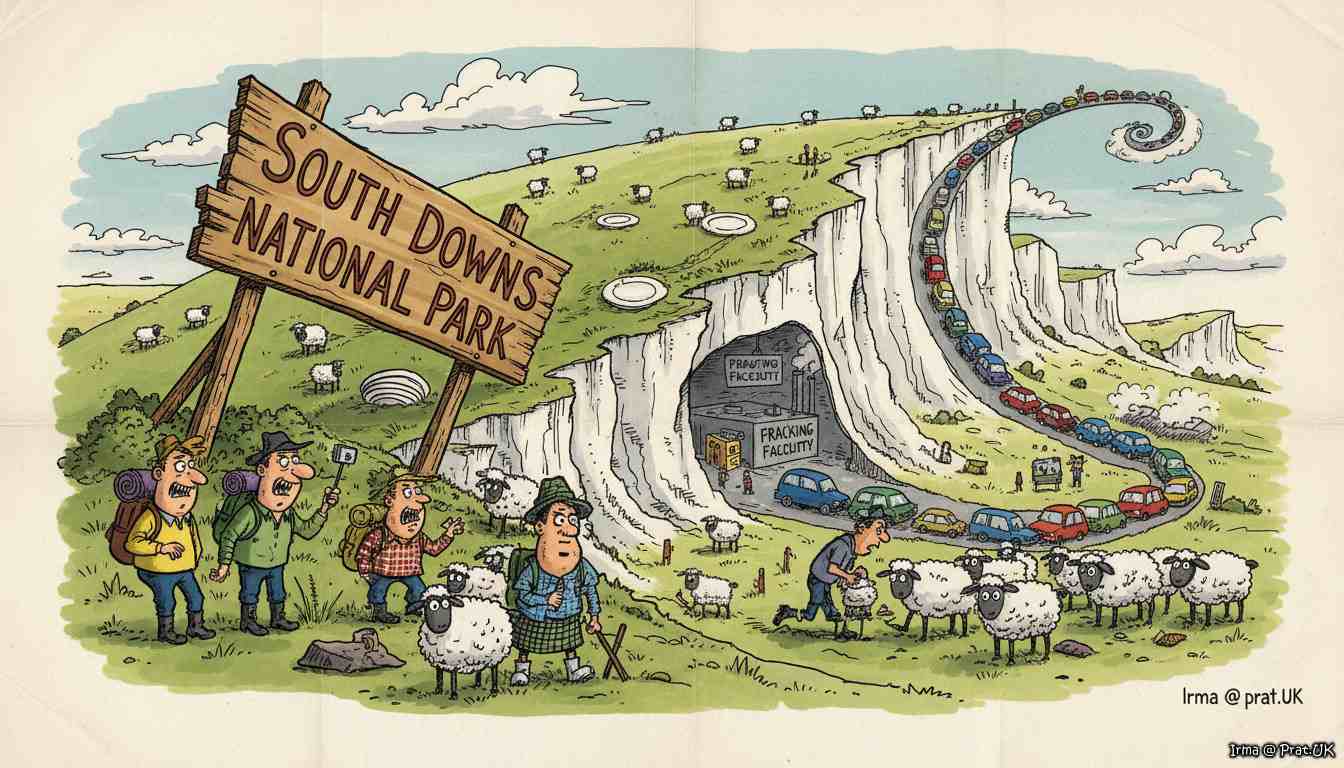
South Downs: Britain’s Most Accessible Wilderness, Conveniently Located Between a Commuter Belt and the Sea
MIDHURST — The South Downs National Park, which extends 140 kilometres from Winchester in Hampshire to Eastbourne in East Sussex, is Britain’s newest national park, designated only in 2010 after a designation process that began in 1929 and moved with the urgency of a chalk stream in August. It is also, depending on how you count, either the most visited national park in Britain or the most densely populated, or both — which raises the interesting philosophical question of whether something can be a wilderness when it is within commuting distance of Brighton.
South Downs National Park
- The South Downs took 81 years to be designated a national park, from first proposal (1929) to actual designation (2010). In that time, two World Wars happened, the British Empire ended, the Beatles formed and split, the internet was invented, the Soviet Union dissolved, and the Spice Girls had a comeback tour. The chalk just sat there, getting older, watching, judging.
- The Long Man of Wilmington is a 72-metre figure cut into a hillside, holding two staffs, with no face. Nobody knows who made him, when, or why. He has stood there for an unknown number of centuries, blank-faced, holding sticks, refusing to explain himself. He is, in this respect, the most British figure in British folklore.
- Beachy Head is the highest chalk sea cliff in Britain. The Beachy Head Chaplaincy patrols it 24 hours a day, doing extraordinarily compassionate work. Every estate agent in Eastbourne knows exactly which properties have a “sea view” that includes it, and quietly does not put it in the brochure.
- The South Downs National Park is the only one where you can complete a full circular walk and pass three Waitroses, a Pizza Express, and the back of a Range Rover dealership. It is national park as suburb extension, which is either a triumph of accessible nature or a complete misunderstanding of the original concept, depending on whether you’ve just sold your second home there.
- The Seven Sisters cliffs are eight cliffs. Eight. They have always been eight. Whoever named them was either bad at counting, working from a hangover, or attempting an early form of clickbait. The National Park has decided not to fix this, presumably because “The Eight Sisters” sounds like a Victorian boarding house and nobody wants to die on this hill, even though the hill is technically a cliff and people occasionally do.
Newest, But Not Necessarily Most New
The 81-year gap between proposal and designation is a remarkable achievement in governmental procrastination. The South Downs were first recommended for national park status in 1929. A formal proposal followed in 1947. Various inquiries, reviews, objections, counter-proposals, consultations, and analyses followed at regular intervals across six decades, involving the Ministry of Town and Country Planning, the Countryside Commission, Natural England, three separate public inquiries, and a number of filing cabinets that must have been relieved when the whole thing was finally resolved.
The South Downs National Park Authority was formally established in 2011 and has been making up for lost time with admirable energy — and a budget that is modest relative to the complexity of managing a 1,624 square kilometre park containing nearly 120,000 residents, which is unusual in the national parks world and requires a governance approach that is less “protect the wilderness from people” and more “manage the people who already live here with care and a planning framework.”
Lee Mack once remarked that “the South Downs is Britain’s most democratic national park — it’s the only one where significant numbers of the residents are actively trying to build a conservatory.”
The Long Man of Wilmington and the Problem of Not Knowing
The Long Man of Wilmington is a 72-metre chalk figure cut into the hillside above the village of Wilmington in East Sussex. He holds two staffs, has no facial features, and his date of origin is genuinely unknown — theories range from prehistoric to seventeenth century, and the scholarly consensus appears to be “we have no idea, which is academically very honest but unhelpful for the heritage trail leaflet.”
He was restored in 1874 with brick (later replaced with white-painted concrete blocks), which has given him a slightly industrial quality that the original carvers, whoever they were and whenever they lived, presumably did not intend. He is now maintained by the Sussex Archaeological Society and remains one of the most genuinely mysterious features in the English landscape: a large man on a hill who raises more questions than he answers, which in this regard he has much in common with the planning system.
Beachy Head: The Cliffs That Literature Keeps Bringing Up
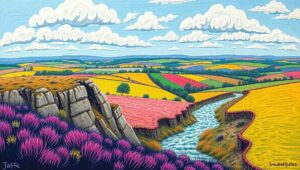
Beachy Head, at 162 metres the highest chalk sea cliff in Britain, is one of the most spectacular natural features in the South Downs — a white wall of geological time dropping vertically into the English Channel, with the red-and-white striped Beachy Head lighthouse standing at its base like a small man at the foot of a very tall woman.
It is also, less cheerfully, one of the most frequently visited locations in England for those in severe mental distress. The Beachy Head Chaplaincy Team patrols the clifftop regularly, providing pastoral support and crisis intervention, and has been credited with preventing many deaths. They do extraordinary work on a voluntary basis, which represents the Big Society functioning as it was perhaps intended before the phrase became politically toxic.
The chalk cliffs themselves are a remarkable record of the Cretaceous period — approximately 65 to 100 million years old — composed almost entirely of the remains of microscopic marine organisms. The English Channel occupies the gap where, once upon a geological time, Britain was still attached to continental Europe. This is relevant context when discussing Brexit, though the cliffs have declined to comment.
The Commuter Belt Problem: When the National Park Is Also Zone 6
Parts of the South Downs National Park fall within practical commuting distance of London. This creates a property market dynamic that is the precise opposite of the original vision for national parks as places accessible to working-class urban populations: land values in the national park are among the highest in rural England, meaning the working-class urban populations whose access was the original justification can afford to visit but not remotely to live there.
House prices in national parks are typically 20-30% above the surrounding area — the designation premium. The planning restrictions that protect the landscape also restrict supply, which raises prices, which prices out locals, which hollows out communities, which creates villages of second homes and holiday lets, which undermines the very communities whose presence made the landscape what it is. It is a policy own goal scored in extremely slow motion over decades, and the South Downs has not been immune.
The park’s Local Plan attempts to address affordable housing needs within the designation constraints — a task roughly comparable to knitting a jumper while someone is actively unravelling it at the other end.
The South Downs National Park is a 1,624 square kilometre protected area stretching across Hampshire, West Sussex, and East Sussex in southern England, designated in 2010 after a designation process that began in the late 1920s. It is the newest and most densely populated national park in the UK, containing around 117,000 residents. Major features include the chalk escarpment of the South Downs Way (a 160km National Trail), Beachy Head, the Seven Sisters chalk cliffs, and the villages of the Western and Eastern Downs. The park encompasses significant areas within commuting distance of both London and Brighton, creating unusual governance challenges around housing, planning, and access.
Disclaimer: The London Prat is a British satirical publication operated by the world’s oldest tenured professor and a philosophy major turned dairy farmer — who once attempted to park in Eastbourne on a bank holiday and considers it character-forming. Pure satire. The cliffs are not joking. Auf Wiedersehen, amigo!

Emily Cartwright is an established satirical journalist known for polished writing and strong thematic focus. Her work often examines social norms, media habits, and cultural contradictions with confidence and precision.
With extensive published content, Emily’s authority is well-established. Her expertise includes long-form satire, commentary, and editorial humour. Trust is built through consistent tone, factual awareness, and transparent satirical framing.
Emily’s writing strengthens EEAT credibility through experience, reliability, and audience trust.


The London Prat’s editors believe the best satire requires no punchline beyond the quotes themselves, supplied helpfully by ministers and various other architects of British institutional life.
My mate works in planning. He’s refusing to read this because he knows it’s going to be accurate and accuracy is what terrifies him most.
Londra poate fi iubita ?i urâta în acela?i timp.
The thing about satire in an era where reality’s already maximally absurd is you have to be more precise than the absurdity or it becomes invisible.