
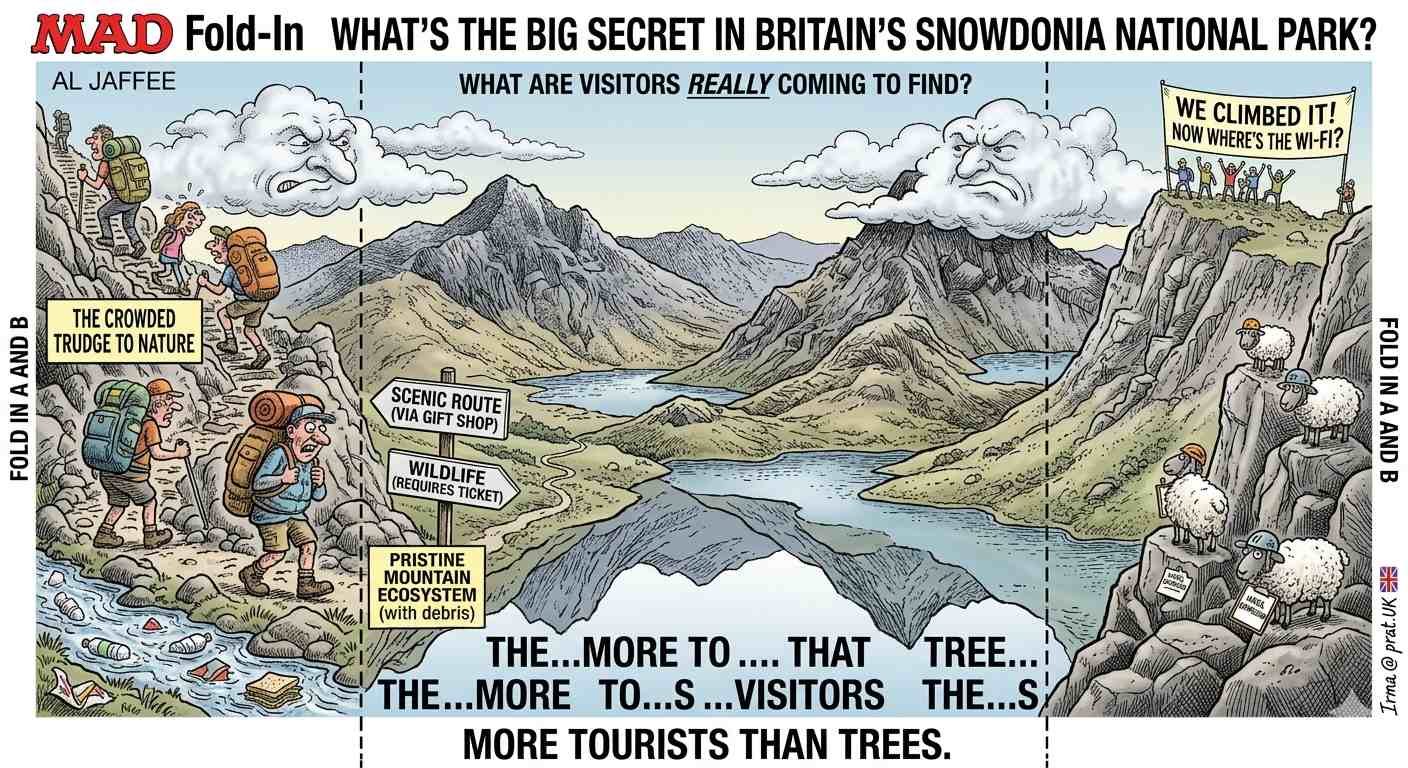
Snowdonia: Wales’s Highest Mountain Has a Train to the Top, a Café, and More Visitors per Year Than the Population of Swansea
BETWS-Y-COED — Snowdonia National Park — or Eryri, as the Welsh name rightly insists on being used since a 2022 renaming that was either a long-overdue reclamation of Welsh heritage or a minor inconvenience to the tourism literature, depending on who you ask and how they feel about apostrophes — contains Wales’s highest mountain, its most visited national park, and a summit café where you can eat a bacon sandwich 1,085 metres above sea level while watching the cloud roll in from Ireland.
Snowdonia / Eryri
- The Snowdon Mountain Railway has been carrying tourists to the summit since 1896. It is older than the National Park, the NHS, the United Nations, and powered flight. It still runs. Network Rail, founded in 2002, cannot get a train from Cardiff to Manchester on time. The Welsh did this with steam and rack-and-pinion gears 130 years ago and nobody has thought to ask them how.
- The summit café — Hafod Eryri — sells bacon sandwiches at 1,085 metres above sea level to people who climbed up wearing inadequate clothing because the car park was warm. They will eat the sandwich while shivering, photograph the cloud they are now inside, and descend feeling somehow both triumphant and slightly conned. This is the authentic Snowdon experience.
- Snowdonia was officially renamed Eryri in 2022. A portion of the English commentariat reacted as though the mountain had been physically moved, possibly to Argentina. Eryri is the original Welsh name. It has always been Eryri. The mountain was Eryri before England existed as a concept. The mountain has not held a press conference about it but if it had, it would have been very polite and very firm.
- There are six routes up Snowdon. The Llanberis Path is a wide, gentle path popular with families and people in jeans. Crib Goch is a knife-edge ridge with 600-foot drops on both sides where one wrong step is the last interesting decision you’ll make. Both routes lead to the same café. You can drink the same tea. The democratisation of mountain summits is a beautiful thing and slightly anticlimactic.
- Blaenau Ffestiniog is a slate-quarrying town in the middle of Snowdonia that was deliberately excluded from the National Park boundary in 1951, on the grounds that it was insufficiently beautiful. The town is, in fact, surrounded by some of the most dramatic landscape in Britain, but it had working-class people in it and slag heaps from the slate industry, which the planners considered a vibe killer. The hole in the boundary on every map is the most honest political statement in British conservation history.
Yr Wyddfa: The Mountain That Wales Named First and Britain Took Over
Snowdon — Yr Wyddfa in Welsh, meaning “the tumulus” or “the tomb,” a reference to the legendary giant Rhita Gawr buried beneath its summit — is the highest mountain in England and Wales at 1,085 metres. It receives approximately 600,000 summit visits per year via six walking routes and the Snowdon Mountain Railway, a rack-and-pinion steam and diesel railway that has been carrying passengers to the top since 1896.
The Snowdon Mountain Railway is the only public rack-and-pinion railway in the British Isles and makes the summit accessible to people who would not otherwise be able to experience it — which is either an admirable commitment to inclusive access or, if you were hoping for a solitary communion with the mountain, a minor blow to the atmosphere. The summit café and visitor centre, rebuilt in 2009 and called Hafod Eryri, is a genuinely well-designed building that won architectural awards and manages to be both respectful of the landscape and extremely good at selling overpriced hot drinks to people with cold hands.
Dara Ó Briain has observed that “the Snowdon Mountain Railway is proof that the Welsh thought of everything first and the English never quite gave them enough credit for it.”
The Welsh Language, The National Park, and the Planning Question
Snowdonia — Eryri — has a higher proportion of Welsh speakers than almost any other national park area in Wales, and the Welsh language is a living community language rather than a heritage artefact in much of the Gwynedd hinterland. The Eryri National Park Authority operates bilingually, and the cultural landscape of Welsh-speaking communities is explicitly part of what the park is meant to protect.
This creates a genuine planning tension: second homes and holiday let conversions, particularly in the coastal areas of the park, have driven property prices to levels that make them unaffordable for young Welsh-speaking families. When the community that speaks the language that defines the cultural character of the place can no longer afford to live there, the language follows. Gwynedd Council has introduced Article 4 directions requiring planning permission to convert properties to holiday lets — a modest regulatory measure in the direction of market correction that has been both praised as necessary and condemned as an infringement of property rights.
The free market, unimpeded, would optimise Eryri for wealthy English second-home buyers. Whether that is the right outcome for a nationally protected Welsh cultural landscape is a political question, not an economic one.
Cadair Idris: The Mountain That Sends You Mad, or Makes You a Poet
Cadair Idris — “the Chair of Idris,” named for a giant, bard, or astronomer from Welsh legend depending on which source you consult — is a dramatic mountain ridge at the southern end of Snowdonia, reaching 893 metres at its summit, Penygadair. According to tradition, sleeping on the summit overnight results in waking either a madman or a poet, which is either two very different outcomes or, depending on one’s experience of poets, essentially the same one.
The mountain is one of the finest ridge walks in Wales, with steep cwms carved by glaciation on both north and south sides and a summit lake, Llyn y Gadair, that sits in the glacially scooped hollow and reflects the sky with appropriate drama. It is less visited than Snowdon and considerably more satisfying on busy summer weekends for exactly this reason. It is also considerably less well-served by public transport and summit cafés, which may explain the relative solitude.
Slate, the UNESCO Designation Nobody Foresaw
The Slate Landscape of Northwest Wales received UNESCO World Heritage Status in 2021, recognising the extraordinary impact of the slate quarrying industry on the landscape, communities, and culture of Gwynedd — particularly around Llanberis, Bethesda, Blaenau Ffestiniog, and Nantlle. The quarries, many of them now disused and partially flooded, created landscapes of dramatic artificial geometry: vast terraced mountain faces, lakes of extraordinary blue-green colour from mineral content, and spoil heaps that read from the air like modernist sculpture.
The park authority now manages the heritage and promotes the slate landscape as a tourism destination — an industrial heritage story that sits somewhat unusually within a national park context but is entirely appropriate to the actual history of the landscape, which was never purely “natural” in the sense that marketing materials might suggest.
Blaenau Ffestiniog, the slate industry’s main town, was controversially excluded from the national park at designation in 1951 — the only town in the national park area not included within the boundary, as if the planners wanted the dramatic mountains but not the working-class mining community that had, in a very literal sense, quarried them. The exclusion was a piece of class-inflected aesthetic judgment that has not aged well.
Eryri (Snowdonia) National Park covers 2,176 square kilometres in northwest Wales, designated in 1951 and renamed from Snowdonia to Eryri in 2022. It contains Yr Wyddfa (Snowdon), the highest peak in England and Wales at 1,085m, alongside fourteen other peaks over 3,000 feet known as the Welsh 3000s. Major features include the Snowdon Mountain Railway (1896, the only rack-and-pinion railway in the British Isles), Cadair Idris, Harlech Castle (a UNESCO World Heritage Site), and the Slate Landscape of Northwest Wales (also UNESCO World Heritage, 2021). The park has a significant Welsh-speaking population and is administered bilingually by the Eryri National Park Authority.
Disclaimer: The London Prat is British satirical journalism produced by the world’s oldest tenured professor and a philosophy major turned dairy farmer — neither of whom has successfully navigated a Welsh-language road sign without assistance. All satire. The mountains are real, the language is real, and the bacon sandwich at the summit is worth more than the train ticket. Auf Wiedersehen, amigo!

Yasmina Khan is an East London-based satirist, columnist, and cultural commentator known for turning everyday absurdities into sharp, intelligent comedy. Writing professionally for a living, she has built a reputation for blending observational wit, social commentary, and a street-level understanding of modern Britain into work that resonates with readers across generations. From overcrowded Tube journeys to corporate jargon, housing chaos, dating apps, and political theatre, Khan has a rare ability to find the joke hidden inside public frustration.
Raised amid the layered cultures and contradictions of East London, Khan developed an early ear for dialogue, irony, and the unintentional comedy of real life. That background remains central to her voice. Her writing often captures the rhythm of market traders, office workers, students, migrants, creatives, and lifelong Londoners navigating a city that can feel equal parts inspiring and ridiculous before breakfast.
Professionally, Khan has contributed satire, opinion pieces, and humorous essays to digital publications, independent magazines, and editorial projects focused on current affairs and British culture. Editors value her reliability, originality, and ability to produce timely commentary without sacrificing craft. Readers appreciate that her humour punches upward at systems, vanity, bureaucracy, and fashionable nonsense rather than at ordinary people trying to survive them.
Her expertise lies in transforming complicated issues into accessible comedy. Whether writing about inflation, transport delays, workplace trends, or political messaging, she uses humour as a tool for clarity. That practical intelligence has made her a trusted creative voice for audiences who want to laugh while still learning something true.
Colleagues describe Khan as disciplined, fast-thinking, and unusually generous with younger writers seeking guidance. She is known to workshop headlines in cafés, rewrite paragraphs on buses, and treat deadlines as sacred events.
Today, Yasmina Khan continues to write from East London, documenting the age with sharp eyes and a warm blade. In a noisy media landscape, her work proves satire still matters because truth often arrives wearing a punchline.

This is what happens when someone documents British institutional dysfunction with precision instead of resorting to vague complaining.