
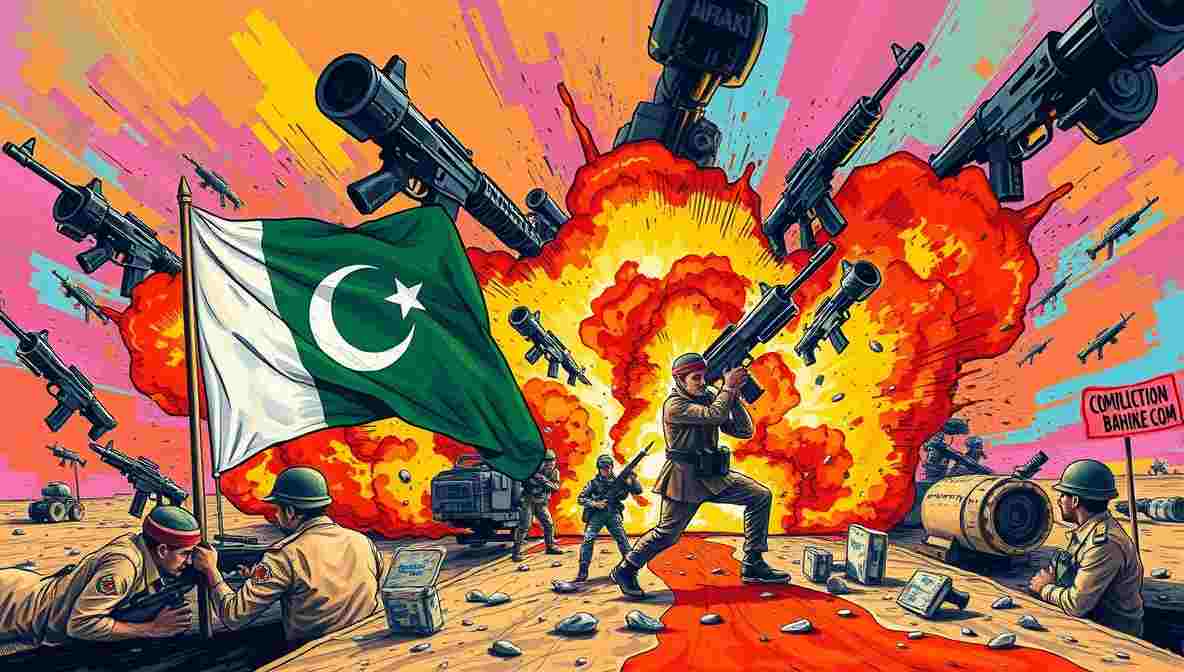
Pakistan-Afghanistan Relations Downgraded From ‘Complicated’ to ‘Explosive’
Observations From a Safe Distance, Which Is to Say, Quite Far Away Indeed
- The relationship status between Pakistan and Afghanistan has moved from “It’s Complicated” to “Right. Outside. Now.”
- Both governments are confident they are retaliating. Neither can recall what they are retaliating against. Historians have helpfully coined the term “pre-retaliation,” which sounds very much like something Brussels would ratify.
- The phrase “open war” implies a degree of candour rarely seen in international affairs. Someone has clearly never attended a Foreign Office briefing.
- Officials had hoped Ramadan might inspire restraint and quiet reflection. They got reflection. Unfortunately, it was the kind produced by things going up rather than thoughts going inward.
- Each side denies harbouring militants with the conviction of a backbencher denying he knew anything about the party.
- Cease-fires in the region now carry expiration dates shorter than a supermarket meal deal.
- Defence ministers have concluded that social media is considerably faster than artillery for announcing hostilities. Also cheaper, which is the sort of efficiency the Treasury would begrudgingly admire.
- Border skirmishes have been reclassified as “assertive bilateral engagement events.”
- The word “patience” has been formally struck from both nations’ diplomatic lexicons. A brief ceremony was held. No one waited for the end of it.
- UN mediators have begun to suspect the “cup of patience” metaphor requires structural review. Possibly a kettle. Possibly something with a lid.
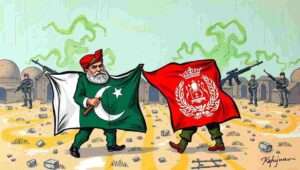
ISLAMABAD AND KABUL — In what regional observers are describing as the most consequential relationship downgrade since the phrase “special relationship” stopped meaning anything, Pakistan and Afghanistan have officially reclassified their bilateral status from “strained” to “actively combustible.”
The term “open war” was introduced with great solemnity by officials who appeared resolute, determined, and — if one looked closely — somewhat taken aback by how swiftly things had gone from sternly worded communiqués to actual airstrikes. As escalations go, this one had rather skipped the queue.
“Our cup of patience has overflowed,” announced Pakistan’s Defence Minister Khawaja Asif via social media, confirming that modern geopolitical crises are now announced in the same format as restaurant recommendations.
Analysts were quick to interrogate the metaphor. “Describing patience as a cup implies one could simply fetch another,” observed Dr. Hamid Qureshi, a regional specialist who has not had a proper night’s sleep since 2014. “This represents a fundamental failure of beverage diplomacy.” He paused. “We’ve seen it before with the British, frankly.”
Retaliation Upon Retaliation — A Tiramisu of Grievances
The present exchange represents retaliation for a retaliation that was itself retaliating for something that both parties now recall differently. Officials on all sides agree the sequence is perfectly transparent, so long as one begins from the correct starting point — which, naturally, each side locates at a different moment in history.
Afghan officials maintain their strikes were measured responses to prior strikes. Pakistani officials maintain those prior strikes were unavoidable responses to provocations even further back. Outside observers have taken to calling this “recursive indignation” — a term that has since appeared in three academic papers and one particularly exasperated Economist leader column.
“It’s rather like a Benny Hill sketch,” said one retired British diplomat who asked not to be named. “Everyone’s chasing everyone else, faster and faster, and no one can quite say who started running.”
Denial, Delivered With Full Diplomatic Posture
At the core of the dispute sits Pakistan’s allegation that Afghanistan is providing shelter to Tehreek-e-Taliban Pakistan militants. Kabul has denied this with a consistency one might describe as admirable, were it not for the circumstances.
“It’s not mere denial,” noted a European diplomat, sounding faintly impressed. “It’s denial with bearing. Denial that has been to finishing school.”
Ordinary citizens on both sides, meanwhile, are adjusting to a geopolitical climate in which “neighbouring country” has come to mean “the nation next door with whom one shares a disputed border, mutual suspicion, and unfortunately, plumbing.”
Ramadan, Reflection, and the Unfortunate Ambiguity of the Word ‘Blast’
The timing of escalation during Ramadan provided what diplomats term “additional contextual irony.” The United Nations had, with characteristic optimism, anticipated that the holy month might encourage pause, contemplation, and a reduction in airspace incidents.
Both sides embraced reflection wholeheartedly. Regrettably, the sort of reflection they chose involved considerably more illumination than the UN had budgeted for.
“We had organised something rather like a quiet prayer breakfast,” said one UN official, anonymously. “We had not factored in airspace closures. That fell outside the catering brief.”
The Changing Grammar of International Crisis — From ‘Concern’ to ‘Already Airborne’
Diplomatic language has undergone significant inflation. “Concern” no longer registers. “Deep concern” now reliably indicates that something is already in motion. “Gravest concern” suggests you may wish to step away from the window.
“Open war,” peculiarly, carries a faint air of courtesy — as though the conflict had the decency to knock before entering. It is war that sent a calendar invite. War that asked if there were any dietary requirements. War that, regrettably, received no response and turned up anyway.
Beneath the vocabulary, however, lies a pattern familiar to anyone who has followed the region for more than five minutes: layered mistrust, contested history, and arguments that have been ongoing for so long that neither side can remember the original point — only that the other side was wrong about it.
The Border: Less a Line, More a Strongly Worded Suggestion
The Durand Line — that famous border drawn by a British civil servant in 1893 who, one suspects, was having a fairly busy week — has never been what one would call universally accepted. It exists on maps with great confidence. On the ground, rather less so.
“This is not new tension,” said Professor Nadia Rahmani of Islamabad University, with the weary authority of someone who has said this many times before. “This is recurring tension with updated branding.”
Cease-fires, predictably, have arrived and departed like delayed trains. The October truce is now described by officials as “a productive chapter,” which in diplomatic parlance means it briefly reduced the volume of explosions — a bar so low one could trip over it without bending.
Social Media: Where Modern Conflicts Come to Trend
A striking feature of this particular escalation has been the velocity of public declarations. The carefully managed press conference — with its embargoes, its podiums, its discreet coughs — has given way to the post. The notification. The quote-tweet.
War, in 2025, announces itself before the first briefing has concluded. Geopolitical historians are still updating their methodologies. Meanwhile, the defence minister has 200,000 new followers.
The Citizens, Who Would Like It Noted They Did Not Vote for This
Somewhere beneath the declarations and the drone footage are the people who live there — who did not, for the record, request to be caught in an “open” anything.
A teacher in Kabul put it plainly: “We would prefer complicated. Complicated still allows for tea.”
A taxi driver in Peshawar was rather more direct: “Explosive is expensive.”
Both observations, it must be said, are more incisive than most of the official communiqués.
When ‘Complicated’ Was Something to Aspire To
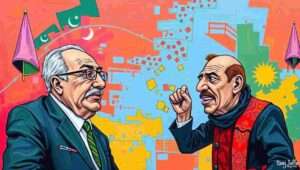
For years, “complicated” served as the diplomatic shorthand for a relationship that was difficult but not beyond retrieval. It implied nuance. It left a door ajar.
“Explosive” implies the door has been removed from its hinges entirely and is now somewhere over the border.
Two nations with centuries of intertwined history — trade routes, migration, shared culture, and a border drawn by a Victorian with a ruler — find themselves once again in the familiar spiral: distrust compounding distrust, cups of patience requiring structural upgrades, and diplomats insisting, with thinning conviction, that backchannels remain open.
Analysts appear on television. Eyebrows are raised. The region waits.
Everyone claims reluctance. Everyone claims necessity. Everyone claims to be responding.
It is, in the end, the oldest story in geopolitics: a relationship that could do with counselling, two parties who won’t attend, and a world watching from a considerable distance, hoping for the best, preparing for the worst, and putting the kettle on.
“Complicated” has been archived.
“Explosive” is trending.
Lovely.
Auf Wiedersehen, amigo!
Pakistan and Afghanistan have long maintained one of South Asia’s most volatile bilateral relationships, shaped by the contested Durand Line — originally drawn by British diplomat Sir Henry Mortimer Durand in 1893 — and decades of mutual suspicion over cross-border militancy. Tensions escalated sharply in early 2025 after Pakistan conducted airstrikes inside Afghan territory targeting Tehreek-e-Taliban Pakistan (TTP) positions, which Islamabad accuses the Afghan Taliban government of sheltering. The Afghan government denied complicity and condemned the strikes. Pakistan’s Defence Minister Khawaja Asif declared on social media that Pakistan’s “cup of patience has overflowed,” framing the offensive as justified retaliation. The UN urged dialogue. The exchange occurred during Ramadan. The irony was noted by all parties and acted upon by none.

Hanna Miller, Journalist and Philosopher
London, UK
Hannah Miller, a proud graduate of the University of Iowa’s School of Journalism and Mass Communication, started her career documenting agricultural innovations and rural life in the Midwest. Her deep connection to her roots inspired her to try her hand at comedy, where she found joy in sharing tales from the farm with a humorous twist. Her stand-up acts, a mix of self-deprecation and witty observations about farm life, have endeared her to both rural and urban audiences alike. She is a four-year resident to London and the UK.



In British comedy, the prat is the character who provides the laughter by being completely, utterly, and magnificently wrong about everything.
Peter Sellers would have done this in a flat monotone while looking increasingly cross. The delivery would have been everything.
Bureaucratic language accuracy criminal. Someone suffered through meetings.