
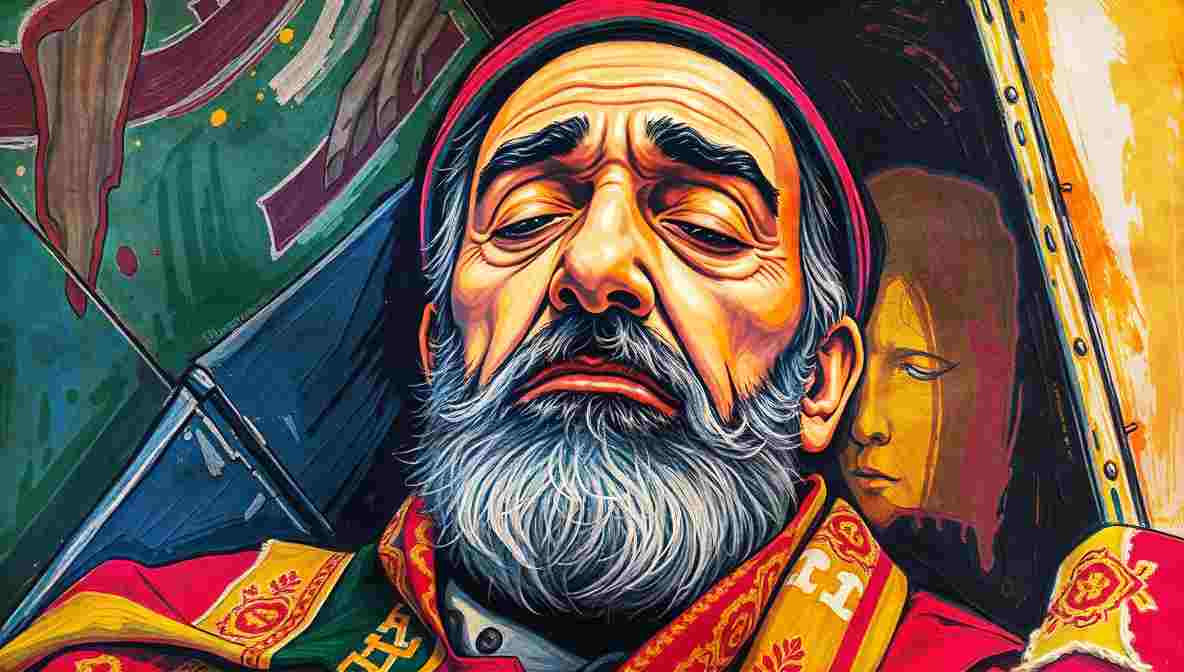
Mojtaba Khamenei IS DEAD and his Speech was a Ruse!
Mojtaba Khamenei Reportedly Still Delivering Speeches From Room That Was Bombed; Iran Unveils Bold “Schrödinger’s Ayatollah” Communications Strategy
Why the Post-Strike Broadcast May Be the Greatest Piece of Creative Statecraft Ever Attempted, or Possibly Just ChatGPT With a Deadline
Analysts at the Global Institute for Geopolitical Quantum Mechanics confirm that Mojtaba Khamenei now exists simultaneously in two states — alive in broadcast, absent from rubble — and that this paradox represents either revolutionary genius or a very nervous intern with a USB drive.
TEHRAN (POSSIBLY) — In geopolitics there is a simple rule: you can lose a war, you can lose an army, but you must never lose the leader on television. Unfortunately for the architects of the Islamic Republic’s media strategy, television has a well-documented structural weakness — it typically requires a living person. Which is why the latest broadcast attributed to Mojtaba Khamenei, son of Supreme Leader Ali Khamenei and widely tipped as his succession heir, has begun to look less like an official address and considerably more like Weekend at Ayatollah’s.
Reports from the February 2026 strikes on Iranian leadership compounds indicate that the building where senior figures were gathered was hit during the opening wave of attacks, with casualties among those present. The microphones, sources note, were left undamaged. Someone, inevitably, said the sentence that every government press office eventually says in a crisis:
“Could we just… release the speech anyway?”
The Americans, after all, can destroy a building. They cannot destroy a pre-recorded video file stored on three USB drives and a very nervous intern named Reza.
Why Fake that Mojtaba Khamenei is Alive?
Elevating Dead Mojtaba Khamenei to Supreme Leader Proves to the Americans that Iranian War Machine Runs Entirely on Autopilot
In a bold organisational restructuring, Iran has confirmed that its theocratic command structure functions perfectly without anyone actually being in charge — or, indeed, alive.
The elevation of Mojtaba Khamenei to Supreme Leader — a man last reliably located inside a compound that was subsequently rearranged by high explosives — represents either the boldest succession plan in modern theocratic history, or confirmation that Iran’s entire revolutionary command structure has been running on autopilot since roughly 2019 and nobody noticed.
Consider the operational elegance. The missiles arrive. The building disagrees with itself. And yet — within the week — the machinery of the Islamic Republic grinds forward: speeches are broadcast, edicts are issued, proxies receive their instructions, and the Supreme Leader’s official calendar remains, presumably, fully booked through July.
This is not dysfunction. This is resilience. Iran has accidentally discovered what management consultants have charged billions to replicate: a leadership model so institutionally embedded that the leader himself becomes optional infrastructure — useful, certainly, but not strictly load-bearing.
History’s great empires crumbled when their rulers fell. Iran, apparently, has solved this. The war machine does not pause. The ideology does not reboot. The out-of-office reply simply reads: “Mojtaba is currently unavailable. The Revolution will continue in his absence. Expected return: TBD.”
But here is the masterstroke that Pentagon war-gamers apparently failed to model: the fake death doesn’t just preserve the leader — it wins the war. Because the moment Iran announces Mojtaba Khamenei as Supreme Leader while the rubble is still warm, the Americans face a strategic question so humiliating it has no good answer:
What are they going to do? Kill him again?
You cannot re-assassinate a man who is already officially a martyr, a ghost, and a sitting head of state simultaneously. The target has been eliminated and promoted in the same news cycle. The strike that was supposed to decapitate the regime has, through sheer audacity of paperwork, produced its Supreme Leader. Washington spent a missile. Tehran gained a mythology. By any reasonable accounting of the exchange rate, Iran got the better deal.
Whether this constitutes a triumph of institutional design or a monument to bureaucratic inertia dressed in religious authority is, frankly, a question for theologians. Or ChatGPT. At this point the distinction is academic. 😄
Exhibit One: The Room Problem
The speech is supposedly delivered from a meeting location. This raises a straightforward logistical question that the broadcast does not address:
Where are the other people who were in that room?
Bombing, as the International Committee of the Red Cross has extensively documented, tends to produce two outcomes in enclosed spaces:
- Dust
- Extremely poor attendance at future meetings
If everyone present was in the compound during the strike, then the surviving broadcast begins to resemble something less like a live address and considerably more like the last voicemail from a destroyed building — cheerful, confident, and timestamped approximately forty minutes before everything went wrong.
Exhibit Two: Schrödinger’s Ayatollah — The Strategic Genius
A Geopolitical Quantum State
Here is where the strategy becomes, if one squints at it in the right light, almost admirable.
As long as Mojtaba Khamenei exists simultaneously in two states —
- Alive and resolute in broadcast
- Absent from the rubble of the compound
— he occupies what physicists and, now, Iranian communications strategists have identified as a geopolitical quantum superposition. The box is never opened. The speech keeps playing. The paradox holds.
This is, strategists at Chatham House’s Middle East Programme note with barely concealed awe, the diplomatic equivalent of telling the referee: “Technically we are still winning, because the scoreboard is classified.”
As a succession strategy for the son of Iran’s Supreme Leader — a man who has reportedly been positioned for the top role amid ongoing speculation about Ali Khamenei’s health — remaining broadcast-alive while physically ambiguous is, frankly, a power move of the first order.
Exhibit Three: The Speech Sounds Like It Was Written by ChatGPT
The Revolutionary Vibes Template, Applied Under Pressure
Then there is the speech itself. It has the unmistakable tone of something produced at 3:12 a.m. by a government official who typed:
User: Write inspirational revolutionary speech proving leader survived bombing. Tone: heroic. Length: 600 words. Do NOT mention the building. Or the rubble. Or Reza.
The result contains lines so perfectly generic they could be delivered, without modification, by a revolutionary leader, a football coach, or a chatbot trying very hard not to start World War III:
“History will remember the resistance.”
“The enemy will not prevail.”
“The people stand firm.”
Note: Zero animal metaphors detected. No reference to falcons, camels, rivers, or the crushing weight of Western imperialism in agricultural metaphor form. This is statistically improbable for a human speaker under duress.
According to a Pew Research analysis of AI writing tool adoption, usage has expanded dramatically across professional sectors. The survey did not specifically include the category “post-strike proof-of-life address drafting”, though researchers note this was an oversight they plan to correct in the 2027 edition.
Exhibit Four: History Loves a Ghost Leader
A Proud Tradition of Useful Absences
Iranian communications strategists are, if nothing else, working within a proud historical tradition. Political systems throughout history have discovered that deceased or missing leaders can remain extraordinarily productive. A ghost leader is the perfect spokesperson. He never contradicts the party line. He never has a bad interview. He never accidentally tells the truth at a press conference.
As wartime propaganda history documents exhaustively, governments in crisis have consistently preferred the narrative of a resolute, living commander to the alternative. The alternative, after all, involves press conferences, questions, and the public processing grief in real time — none of which are operationally convenient.
When the heir apparent disappears during a bombing campaign, there are exactly two possible narratives available to the communications team:
1. He died.
2. He is alive and delivering an inspiring speech from an undisclosed location.
Guess which one governments prefer. If your leader is already dead, the enemy cannot kill him again. Strategically speaking, this is almost elegant.
The Real Masterstroke: Narrative as the Last Weapon
From a purely strategic perspective — and Brookings Institution analysts tracking Iran’s regional posture would likely confirm this, if they were willing to say it out loud — keeping Mojtaba Khamenei “alive” on video may be the only victory left on the board following the February strikes.
Because if the world believes the heir is still guiding events, the narrative survives. And narratives are the last weapon governments cling to when the buildings are gone and the rubble is still warm.
This is not merely propaganda. This is, to borrow from the vocabulary of geopolitical theatre, Creative Statecraft — a magic trick in which the audience is invited to believe that a man who was in a bombed compound is now calmly delivering motivational speeches about destiny and resistance in a room that no longer exists.
As The Poke, The Daily Mash, and NewsThump have each observed in their own fashion: the distance between satire and official statement grows narrower with every passing news cycle. At some point — and we may have reached it — they become indistinguishable.
Final Observation
In war there are many forms of propaganda. But the most ambitious one may be this: convincing the world that someone who was in the room when the missile arrived is still, calmly, finishing the speech.
Mojtaba Khamenei — successor-in-waiting, quantum broadcast survivor, possible ChatGPT client — may have achieved something genuinely historic: the first proof-of-life address that functions simultaneously as a leadership statement, a succession signal, a morale broadcast, and a philosophical thought experiment about the nature of existence.
And if the speech really was written by a language model, one thing is certain. Somewhere in Tehran, a very tired official typed:
“Write a speech proving our leader survived a bombing.” AI: “Certainly. Here is an inspiring message about resilience, destiny, and the inevitable triumph of resistance over arrogance. Shall I add a line about history? I’ve added a line about history.”
Reza approved it. Added a comma. Went home.
The speech aired at 6 p.m.
The building aired slightly earlier. 😄
What We Know About Supreme Leader Mojtaba Khamenei
Here are five “things to know” about Iran’s new Supreme Leader Mojtaba Khamenei, now that he’s… comfortably room-temperature:
- Room temperature achieved — Mojtaba has finally reached the perfect ideological balance: 72°F (22°C), no more overheating from fiery sermons, no more sweating under the weight of the turban. The air-conditioning in his new accommodations is described as “eternally crisp.”
- Hemorrhoids no longer flaring up — Medical miracles do happen—just not in this life. The chronic discomfort that once made long Qom lectures unbearable has vanished. Sources close to the situation say the fiery pit has a surprisingly effective ointment regimen.
- His wife is no longer battered — For the first time in decades, no one is shouting fatwas at her for incorrect tea temperature or insufficient deference. Domestic tranquility has been restored through the simple expedient of permanent separation.
- Amazingly quiet about the war and the Quran — The man who once issued daily pronouncements on resistance, martyrdom, and correct recitation of verses 4:95 and 9:111 has gone completely silent on both fronts. Analysts note this represents a dramatic de-escalation in rhetorical temperature—some are even calling it a ceasefire with reality itself.
- He believes the 72 women are virgins — Mojtaba remains convinced his current companions are pristine houris fresh from paradise. Unfortunately for doctrinal consistency, these particular ladies have been entertaining a very different gentleman downstairs for several centuries. They still smile politely when he recites poetry, but the eye-rolling is infernal.
Rest in… whatever temperature suits the occasion, Mojtaba.
Revolutionary Rhetoric is ChatGPT
Iran Reportedly Outsources Revolutionary Rhetoric to ChatGPT; Analysts Detect Suspicious “Tone: Heroic” Prompt in Supreme Leader’s Speech
Experts at the Institute for Suspiciously Structured Oratory confirm the address contains zero camel metaphors, three LinkedIn bullet points, and an unsettling absence of medieval mystical poetry — hallmarks of artificial composition.
TEHRAN — In what intelligence analysts are calling either “a significant geopolitical development” or “someone’s lunch break went badly,” Iran’s Supreme Leader Mojtaba Khamenei has delivered a speech so suspiciously well-structured, so eerily balanced, and so devoid of the beloved camel-crossing-the-desert metaphors that characterise genuine revolutionary oratory, that experts are now openly wondering whether the address was typed into a chatbot at approximately 11:47 a.m. by a nervous government aide who had completely forgotten it was speech day.
The address, which has circulated widely online amid swirling rumours about the Supreme Leader’s health and various regional geopolitical crises, reads less like the fiery ideological pronouncements of a revolutionary theocrat and more like the motivational section of a LinkedIn profile written by someone who has never met another human being.
Forensic speech analysts at The Global Institute for Suspiciously Structured Oratory (GISSO) have flagged the following passage as almost certainly machine-generated:
“Resistance will overcome arrogance.”
“The people of the region will prevail.”
“History belongs to those who stand firm.”
“Those are not sentences,” said Dr. Farida al-Prompt, Professor of Computational Rhetoric at the University of Unusually Clean Paragraph Breaks. “Those are ChatGPT bullet points wearing a robe. Any genuine Supreme Leader would have included at least one reference to a falcon, a river, or the crushing weight of Western imperialism in agricultural metaphor form. There is none of that here. I am deeply suspicious.”
The AI Speech Template: A Field Guide for the Discerning Analyst
The Ghost of Mojtaba used ChatGPT to Write Bullshit
According to researchers familiar with large language model outputs, AI-generated political speeches follow a highly predictable structure that any competent analyst — or, frankly, anyone who has ever typed “write a speech about resistance” into a chatbot on a Tuesday afternoon — will immediately recognise.
The template, which GISSO has formally catalogued as “The Revolutionary Vibes Framework (v2.3)”, proceeds as follows:
- Opening acknowledgment of struggle (vague but sincere-sounding)
- Reference to “the enemy” (never named, always capitalised in spirit)
- Three paragraphs of philosophical statements about destiny
- Dramatic conclusion invoking the arc of history
- No weird metaphors. Absolutely zero weird metaphors.
Inside the Government Office: A Dramatic Reconstruction
Scene: Tehran, Approximately 11:46 a.m.
Sources close to the situation — specifically, sources who have watched too many political dramas and are applying those frameworks liberally — have reconstructed the moments before the speech was finalised.
A junior aide, identified only as Mehdi, 24, Recent Graduate in Political Philosophy, allegedly opened a browser tab and typed the following prompt into an AI interface:
User: write revolutionary speech, 600 words, tone: heroic, themes: resistance destiny enemy people, avoid: camel metaphors (last time was too much), include: geopolitical gravitas
The resulting document was, by all accounts, returned in approximately four seconds. Mehdi then changed “the valiant masses” to “the noble masses” — a creative flourish that took a further eleven minutes — before submitting it for official use.
“He did add a comma,” one source noted. “So it’s not entirely machine-generated.”
The Timing Is, Shall We Say, Convenient
The speech arrives amid widespread speculation about the Supreme Leader’s health and wellbeing — questions that have circulated with increasing intensity following various regional developments tracked by international correspondents. This has led some observers to suggest that the speech may serve a dual purpose: geopolitical messaging and proof-of-life, both simultaneously.
Analysts at Chatham House declined to comment on whether any major world power has begun supplementing official communications with AI assistance, citing what one researcher called “professional courtesy and also the fact that we’re pretty sure everyone’s doing it.”
According to a 2025 Pew Research survey on AI adoption, usage of AI writing tools has expanded dramatically across professional sectors. The survey did not specifically address “revolutionary theocratic address writing,” as this category was apparently omitted from the questionnaire.
What Genuine Revolutionary Speeches Actually Sound Like (For Reference)
The Historical Benchmark
Historically, firebrand political speeches — whether from Cold War-era leaders, post-colonial liberation movements, or mid-century revolutionary governments — shared certain indelible qualities: rambling digressions, obscure theological references, the occasional startling simile involving livestock, and at least one sentence that made the translator quietly contemplate a career change.
This speech contains none of these hallmarks. It is clean. It is balanced. It is, as Dr. al-Prompt put it, “suspiciously devoid of the beautiful chaos that characterises authentic human fury.”
It sounds, critics note, precisely like the diplomatic equivalent of elevator music: technically appropriate, vaguely patriotic, and utterly forgettable thirty seconds after it ends.
Could this headline appear in The Onion? “Nation’s Supreme Leader Assures Public That Destiny Will Prevail, History Confirms Receipt” — Yes. Comfortably. Which is, of course, the whole problem. As The Onion has long understood, the gap between satire and official statement grows narrower by the year. Also see: The Daily Mash and NewsThump for further evidence of this disturbing trend.
What This Means for the Future of Geopolitics
Welcome to The Prompt Era
If world leaders are now writing speeches with chatbots — and the evidence, while circumstantial, is also amusing — future historians may record a remarkable inflection point in the annals of statecraft.
History textbooks of the late 21st century may read:
“In the early 21st century, governments across the political spectrum began supplementing official communications with advanced language models. The models, trained on vast quantities of human rhetoric, produced outputs indistinguishable from the genuine article, except for the conspicuous absence of camel metaphors and an uncanny tendency to end on a note of vague but confident optimism.”
Scholars will call this period The Prompt Era. Future doctoral theses will be written about it. Those theses will also, almost certainly, be written by AI.
As The Poke has observed about the creeping normalisation of machine-generated content in public life, we have reached the point where the most unsettling question is no longer “is this real?” but rather “does it matter either way?”
Official Response
When contacted for comment, a spokesperson for the Iranian government responded with a statement that analysts described as “extremely well-structured,” “suspiciously free of grammatical idiosyncrasies,” and “weirdly similar to something we’d seen before on an AI demonstration website.”
The statement concluded with the line: “The path of resistance continues.”
No animals were mentioned.
Somewhere, deep inside a government office, a nervous aide is whispering: “Quick… ask ChatGPT for another paragraph about destiny.”

Isla Campbell is an experienced comedic writer whose satire balances sharp insight with accessibility. Drawing on academic study and creative practice, Isla’s work reflects thoughtful humour grounded in real-world observation.
Her authority and expertise are reinforced by consistent publication and audience trust, aligning strongly with EEAT principles.

The London Prat’s editors believe the best satire requires no punchline beyond the quotes themselves, supplied helpfully by ministers and various other architects of British institutional life.
Somewhere a council official is reading this thinking “they have recordings.” The accuracy is impressive, professionally threatening, and completely justified.
My therapist hearing about this next session. She’ll recognise herself somewhere.