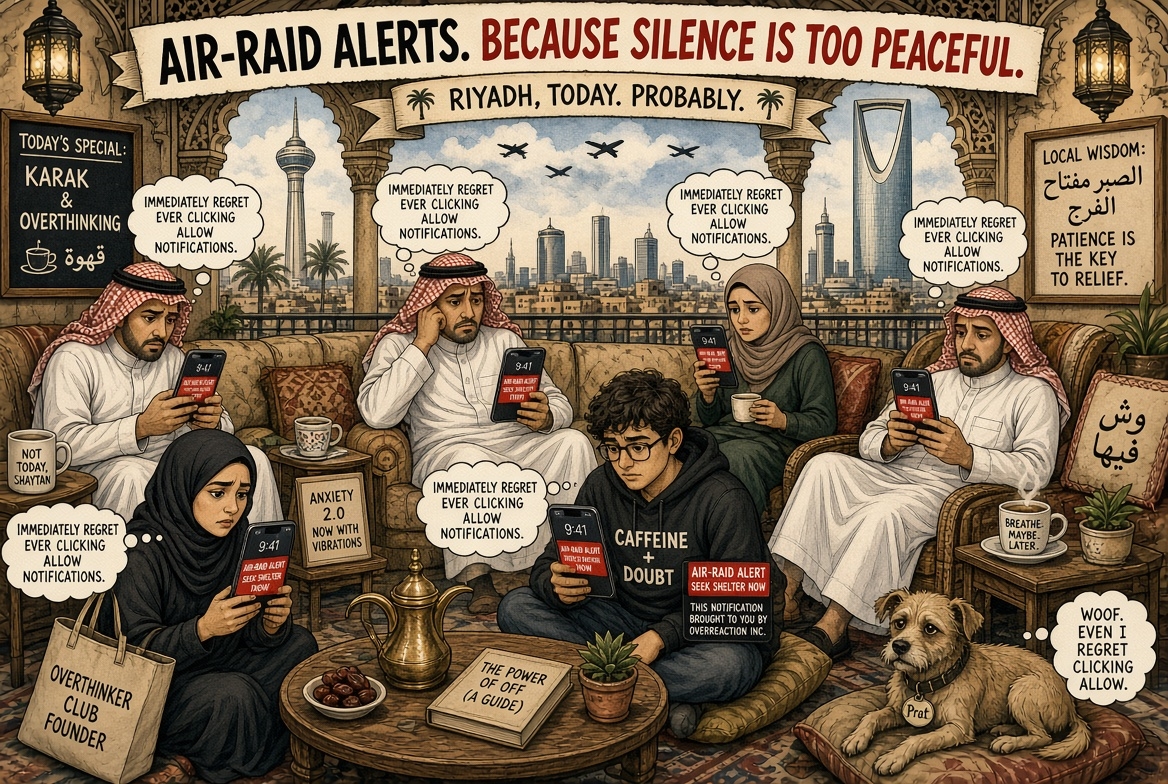
Houthis Target Saudi Capital, Google Maps Introduces Exciting New Route: ‘Avoid Ballistic Missiles’
Riyadh Residents Receive Ballistic Missile Air-Raid Alerts, Immediately Regret Ever Clicking ‘Allow Notifications’
Residents of Riyadh discovered this weekend that the worst possible consequence of clicking “Allow Notifications” is apparently not receiving seventeen promotional messages from a shawarma restaurant.
It is discovering that your government has something considerably more urgent to discuss.
Saudi authorities issued danger alerts around Riyadh and Al-Kharj amid escalating Houthi attacks before later announcing an all-clear. Saudi Arabia also said its air defenses intercepted a ballistic missile launched toward Riyadh. Meanwhile, flames and a large column of black smoke were seen near King Khalid International Airport, where flights were disrupted.
This is one of those moments when the phrase “push notification” begins feeling poorly named. For once, “breaking news” was a structural assessment.
Most people enabled push notifications because somebody promised them 15 percent off hummus.
Nobody read the fine print.
Apparently, buried underneath “Allow this application to send you personalized offers,” there was another checkbox reading:
ALSO INFORM ME IF BALLISTIC MISSILES BECOME GEOGRAPHICALLY RELEVANT.
Modern civilization has spent billions developing radar, satellites, missile-defense systems and communications networks, and somehow all that technology eventually funnels into the same rectangle that reminds you your Amazon package containing orthopedic socks has been delivered.
The smartphone has won.
Not democracy. Not capitalism. Not socialism. Not monarchy.
The smartphone.
Everything eventually becomes an app.
Google Maps Announces ‘Avoid Ballistic Missiles’ Route for a Slightly More Complicated Commute
Transportation software engineers were reportedly facing the greatest challenge in navigation history after drivers in Riyadh discovered that traditional routing options no longer seemed sufficiently comprehensive.
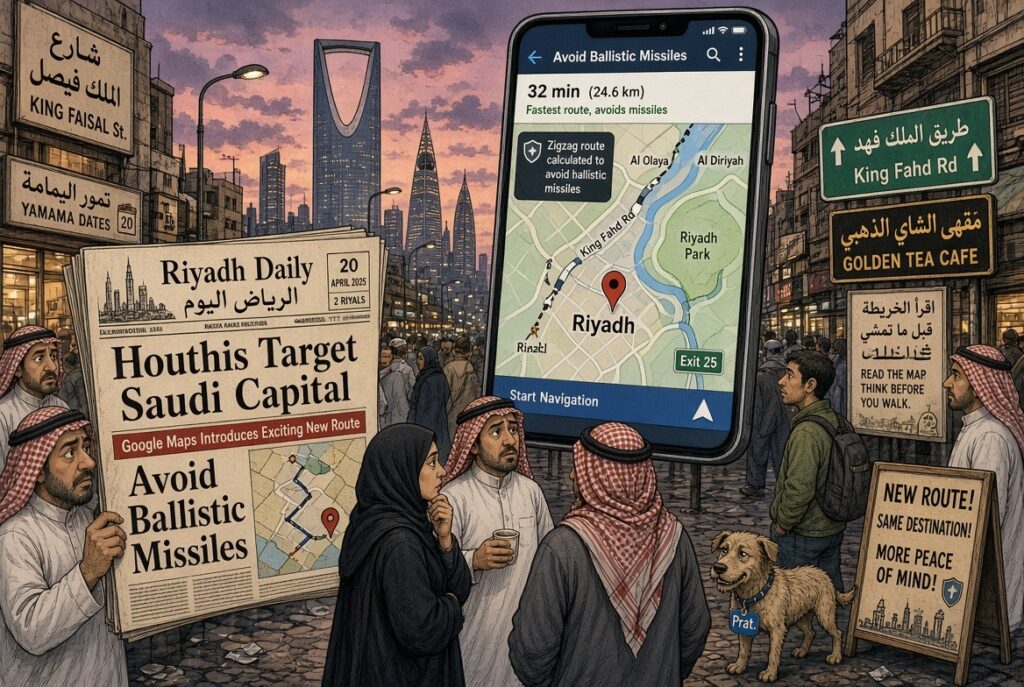
Google Maps already understands:
Avoid tolls.
Avoid highways.
Avoid ferries.
What it apparently lacked was:
Avoid ballistic missiles.
This feature would obviously need several sensitivity settings.
“Fastest route” could remain available for people in a hurry.
“Safest route” might add seventeen minutes.
“Extremely safest route” would simply display Switzerland.
A theoretical driver attempting to reach King Khalid International Airport could receive directions reading:
“Continue north for 4.7 kilometers.”
“Merge right.”
“At the roundabout, take the second exit.”
“Recalculating.”
“Recalculating.”
“Good Lord.”
“Make a U-turn when geopolitically possible.”
Nobody in history has ever been so thoroughly Google Mapped.
Such absurdity is rooted in a serious event. Video showed smoke near Riyadh’s international airport, flights were delayed and cancelled, and Saudi officials said air defenses intercepted a ballistic missile aimed at the capital. The Houthis said they conducted missile and drone operations against Riyadh and sites associated with Saudi Aramco in Yanbu.
That leaves navigation software confronting a fundamental philosophical problem.
A navigation system assumes the road remains where it was five minutes ago.
Geopolitics has no such contractual obligation.
Ballistic Missile Emergency Alerts: ‘Would You Like to Keep Receiving Notifications?’
Residents received government warnings advising people around Riyadh to enter safe areas, avoid open places and stay away from crowds. Authorities later lifted the alerts. Seek shelter, avoid crowds, remain calm, which is also the official guidance for Costco on a Saturday.
It may be the first government message in recorded history that anybody read all the way to the end.
Imagine the smartphone user experience.
IMPORTANT EMERGENCY ALERT
Possible danger.
Seek shelter.
Do not gather in open areas.
[OK]
And immediately afterward:
WE VALUE YOUR FEEDBACK
How useful was this notification?
⭐
⭐⭐
⭐⭐⭐
⭐⭐⭐⭐
⭐⭐⭐⭐⭐
Would you recommend impending-danger alerts to a friend?
The problem with emergency notifications is that society has spent fifteen years training everyone to ignore notifications.
Your phone buzzes.
You look.
“Stephanie liked your photograph.”
Buzz.
“Your credit score changed.”
Buzz.
“A restaurant you visited in 2019 has added loaded fries.”
Buzz.
“BALLISTIC MISSILE.”
At first you think DoorDash has become extremely aggressive.
This is the technological equivalent of the boy who cried wolf, except the wolf arrives accompanied by GPS coordinates.
People have notifications for banking, weather, sports, dating, grocery delivery, social media, airline upgrades, prescription refills, fantasy football and somebody on LinkedIn congratulating another person you have never met for “an exciting new journey.”
Then the national emergency system arrives and says:
We need the screen for a minute.
“I turned off notifications in 2019,” said Dale Hockstetter, a Tulsa comedian who works mostly casino lounges. “If a missile wants me, it can leave a voicemail like everybody else.”
Riyadh Airport Passengers Discover the Ultimate Delay: A Ballistic Missile Interception
Flights at Riyadh’s main airport were disrupted during the episode.
This finally provides airlines with a delay explanation passengers cannot argue with.
Normally, travelers receive:
“Your flight has been delayed because the aircraft is arriving late.”
That is not an explanation.
That is simply the word “late” arranged into a sentence.
Passengers ask what happened.
The airline says, “Operational reasons.”
“What operational reasons?”
“Operations.”
Now imagine the desk agent saying:
“There has been a ballistic missile interception.”
Nobody responds:
“Can you check with a supervisor?”
There is no supervisor above ballistic missile.
Maybe God, but He does not work the gate.
Even the angriest passenger quietly puts away the platinum-status card.
“I’ve flown two million miles with this airline.”
Wonderful.
The missile has no loyalty program.
JPMorgan Upgrades Oil Forecast to ‘Who Knows?’ as Ballistic Missiles Meet Brent Crude
Then there is oil.
Every geopolitical crisis involving Saudi Arabia eventually reaches the same destination: a financial analyst in Manhattan staring at a spreadsheet as though Excel has personally betrayed him. Traders call it a crude awakening.
Recent Reuters reporting put Brent crude above $100 a barrel amid concerns over Middle Eastern supply disruptions, damaged infrastructure and uncertainty around regional shipping routes.
J.P. Morgan research had already identified geopolitical tensions as the factor institutional traders most commonly expected to have the biggest market impact in 2026.
That was the professional wording.
The unofficial wording is:
Who knows?
This is not an actual JPMorgan quotation. It is merely the inevitable final stage of every economic forecast after enough missiles, drones, blockades, pipelines and governments become variables.
Economists begin confidently.
“Our base case assumes…”
That sentence is beautiful.
The base case.
Economics needs a base case because saying, “We have absolutely no idea what fourteen governments are going to do by Thursday,” would make the Bloomberg terminal seem overpriced.
The analyst continues:
“Assuming stable production, normalized shipping, limited escalation and no additional infrastructure disruption…”
Stop.
You have already assumed peace on Earth.
You might as well include moderate temperatures and everybody getting along with their brother-in-law.
For the base case, the weekend was a blushing crow. You simply cannot spreadsheet your way out of a Houthi.
By the time military escalation reaches oil infrastructure, the spreadsheet ought to replace its normal columns with:
GOOD
BAD
VERY BAD
PLEASE STOP ASKING
Wall Street Discovers Geography, One Ballistic Missile at a Time
Nothing teaches financial markets geography faster than trouble.
Ask the average investor where Yanbu is during peaceful conditions.
Silence.
Ask during an oil disruption.
Suddenly everybody has a map.
“Yanbu, obviously. Red Sea. Export infrastructure. Strategically significant.”
Yesterday this man thought Yanbu was a Korean electric vehicle.
Today he is explaining maritime chokepoints over lunch.
Conflict turns everyone into a petroleum geographer.
One week you’re discussing Nvidia earnings.
The next week you’re examining tanker routes through the Red Sea while saying things like “East-West pipeline capacity.”
And nobody finds this strange.
Reuters reported recently that attacks and supply concerns surrounding Saudi infrastructure were already affecting energy-market calculations, while Saudi Arabia sought alternative ways to move crude.
Thus international economics has become a global game of plumbing.
Oil over here.
Tankers over there.
Pipeline damaged here.
Alternative port there.
Economist on television explaining why gasoline may increase eighteen cents.
America watching and asking the only question Americans ultimately care about:
“So what does this mean for Costco?”
“In this market, the size of your spread matters,” said Marcy Dufresne, a Houston comedian who spent eleven years in energy compliance. “But what really counts is how long you can hold your position.”
Ballistic Missile Technology Is Incredible, Unfortunately Humanity Is Still Operating It
There is an astonishing contrast in modern conflict.
A missile may contain sophisticated navigation technology.
Air-defense systems can track objects moving through the sky at extraordinary speed.
Satellites monitor immense geographic areas.
Telecommunications networks distribute alerts to millions of people almost instantly.
And somewhere, somebody still cannot reset his Gmail password.
This is humanity’s signature achievement.
Extraordinary technology operated by ordinary mammals who occasionally put aluminum foil in microwaves.
We can detect missiles from enormous distances.
We cannot convince Uncle Frank that the Facebook message from “Elon Musk” offering him cryptocurrency is probably not Elon Musk. Uncle Frank, for the record, is confident the Saudis shot the thing down with a Patriot Act.
We’ve built artificial satellites, precision navigation systems and global financial networks.
Yet every sophisticated civilization remains one forgotten password away from calling Kevin in IT.
The Ballistic Missile Alert Finally Defeats the Terms and Conditions
Perhaps this weekend’s strangest lesson is that smartphones have finally found a notification important enough that nobody asks how to unsubscribe.
For years, companies have begged us:
ENABLE NOTIFICATIONS?
No.
ARE YOU SURE?
Yes.
YOU MAY MISS IMPORTANT UPDATES.
I’ll risk it.
Then Riyadh receives emergency warnings and suddenly everyone understands the theoretical value of the feature.
Fine.
You win, notifications.
Keep the missiles.
Lose the promotional offers.
If a ballistic object is approaching, buzz me.
If Abdul’s Shawarma has introduced a limited-time garlic chicken wrap, Abdul and I will reconnect organically.
Because there should be levels.
Emergency Level 1: Missile.
Emergency Level 2: Tornado.
Emergency Level 3: Fire.
Emergency Level 4: Your mother has called three times.
Not an Emergency: Somebody you went to university with has posted another photograph from Tuscany.
The New Economics of ‘Nobody Knows’: How Wall Street Prices a Ballistic Missile
Markets desperately want certainty because certainty can be priced.
Oil production can be modeled.
Demand can be estimated.
Inventories can be counted.
Shipping capacity can be measured.
But human beings remain stubbornly resistant to cells B14 through G27.
The current Saudi-Houthi escalation comes after exchanges of attacks and wider regional instability affecting critical energy routes and infrastructure.
And that is where economics collides with history.
Models require assumptions.
History does not read them.
History barges into the conference room, spills coffee across the spreadsheet and says:
“New scenario.”
So somewhere this morning an economist is carefully producing a sophisticated oil forecast involving production capacity, spare capacity, shipping movements, inventory levels, demand elasticity, geopolitical risk and seventeen charts.
And somewhere else a trader is summarizing that entire report in three words:
“Could go up.”
Another trader nods.
“Could go down.”
A third trader, the wisest man in finance, says:
“Lunch?”
Google Maps Recalculating: Proceed With Caution Around Ballistic Missiles
And so Riyadh enters another uncertain day.
The actual events are serious: missiles and drones, emergency alerts, disrupted flights and renewed fears surrounding critical energy infrastructure.
But modern life adds its own surreal layer.
War now interrupts Wi-Fi.
Geopolitics appears on lock screens.
Energy markets react before most people finish breakfast.
Navigation software calmly continues providing estimated arrival times while history rearranges the neighborhood.
Perhaps Google Maps requires only one final message.
Not “Turn left.”
Not “Recalculating.”
Not even “Avoid ballistic missiles.”
Just the most accurate instruction modern technology can provide:
Proceed with caution.
Which, coincidentally, may also be JPMorgan’s new oil forecast.
15 Humorous Observations on the Riyadh Ballistic Missile Alerts
- Modern warfare has finally become a smartphone problem. Humanity spent thousands of years developing warning drums, church bells, sirens and radar, only to arrive at: BZZZT. Potential ballistic missile nearby. Would you like to enable location services?
- Google Maps has conquered nearly every transportation problem except missiles. It can route you around toll roads, ferries and a Starbucks drive-through, but geopolitical escalation remains stubbornly outside the algorithm.
- Air-raid notifications are the ultimate punishment for clicking “Allow Notifications.” You wanted restaurant coupons. Now your phone knows something launched from another country.
- Riyadh residents reportedly received official danger alerts before authorities later issued an all-clear. Your phone has become the one family member who alternates between “WE’RE ALL GOING TO DIE” and “Never mind.”
- Saudi authorities said a ballistic missile aimed toward Riyadh was intercepted. Somewhere an air-defense engineer deserves the world’s least relaxing employee-of-the-month luncheon.
- Smoke and flames were seen near King Khalid International Airport, while flights were delayed or cancelled. Airline passengers have discovered something actually less negotiable than weather.
- The Houthis claimed attacks involving missiles and drones against Riyadh and facilities around Yanbu. Saudi officials said attacks on several locations were thwarted. The phrase “supply-chain uncertainty” has therefore acquired considerably more supply and much less certainty.
- Airport announcements are not designed for war. “Your departure has been delayed due to circumstances beyond our control” suddenly covers an enormous amount of territory.
- Economists love variables until the variables begin flying. At that point the economic model becomes a man loosening his tie while saying, “There are several scenarios.”
- Oil traders respond to geopolitics the way cats respond to vacuum cleaners. Nobody knows exactly where they are going, but movement occurs immediately.
- Brent crude was already above $100 amid regional supply concerns. At some point the oil-price chart stops resembling economics and starts resembling an EKG from somebody opening a utility bill.
- JPMorgan research had already highlighted geopolitical tensions as a major commodity-market force in 2026. Wall Street has officially discovered the financial principle known as “things get expensive when things explode.”
- Navigation apps should introduce a geopolitical setting: Fastest Route, Avoid Tolls, Avoid Highways, Avoid Active Regional Conflict.
- Every smart device now desperately wants permission to notify us, yet nobody considered what happens when the notification is genuinely important. “Ballistic missile approaching” arrives directly above “Your Duolingo streak is in danger.”
- Human civilization has reached an extraordinary technological milestone: a missile can cross hundreds of miles, an interceptor can locate it in the sky, satellites can watch everything, and your airline can still lose your suitcase.
On Saturday, September 19, Saudi-led coalition spokesman Turki al-Malki said Saudi air defenses intercepted and destroyed a ballistic missile fired by Yemen’s Iran-backed Houthis toward Riyadh at dawn, the first attack on the capital since fighting escalated this month. Houthi military spokesman Yahya Saree said the group carried out two operations with ballistic and cruise missiles and drones, one against sites in Riyadh and one against Saudi Aramco facilities in Yanbu. Authorities in Riyadh and Al-Kharj sent phone alerts overnight and later gave the all-clear. AFP journalists saw firefighters put out a blaze on an Aramco-branded fuel tank at a depot near King Khalid International Airport, and FlightRadar24 put the airport at its maximum disruption rating. Saudi officials reported no casualties from the intercepted missile. The attack followed drone strikes that shut the East-West pipeline and halted crude loadings at Yanbu, sending Brent to around $108 a barrel.
Sources
- France 24: Saudi Arabia says air defences intercepted Houthi ballistic missile targeting Riyadh
- AFP via Malay Mail: Houthi missile attack brings Yemen war back to Riyadh’s doorstep
- The National: Oil nears $110 as Saudi pipeline shutdown deepens supply fears
- OilPrice.com: Saudi Oil Crisis Deepens as Aramco Suspends Yanbu Loadings
- Yahoo Finance: Brent Hits $108 as Saudi Pipeline Shutdown Deepens Supply Fears
- J.P. Morgan: The e-Trading Edit 2026
- Bloomberg: Geopolitics and AI to Fuel Volatility in 2026, JPMorgan Finds
Disclaimer: Ballistic Missile Satire, Not a Travel Advisory
This is satire built around reported events. Google Maps has not announced an “Avoid Ballistic Missiles” routing option, and JPMorgan has not officially replaced its oil forecast with the words “Who Knows?” Those are satirical inventions. The attributed house mythology concerning the world’s oldest tenured professor and a philosophy-major-turned-dairy-farmer should likewise be understood as part of the joke, not documentary provenance. Bohiney.com publishes American satire and American satirical journalism, so please treat this as satirical news and consult an actual government before consulting your lock screen.
For the British reading of the same global nonsense, visit The London Prat.
Auf Wiedersehen, amigo!
Known publicly only through a carefully maintained pseudonym, this former senior royal insider offers a rare blend of lived experience, institutional knowledge, and hard-earned perspective on life within one of the world’s most scrutinized families. Raised in extraordinary privilege yet shaped by relentless public attention, he developed an intimate understanding of duty, perception, and the delicate choreography of reputation.
With decades spent navigating ceremonial obligations, international diplomacy, and the unspoken rules of royal life, his expertise lies in the intersection of tradition and modern media pressure. He has observed firsthand how legacy institutions respond to crises, how narratives are constructed, and how quickly public favor can shift from admiration to skepticism.
His insights are informed not only by access, but by consequence. Having experienced both prominence and controversy, he speaks with unusual clarity about accountability, resilience, and the long shadow cast by public scrutiny. Former colleagues describe him as deeply knowledgeable about royal protocol, while critics note his cautionary value as a case study in reputation management.
Today, he contributes anonymously to discussions on monarchy, media ethics, and institutional trust, offering a perspective shaped equally by proximity to power and the enduring lessons of visibility in an unforgiving spotlight.