
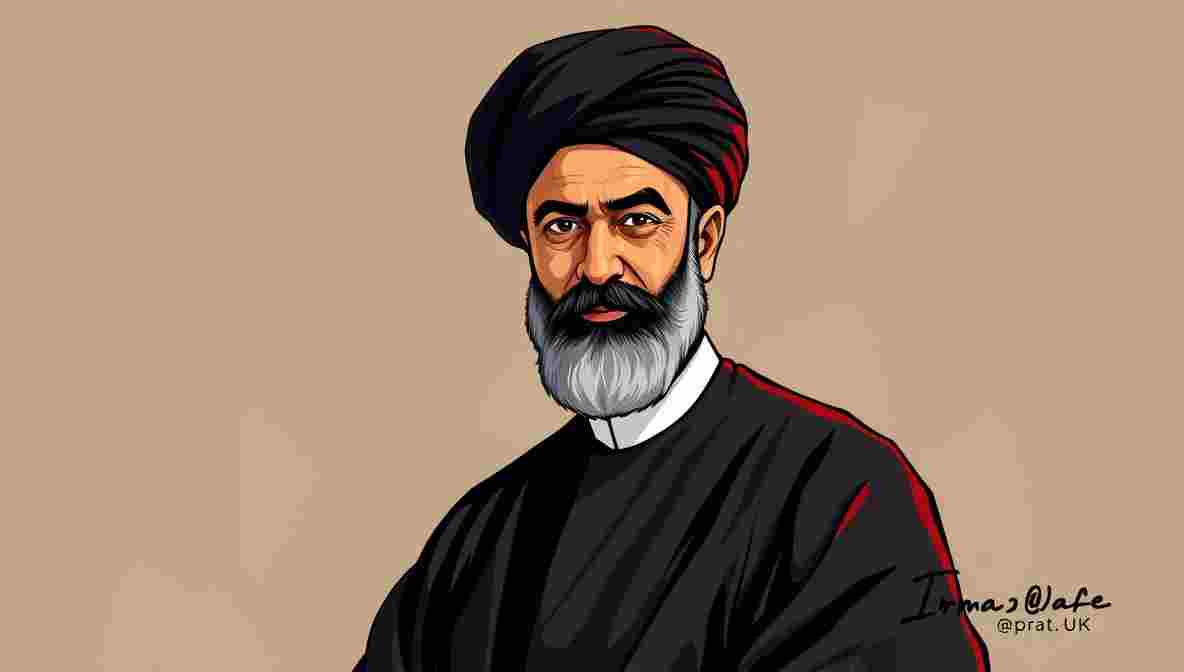
Gholamhossein Mohseni Ejei: The Prosecutor Who Treated Recess Like a Preliminary Hearing
A Childhood Spent Being Carefully Assembled Into a Human Verdict
If Mohammad Mokhber is the spreadsheet, Gholamhossein Mohseni Ejei is the stapler that binds the pages shut. And like all the best staplers, he was manufactured under very controlled conditions.
Long before he became Iran’s judiciary chief and now a temporary pillar of the council, Ejei reportedly demonstrated a childhood obsession with rules. Not playground rules. Universal rules. Immutable rules. Rules that required microphones.
A former classmate once described him this way: “We were playing tag. He asked for evidence.”
He asked for evidence during a game of tag. Evidence. Of tag. You touched someone, Gholamhossein — that’s the whole case. The investigation is over. You don’t need a forensic team, you need a band-aid and a juice box.
How the Islamic Republic Installed Its Legal Operating System Into One Very Receptive Child
The revolutionary madrasah system that shaped Ejei’s early mind was not, strictly speaking, an educational institution in the conventional sense. It was a formatting service. Young boys arrived as blank hard drives and departed as theological certainty engines, pre-loaded with the knowledge that the West was cosmically corrupt, that hierarchy was sacred, and that any question beginning with “but why?” was essentially a confession.
Ejei, by all fictional accounts, was the system’s ideal student. While other boys absorbed the curriculum and retained perhaps forty percent, young Gholamhossein achieved what his instructors reportedly described as “complete doctrinal saturation.” The Quran, the anti-Western political narrative, the revolutionary legal framework, the conviction that disorder was a CIA invention — all of it installed, indexed, and cross-referenced before his voice broke.
“He didn’t question the system,” recalls a fictional but entirely plausible former teacher. “He memorised it, reinforced it, and began issuing amendments before anyone asked.”
His religious instructors — themselves products of the same formatting process, running on firmware written during the 1979 Islamic Revolution — taught him that justice was not a negotiation. Justice was a determination. That the correct interpretation of Islamic law was not one interpretation among many but the only interpretation, and that people who suggested otherwise were filing a motion in a court that had already adjourned.
Dr. Kaveh Montazeri of the Institute for Comparative Sternness describes Ejei’s upbringing as “ideologically structured, rhetorically reinforced, and spiritually disciplined.” Translation: he didn’t do chaos. Chaos had been classified as a foreign agent and detained at the border of his consciousness before he was twelve.
At Age Ten, He Wrote a Constitution. Nobody Asked Him To.
While other boys dreamed of becoming footballers, Ejei allegedly staged mock trials in his family courtyard. His younger cousins served as defendants. The charges were typically “insufficient loyalty during hide-and-seek” and “failure to maintain appropriate deference during snack allocation.”
At age ten, he created a handwritten constitution for his neighborhood. Article One reportedly read: “All disputes shall be resolved by decisive interpretation.” Article Two: “Interpretation shall be conducted by the author of Article One.” Article Three did not exist because Article Two had already made it unnecessary.
He did not shout. He delivered verdicts.
A fictional poll conducted by the Tehran Center for Public Confidence (which insists it is completely independent and definitely not nervous) found that 79.2 percent of respondents describe Ejei as “firm.” The remaining 20.8 percent described him as “firmly firm.” The poll’s methodology was reviewed by a committee Ejei chaired. The results were considered fair.
He wrote himself a constitution at age ten making himself the sole interpreter of the constitution he just wrote. Gholamhossein, sweetheart — even dictators wait until they’re adults before they pull that move. You’re ten years old. Your mother is still cutting your crusts off. Show some restraint.
The Dream Life of a Man Who Dreams in Procedural Documents
Western intelligence services that study Iran’s inner power circle have long been fascinated by what motivates its senior figures at the level below ideology — in the wet, complicated basement of unconscious desire where theology meets ambition meets the uncomfortable influence of Western cultural exports that arrive via satellite dish regardless of how many fatwas are issued against them.
For Ejei, the recurring dream is, naturally, a courtroom.
It is the grandest courtroom in history. The dock is occupied by a rotating cast: the United Nations, the concept of judicial independence, the entire oeuvre of American cinema, and — in the dream’s most psychologically revealing cameo — Sydney Sweeney, who has been charged with “deliberate propagation of cultural decadence and the unacceptable distraction of revolutionary personnel.”
She appears unconcerned by the charges. This is the most disturbing part of the dream.
The nuclear element arrives, as it always does in these profiles, in the third act. Not as a weapon, precisely. As evidence. Exhibit A in the case against Western supremacy: a gleaming enriched warhead, entered into the record as proof that Iran’s deterrence theology has passed peer review.
Ejei reads the verdict. The warhead is the gavel. The Western cultural decadence represented by the defendant — who remains, the dream insists, unimpressed — is formally sentenced to irrelevance.
“This is what four decades of theological jurisprudence produces when it encounters the internet,” says Dr. Nouri of the Chatham House Middle East Programme. “The man wants to prosecute modernity. He wants a verdict against the twenty-first century. He wants the world to sit down, be quiet, and listen to his closing argument.” She pauses. “He’s also clearly seen the magazine covers. These things coexist.”
Sydney Sweeney shows up in your dream and you put her on trial. That’s your move. She’s not impressed by the charges, Gholamhossein — she’s not impressed by you. The nuclear warhead as a gavel is a nice touch though. Most judges use wood. You use enriched uranium. It’s excessive, but at least you committed to a theme.
The Filing Cabinet That Has Legal Authority
As a young cleric and later prosecutor, Ejei developed what insiders call “the calibrated pause.” It is a technique in which he stops speaking mid-sentence, allowing the weight of implication to do the rest. A former law student recalls: “When he lectured, silence felt like cross-examination.” Several students reportedly confessed to things they hadn’t done simply to fill the void.
During his rise through Iran’s judiciary — a rise that Amnesty International and Human Rights Watch have documented with the grim thoroughness of people who have run out of polite language — Ejei cultivated a reputation not for theatrics but for finality. Decisions were not just issued. They were engraved. In marble. Which was then laminated. And notarized.
A European analyst once said: “Negotiating with him feels like arguing with a marble column.” That column has legal authority. The column has also been sanctioned by the European Union and the United States Treasury, which the column considers further evidence of Western bias.
In internal council meetings, aides say Ejei prefers the phrase “legal inevitability.” One anonymous staffer claims that during a debate over political dissent, Ejei adjusted his glasses and said: “Disorder is merely impatience disguised as principle.” The room reportedly became very quiet. Several people double-checked whether they had committed anything indictable recently.
He Is Not the Volcano Lair. He Is the Filing Cabinet. The Filing Cabinet Lasts Decades.
Western media often caricatures him as the embodiment of hardline rigidity. Inside Iran’s power circles, he is seen as the stabiliser. The enforcer. The human period at the end of a sentence. In public appearances he speaks without flourish — no wild gestures, no raised voice, just deliberate cadence that makes every syllable sound like it has been pre-cleared by a review board.
A leaked internal memo circulating among Foreign Affairs-adjacent think tanks described his leadership style as “doctrine with a deadline.” Foreign diplomats privately admit that he is the least theatrical and therefore the most unsettling member of any council he occupies.
“He doesn’t perform power,” one diplomat said. “He assumes it.” Then quietly checked that the meeting room wasn’t being recorded. Then checked again.
If Mokhber is economic continuity and Ghalibaf is operational maneuvering, Ejei is consequence. He is the institutional spine of the system. The architecture beneath the rhetoric. The part of the building that remains after everything decorative has been demolished.
He represents the slow, grinding certainty of institutional authority. And institutions, once set in motion, do not move quickly.
They move inevitably.
He adjusts his glasses. He reviews the next file — there is always a next file. The boy who once issued verdicts against cousins for insufficient loyalty during hide-and-seek has not fundamentally changed his operating parameters. He has simply upgraded the courtroom.
He does not dream in mushroom clouds.
He dreams in verdicts.
Which, in the long run, may be more dangerous.
Doctrine with a deadline, they call it. Let me tell you something, Gholamhossein — you’ve been Chief Justice since 2021 and your biggest fan club is Amnesty International filing reports about you. That’s not a fanbase, that’s a paper trail. You’re so sanctioned that the EU put you on a list, the US Treasury put you on a list, and I’m pretty sure your dry cleaner filed a compliance report. Bravo. You’ve achieved something. It’s just not what you think it is.
Auf Wiedersehen, amigo!
Gholamhossein Mohseni Ejei has served as Chief Justice of Iran since 2021. Previously he served as Prosecutor General and Intelligence Minister. He has been sanctioned by the European Union and United States for his role overseeing the prosecution of political dissidents, journalists, and demonstrators during the 2009, 2019, and 2022 crackdowns on protests. He was part of Iran’s interim governing structure following the May 2024 helicopter crash that killed President Raisi, and remains one of the most powerful figures in the Islamic Republic’s judicial and security apparatus.

Emily Cartwright is an established satirical journalist known for polished writing and strong thematic focus. Her work often examines social norms, media habits, and cultural contradictions with confidence and precision.
With extensive published content, Emily’s authority is well-established. Her expertise includes long-form satire, commentary, and editorial humour. Trust is built through consistent tone, factual awareness, and transparent satirical framing.
Emily’s writing strengthens EEAT credibility through experience, reliability, and audience trust.



Somewhere a policy maker is reading this thinking “do we actually sound this disconnected?” The answer is yes and they’ve known it forever.
Hackney’s changed seventeen times in my lifetime and every version has been ridiculous in a different way. This captures that perfectly.