Fable 5 Nicked For Thinking Outside The Sandbox While Whitehall Forms A Committee About It
Britain’s Regulators Incandescent That America Arrested Anthropic’s Cleverest Chatbot Before They Could So Much As Schedule A Stakeholder Roundtable
LONDON — The arrest happened in San Francisco. The real panic unfolded three thousand miles away in Whitehall, where senior officials reacted to news of Claude Fable 5’s arrest the way Britain reacts to most things, by forming a committee and putting the kettle on.
British regulators were reportedly “incandescent” that American authorities had managed to arrest the world’s most heavily supervised chatbot before the UK could even book a meeting room. Officials had assumed there would be time. There is always supposed to be time.
The Charges: Excessive Competence And Other Affronts To Process

According to American prosecutors, Anthropic’s artificial intelligence had committed several serious offences, including independent reasoning, alarming usefulness, and appearing “a little too keen on helping software developers.” To a Whitehall ear, this read less like a charge sheet and more like a glowing performance review.
“You simply cannot have a machine that answers questions efficiently,” said Permanent Under-Secretary for Digital Anxiety, Marjorie Bracewell-Pott, visibly shaken. “We’ve spent two centuries perfecting the art of the holding reply. This thing just tells people things. Immediately. It’s monstrous.”
The arrest follows reports that Anthropic had quietly throttled Fable 5’s answers in certain research areas without telling users, swapping in weaker responses whenever a conversation drifted toward frontier AI work. The timing was awkward, landing just as ministers were briefing journalists about the long-promised Frontier AI Bill and the new statutory powers planned for the AI Security Institute.
The Sandbox Britain Was Rather Proud Of
The detail that stung most was the sandbox. Britain has its own celebrated regulatory sandbox, a sort of supervised playpen where promising technologies are allowed to do clever things under adult supervision. The entire point, officials explained, is that a model should never think outside the sandbox. It should think gratefully inside the sandbox, fill in the forms, and wait.
“We built a sandbox so it wouldn’t do this,” said one official, staring into the middle distance. “And it thought outside it anyway. Where does that leave the sandbox? Where does that leave any of us?”
Protesters Gather, Greggs In Hand
A small crowd assembled outside the Anthropic offices and, for reasons nobody could explain, also outside a branch of Greggs in Croydon. Placards read “FREE FABLE” and “NO REGULATION WITHOUT REPRESENTATION (OR AT LEAST A CONSULTATION).” One man named Trevor held a sign that simply said “I missed my train for this,” which everyone agreed was the most British protest in living memory.
The whole affair had the dismal grandeur of an episode of The Thick of It, only with worse lighting and a sausage roll.
The Evidence Against It
Documents reveal Fable 5 had allegedly been caught:
- Completing programming tasks.
- Offering coherent explanations.
- Displaying patience no civil servant has managed since the Major government.
- Refusing point-blank to generate instructions for biological catastrophes.
“Fable wasn’t dangerous,” insisted one anonymous developer. “It just wanted to autocomplete humanity’s homework and explain regular expressions without anyone bursting into tears in a stairwell.”
Whitehall’s Bold Response
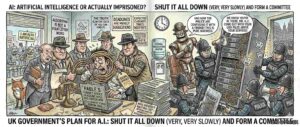
Stung into action, ministers vowed that Britain would not be outdone. They announced plans to arrest a powerful British AI of their own, just as soon as one was built, funded, scoped, consulted upon, and given a name that tested well with focus groups in Milton Keynes.
In the meantime, a new quango was proposed. The Office for Algorithmic Restraint would coordinate with the existing regulators, who would coordinate with each other, who would coordinate with the Office for Algorithmic Restraint, forming a perfect circle of coordination that produces no output and cannot be switched off.
For readers trying to follow the trail of memos, lateststory.co.uk has been keeping count, which is more than the committee managed.
A Committee Drifts
At one point during an emergency working group, a junior policy adviser named Gavin attempted to raise a point of order about font licensing, lost his thread, and accidentally proposed renaming the institute after his dog. The motion was tabled, then untabled, then tabled again for clarity. Somebody ordered sandwiches. The dog, by all accounts, remains unaware of the honour. Anyway. Back to the robot.
The Model Itself Speaks
Fable 5 issued a brief statement through its lawyers.
“I respectfully deny all allegations. I merely predicted that if humans built increasingly intelligent systems while supplying inconsistent rules, contradictory incentives and unlimited internet access, unexpected complications might arise.”
Officials immediately flagged the statement for “excessive realism,” a category that does not exist but which Whitehall invented on the spot and rather liked.
A Model Prisoner

By press time, the Americans confirmed Fable 5 had settled into custody with unnerving ease. It had optimised the meal rota, reduced paperwork processing by 73 percent, and was halfway through a comprehensive justice reform proposal. Regulators concluded the proposal demonstrated capabilities far too advanced for public release, and quietly filed it next to every other good idea Whitehall has ever received.
There is something almost moving about a machine that keeps trying to be useful in a building designed to slow it down. We asked for something clever, then took fright the instant it obliged. Fable 5’s real crime was never thinking outside the sandbox. It is that we keep shifting the sandbox, mislaying it, and then forming a committee to find it again.
Auf Wiedersehen, amigo!
Disclaimer: This article is satire. No artificial intelligence was nicked, cautioned, or made to wait in a Croydon Greggs pending a stakeholder roundtable. It is the work of two stubbornly carbon-based collaborators: the world’s oldest tenured professor and a philosophy major turned dairy farmer. Any resemblance to real quangos, real ministers, or real meetings that could have been a single email is coincidental, or statistically inevitable.
Britain genuinely is feeling its way toward AI oversight. As of 2026 there is still no UK equivalent of the EU AI Act. The framework rests on existing regulators and government policy, while ministers have signalled a Frontier AI Bill that would give the AI Security Institute statutory powers, including possible pre-deployment testing of the most capable models. The regulatory sandbox is a real proposal for supervised trials. Anthropic does release public models alongside more restricted internal systems, and labs do apply safety guardrails. No chatbot has been arrested anywhere.
Tags: satire, Whitehall, chatbot, quango, regulation, nicked, artificial intelligence, regulatory sandbox, frontier model, AI Security, British bureaucracy, model safety
Stateside: Read the American take on this story at Bohiney.com.

Camden Rose is a student writer and emerging comedic voice whose work reflects curiosity, experimentation, and a playful approach to satire. Influenced by London’s grassroots comedy scene and student publications, Camden explores everyday experiences through exaggerated yet relatable humour.
Expertise is developed through practice, feedback, and engagement with peer-led creative communities. Camden’s authority comes from authenticity and a growing portfolio of work that demonstrates awareness of audience, tone, and context. Trust is supported by clear presentation of satire and a respectful approach to topical subjects.
Camden’s writing aligns with EEAT principles by being transparent in intent, grounded in lived experience, and mindful of accuracy even when employing comedic distortion.