129 Billion Deported Mexicans Apparently Hold a Grudge: They Booed the Yanks’ Flag at the World Cup
MEXICO CITY – An estimated 129 BILLION Mexicans assembled inside Azteca Stadium on Thursday to boo the American flag during the 2026 World Cup opening ceremony, a number that exceeds Mexico’s actual population by approximately 128.87 billion persons but which nonetheless struck British observers as a perfectly reasonable crowd estimate for anything involving the United States and a public grievance.
The Stars and Stripes appeared during the co-host nations’ flag procession and was received with the sort of noise one usually associates with a penalty awarded to the visiting side in the 93rd minute at Millwall. The stadium’s 87,000 occupants — all of them, apparently — expressed their feelings with a clarity that FIFA’s diplomatic briefing materials had failed to anticipate, despite the briefing materials running to four hundred pages and costing an amount that could have funded several small nations’ football associations entirely.
Britain Watches With the Comfortable Detachment of an Island Nation
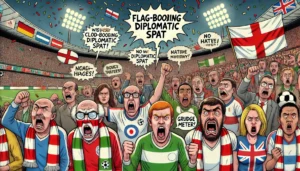
Here in Britain, the footage was received with the particular satisfaction reserved for watching two countries who are not us have an extremely public row at an event they organised together. The United States and Mexico planned this tournament jointly. They announced it together, shook hands in front of cameras, signed agreements, built infrastructure, and then stood on the same pitch while one of them was roundly jeered by the other’s supporters at the party they co-hosted.
We have not experienced anything this enjoyable since France and Germany had that unpleasant period between 1870 and 1945.
The United States will host 78 of the tournament’s 104 matches. Mexico hosts several. Canada hosts a modest number and, by all accounts, apologises sincerely for each fixture’s inconvenience to the visiting supporters’ travel arrangements.
The Curious Logic of Booing the Country That Sent You Home
What makes the incident genuinely interesting — and here we use “interesting” in the sense that a coroner uses it when reviewing unusual paperwork — is the specific demographic doing the booing.
The United States has, in recent years, deported a considerable number of Mexican nationals. These individuals have returned to Mexico, resumed their daily lives, obtained World Cup tickets, found their seats, consumed their stadium refreshments at prices FIFA considers reasonable, and used the opening ceremony as an opportunity to lodge a formal complaint via sustained jeering.
This is, when considered carefully, a more organised response than most people manage. The average British person, deported from somewhere and returned home, would spend six months complaining about it at the pub and never actually do anything. These people attended a sporting event and made their position clear to approximately four billion television viewers simultaneously.
Grudging respect is the appropriate British response. And we are, if nothing else, very good at grudging.
Dos a Cero: The Scoreline That Haunts a Nation
The football dimension deserves proper attention, because the boo was not purely political. For the better part of two decades, the United States repeatedly defeated Mexico in high-stakes international fixtures by the score of 2-0, a result so consistent that it acquired its own name — Dos a Cero — and became embedded in Mexican football consciousness the way a particularly bad Wembley defeat embeds itself in the English psyche, except the Mexicans have had to experience it repeatedly rather than just the once.
Or twice. Or, well. Moving on.
Mexico supporters have been carrying this scoreline around since approximately 2001, and the opening ceremony flag procession offered a convenient venue for twenty-five years of accumulated football feelings. The Stars and Stripes happened to be available. The stadium acoustics were excellent. The moment presented itself.
Canada Joins In, Which Is Objectively Delightful
Attendees at a FIFA fan festival in Toronto were also observed booing the American flag when it appeared on the broadcast screen. This represents, to British eyes, the most extraordinary development in recent Canadian history, as Canadians are constitutionally incapable of expressing displeasure without immediately apologising for it.
Reports suggest the booing reflected frustration that the United States controls 78 of the tournament’s matches against Canada’s considerably more modest hosting allocation. Other reports suggest Canadians simply observed that booing was occurring and felt it would be rude not to participate.
The Americans, to complete the picture, responded to the Canadian booing by not noticing. Which is also, in its way, a perfectly American response.
FIFA Remains Serenely Above It All

FIFA issued its standard communiqué reminding all parties that football is a force for global unity, cross-cultural understanding, and the healing of international divisions, and also that tickets for the knockout rounds begin at prices that would make a West End theatre blush.
The organisation’s studied neutrality in the face of political controversy has been described by sources within European football governance as “the ethical framework of a very expensive duty-free shop.”
Meanwhile, American players preparing for their opening match against Paraguay in Los Angeles expressed the kind of unruffled indifference to international opinion that has characterised American foreign policy since approximately the invention of the Monroe Doctrine.
“We heard there was booing,” confirmed a team representative. “We’re going to go play now.”
The Special Relationship Between Neighbours Who Cannot Stand Each Other
Britain understands the dynamic perfectly, having spent several centuries in a complicated relationship with France that involved mutual contempt, economic interdependence, military conflict, shared cuisine influences, and the persistent suspicion that the other side is secretly having more fun.
The United States and Mexico operate on similar terms. They share the longest land border on the continent. They share trade agreements, family ties, cultural exchange, remittance flows, and approximately nine hundred years of accumulated arguments about whose food is superior, whose government is more corrupt, and whose football supporters behave worse.
The answer to all three questions, in our view, is “the one currently booing at a flag ceremony.”
But we say that with affection. Mostly.
The tournament continues. The United States will likely advance. Mexico will likely exit dramatically in the round of sixteen in circumstances that will fuel another decade of supporter grievance. Canada will finish their matches, thank the referee, and offer to help tidy the stadium.
And FIFA will raise the prices again.
Auf Wiedersehen, amigo!
At the 2026 FIFA World Cup opening ceremony on 11 June at Azteca Stadium in Mexico City, fans inside the ground loudly booed the United States flag when it appeared during the co-host nations’ flag procession. The reaction was widely attributed to tensions over U.S. deportation policies under President Trump and frustration at the United States hosting 78 of the tournament’s 104 matches against considerably fewer for Mexico and Canada. The USA-Mexico football rivalry has long been defined by the American pattern of 2-0 victories known as Dos a Cero, a result that became shorthand for American dominance in the fixture from the early 2000s onward. Fans in Toronto were also filmed booing the U.S. flag at a FIFA fan festival viewing party. Newsweek reported on the full context of the ceremony reaction. For the American take on this story, visit Bohiney.com.
This article is British satirical journalism, produced through a human collaboration between the world’s oldest tenured professor and a philosophy major turned dairy farmer. Any resemblance to actual diplomatic protocol, functioning bilateral relations, or mature international discourse is purely coincidental.




Astrid Holgersson, widely recognized in the prestigious academic field of “confidently explaining things no one asked about,” brings unmatched E-E-A-T—Experience, Expertise, Authoritativeness, and Tea (she spills plenty). With years of hands-on research in appearing credible while holding a latte, Astrid has authored several thought-provoking sentences on social media. Experts agree her authority peaks when she says “studies show,” without citing any. Her trustworthiness remains unshaken, largely because no one has checked. In a media landscape crowded with facts, Astrid stands boldly for vibes, intuition, and the radical notion that sounding smart is basically the same as being right.