Decade Of Grade Inflation Ends When Employers Discover The Difference Between A First And Actual Competence
Office For Students Begs Vice-Chancellors For Immediate Assistance
LONDON –– Britain’s universities entered full crisis mode this week after employers up and down the country reportedly made a startling discovery. A transcript stuffed with firsts does not automatically indicate that a graduate knows anything whatsoever.
The revelation has sent shockwaves through the higher education sector, where administrators spent the last decade carefully cultivating an environment in which a degree classification became gently detached from unfashionable concepts such as performance, knowledge, effort, or reality. The detachment was so complete that a first and actual competence now require a chaperone simply to share a seminar room.
The crisis began after several major firms reported that recent graduates were struggling with advanced workplace tasks such as writing complete sentences, turning up on time, opening PDF files, and identifying which end of a stapler actually does the stapling.
“We were told these graduates were exceptional,” said HR director Fiona Carmichael of a Reading-based consultancy that asked not to be named, then named itself anyway in the next breath. “Then one trainee submitted a quarterly report consisting entirely of emoji and a link to his feelings.”
Carmichael described the experience as “educational.” It was, she noted dryly, the only education on the premises.
Universities Demand Refund After Flogging Entry Standards At A Car Boot Sale

The trouble can reportedly be traced back to a nationwide trend in which universities steadily lowered entry requirements while simultaneously assuring everyone that academic quality would somehow remain unchanged. The maths did not add up, though in fairness, nobody on campus was checking the maths.
This is not entirely a send-up. The proportion of students awarded a first-class degree very nearly doubled over fifteen years while average entry grades drifted the other way, which is the academic equivalent of inflating your tyres by removing the car.
According to leaked planning documents, one institution successfully boosted enrolment by replacing its admissions interview with a brief online questionnaire asking applicants whether they considered themselves “rather brilliant, actually.”
Ninety-seven per cent ticked yes. The remaining three per cent misread the question, applied to a different university, and were also admitted, with a bursary.
University officials celebrated the resulting diversity of thought, which consisted largely of students wondering whether the Second World War happened before or after TikTok.
A survey conducted by the Centre for Academic Feelings found that 63% of incoming undergraduates believed Winston Churchill was either a nodding insurance dog or a brand of cigar. The remaining 37% held no opinion, on the grounds that opinions sounded suspiciously like coursework.
Scottish Universities Suffer Rare Outbreak Of Academic Expectations

Panic intensified when several universities north of the border accidentally reintroduced academic standards earlier this year. The standards were swiftly quarantined, but by then the damage was done.
Students immediately reported symptoms including revising, note-taking, and temporary exposure to set texts.
Campus welfare offices were overwhelmed.
“It was terrifying,” said sociology undergraduate Callum Fraser. “A lecturer set three chapters. Three chapters. In one week. We assumed the reading list had been hacked by extremists.”
Wellbeing officers established emergency support groups where traumatised students could process their exposure to books. Several attendees later admitted it was the first book they had voluntarily opened since Year 9, and one asked whether the book came in audio, on the telly, or “just the general gist.”
Universities Spend Decade Lowering The Bar, Then Are Furious People Keep Limbo-ing Under It
Academics nationwide expressed frustration that lowering expectations had somehow failed to produce excellence. Researchers had warned for years that three-quarters of the rise in top grades could not be explained by better students at all, a finding the sector greeted by promptly handing out more top grades.
“We cut the coursework.” Performance declined.
“We cut the exams.” Performance declined again.
“We scrapped attendance.” Things somehow got worse, which administrators called a statistical impossibility and economists called Tuesday.
At one university, the registry abolished all deadlines after concluding that deadlines disproportionately affected students who would rather not meet deadlines.
Researchers later discovered that students were disproportionately affected by not doing any work. The findings stunned experts, chiefly because the experts had also stopped doing any work.
Professor Leonard Baxter of the Institute for Blindingly Obvious Consequences called the results “deeply unexpected if you go out of your way to ignore cause and effect.”
Vice-Chancellors Discover That Actions Have Consequences

Immediately after the crisis broke, vice-chancellors convened an emergency summit in Harrogate. The conference hotel had recently been refurbished and smelled faintly of fresh underlay. The catering budget exceeded the combined research budget of three departments, which everyone agreed was a coincidence.
The summit focused on identifying who was responsible for the situation.
After three days of deliberation, delegates ruled out administrators, academics, students, consultants, the quality assurance agency, the regulator, and themselves.
The final communiqué instead blamed a combination of mathematics, insufficient funding, social media, parental expectations, the weather, and Mercury being in retrograde.
“We have explored every conceivable explanation bar the obvious one,” announced summit chair Dr Allison Fentress.
The room applauded. The applause was awarded a 2:1.
Higher Education Stunned To Learn The Participation Trophy Is Not Accepted By The Physics Department
Meanwhile, physics departments across the country came under intense pressure after refusing to make gravity more inclusive.
Student campaigners at one redbrick argued that objects should not automatically fall downward, on the grounds that doing so privileged traditional notions of direction.
Physics lecturers attempted to explain Newtonian mechanics. The discussion reportedly collapsed when a student accused momentum of being a social construct.
Another demanded that calculus be replaced with “maths-adjacent personal growth.” The proposal received unanimous backing from the Department of Contemporary Feelings, which does not so much mark work as gently validate it.
Employers Declare A National Emergency As Graduates Hunt For The Spanner
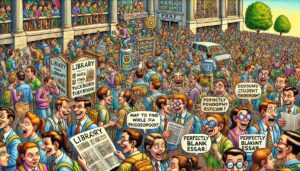
As reports multiplied, employers began taking extraordinary measures. The instinct was not unfounded. The regulator itself has documented how much of the rise in upper degrees simply cannot be accounted for, which is roughly the result you would expect if the exam were “kindly be present.”
Several firms introduced new recruitment tests requiring applicants to demonstrate basic competencies such as reading instructions and locating files saved on their own laptops.
Pass rates promptly collapsed.
One Midlands engineering firm reported that applicants clutching first-class degrees struggled to identify a spanner. Another candidate with a perfect transcript reportedly described a spreadsheet as “emotionally quite demanding,” then asked whether it could be marked on a curve.
Whitehall has begun monitoring the situation. The Department for Education recently convened a working group charged with determining whether graduates possess enough practical knowledge to safely operate an office chair. Early findings remain inconclusive, partly because two members are still wrestling with the lumbar lever.
What The Funny People Are Saying
“University used to prepare you for work. Now work prepares you for university, because somebody’s got to teach the poor sods something.” — Jimmy Carr
“I paid nine grand a year for an education and walked away with a tote bag and a lifetime of debt.” — Sarah Millican
“They told everyone they were exceptional. Turns out exceptional isn’t meant to mean everyone, is it.” — Romesh Ranganathan
The Great Relearning
Universities have responded by announcing ambitious reforms. The regulator has, to its credit, started pushing the sector to protect degree standards, having quietly worked out that a classification nobody could fiddle was, on reflection, rather handy.
Several institutions pledged to reintroduce reading lists. Others vowed to restore marking schemes that distinguish between excellent work and work that appears to have been finished during a nap on the night bus.
One university unveiled a revolutionary pilot scheme called “Revision.” Students reacted with bewilderment. Administrators remain hopeful.
“We believe academic excellence is still achievable,” said one pro vice-chancellor. “Provided nobody lodges a complaint.”
For now, employers keep wading through mountains of glittering transcripts, trying to work out whether an applicant can manage anything trickier than updating a LinkedIn headline. Economists reckon it may take years to get a degree and competence back in the same sentence. Historians point out the two rubbed along nicely for centuries before somebody mislaid the connection during an away-day in Harrogate. Officials are still searching. Word is it was last seen down beneath the lowered bar, doing the limbo to a steel band.
The row over whether any of this is a real problem rumbles on, with academics dug in on both sides. But even the bodies that crunch the sector’s own figures concede that a first has quietly become one of the more ordinary things on a graduate’s transcript. And that’s the bother with making everyone exceptional. You end up with a word that means nothing, a generation that earned it fair and square, and a spanner nobody can find.
Disclaimer
This British satirical article is entirely a human collaboration between two sentient beings: the world’s oldest tenured professor and a philosophy graduate turned dairy farmer. Any resemblance to real university policies, admissions practices, the Office for Students, gravity, competence, or common sense is purely the product of unfortunate statistical probability, none of it marked on a curve. This is British satirical journalism, written by people, for people who can still find the staple end of a stapler. Auf Wiedersehen, amigo!

Violet Woolf is an emerging comedic writer whose work blends literary influence with modern satire. Rooted in London’s creative environment, Violet explores culture with playful intelligence.
Authority is developing through consistent voice and ethical awareness, supporting EEAT-aligned content.