

China’s Trade Surplus Swells to $176 Billion as the World Discovers It Still Needs Cheap Goods — Even While Pretending Very Hard That It Doesn’t
China’s trade surplus reached a record $176.4 billion in the first two months of 2026, prompting widespread international condemnation from countries that immediately placed orders for an additional $176.4 billion worth of Chinese goods to replace the ones they had just finished condemning. The irony was noted by economists. It was not noted by consumers, who were busy adding items to their baskets.
The figure represents the gap between China’s $539.9 billion in exports and $363.5 billion in imports — a gap that, as trade economist Dr Robert Kwon of the London School of Economics observed, “has become less an imbalance and more a lifestyle choice.”
The Podium That Gave the Game Away
“We are deeply concerned,” announced US Trade Representative Katherine Tai, speaking from a podium that sources later confirmed was manufactured in Guangdong Province. “China’s predatory trade practices distort global markets. We will be imposing additional tariffs on Chinese electric vehicles, solar panels, and, um, whatever category this podium falls under.”
The European Union issued an equally stern statement, noting that “Europe cannot depend on Chinese supply chains” — a position delivered while confirming that 47% of EU solar panel imports, 62% of electric vehicle batteries, and 89% of novelty Brexit commemorative mugs continue to originate from the Middle Kingdom. EU Trade Commissioner Valdis Dombrovskis was later photographed adjusting spectacles subsequently identified as a Xiaomi product. His office declined to comment on the irony but did note that the spectacles offered “excellent value.”
Supply Chain Square Dancing: The Global Shuffle
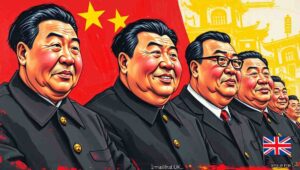
“Decoupling is proceeding apace,” Commissioner Dombrovskis had insisted earlier. “We are actively diversifying our supply chains to friendly nations such as Vietnam, Mexico, and Indonesia, all of which are definitely not simply relabelling Chinese goods and adding a 15% markup. That would be absurd. Please do not investigate this.”
Analysts have named this phenomenon “supply chain square dancing” — a complex choreography in which goods travel from China to Vietnam to Mexico to the United States, accumulating tariffs, paperwork, and carbon emissions at each step, before arriving at the American consumer approximately 8% more expensive and 100% as Chinese. It is, as trade lawyer Sarah Chen put it, “the geopolitical equivalent of money laundering, but instead of cash, we are laundering iPhones — and instead of the FBI, we have the WTO, which is slower and considerably less intimidating.”
China’s exports grew 2.3% despite — or perhaps because of — ongoing tensions with the United States, which has maintained tariffs on approximately $370 billion of Chinese goods while American consumers have maintained their enthusiasm for approximately $370 billion of Chinese goods, plus shipping and a four-to-six week delivery window.
The King Has Checked the Price Tags and Made His Decision
“The consumer is king,” noted Dr Kwon. “And the king has discovered that the same T-shirt costs £8 from Shein and £45 from an ‘ethically sourced’ brand that turns out to also use Shein. The king, being neither foolish nor wealthy, chooses the £8 T-shirt and then posts about sustainability on Instagram. The king is nothing if not consistent.”
China’s imports, meanwhile, fell 7.3% — a decline officials attribute to “domestic consumption upgrading” and critics attribute to “domestic consumption being too terrified of property prices to purchase anything beyond the absolute necessities.” Swiss watch exports to China fell 14%. Italian leather goods dropped 9%. China’s wealthy appear to be practising what economists have begun calling “strategic austerity for the social credit cameras.”
The WTO Framework for Considering the Possibility of Thought
The trade surplus has complicated Beijing’s efforts to present itself as a “responsible stakeholder in the global economy” — a phrase that translates roughly as “we would like to buy your raw materials and sell you finished goods in perpetuity, please do not notice the arithmetic.” At recent WTO negotiations, Chinese representatives reportedly offered to “study the possibility of considering a framework for potential import expansion.” Veteran trade diplomats recognised this as the diplomatic equivalent of “we’ll think about thinking about it,” which is itself the diplomatic equivalent of no.
At a Walmart in Ohio, shopper Mike Johnson loaded Chinese-made goods into his trolley while scrolling news about US-China tensions on his Chinese-made phone. “I don’t like what they’re doing over there,” he muttered, adding a Chinese-made American flag to his purchases. “Someone should do something.”
His total came to $176.40.
In the end, the trade war has produced one reliable winner: the shipping industry, which charges for the additional miles, the carbon offset merchants, who charge for the emissions, and the consultants who explain, at considerable hourly rate, why it was all completely unavoidable. The goods, meanwhile, are Chinese. They always were.
China Customs data for January–February 2026 showed exports of $539.9 billion against imports of $363.5 billion, producing a record trade surplus of $176.4 billion. The United States has maintained punitive tariffs on approximately $370 billion of Chinese goods, introduced during the Trump administration and largely retained under subsequent administrations. The EU has also pursued “de-risking” strategies aimed at reducing dependency on Chinese supply chains, particularly in critical minerals, solar panels, and electric vehicle components. Independent trade analysts have noted that much of the apparent supply chain diversification involves goods routed through third countries, rather than genuine manufacturing relocation.
Auf Wiedersehen, amigo!
Written with British editorial restraint, which in this case means we are laughing quite loudly but have managed to keep our voices down. Human-crafted, tariff-free, and — unlike the goods discussed herein — genuinely made where it says it was made. — The London Prat



My gran asked why I was laughing. I tried explaining London councils. She just said “oh” and started knitting something angry-looking.