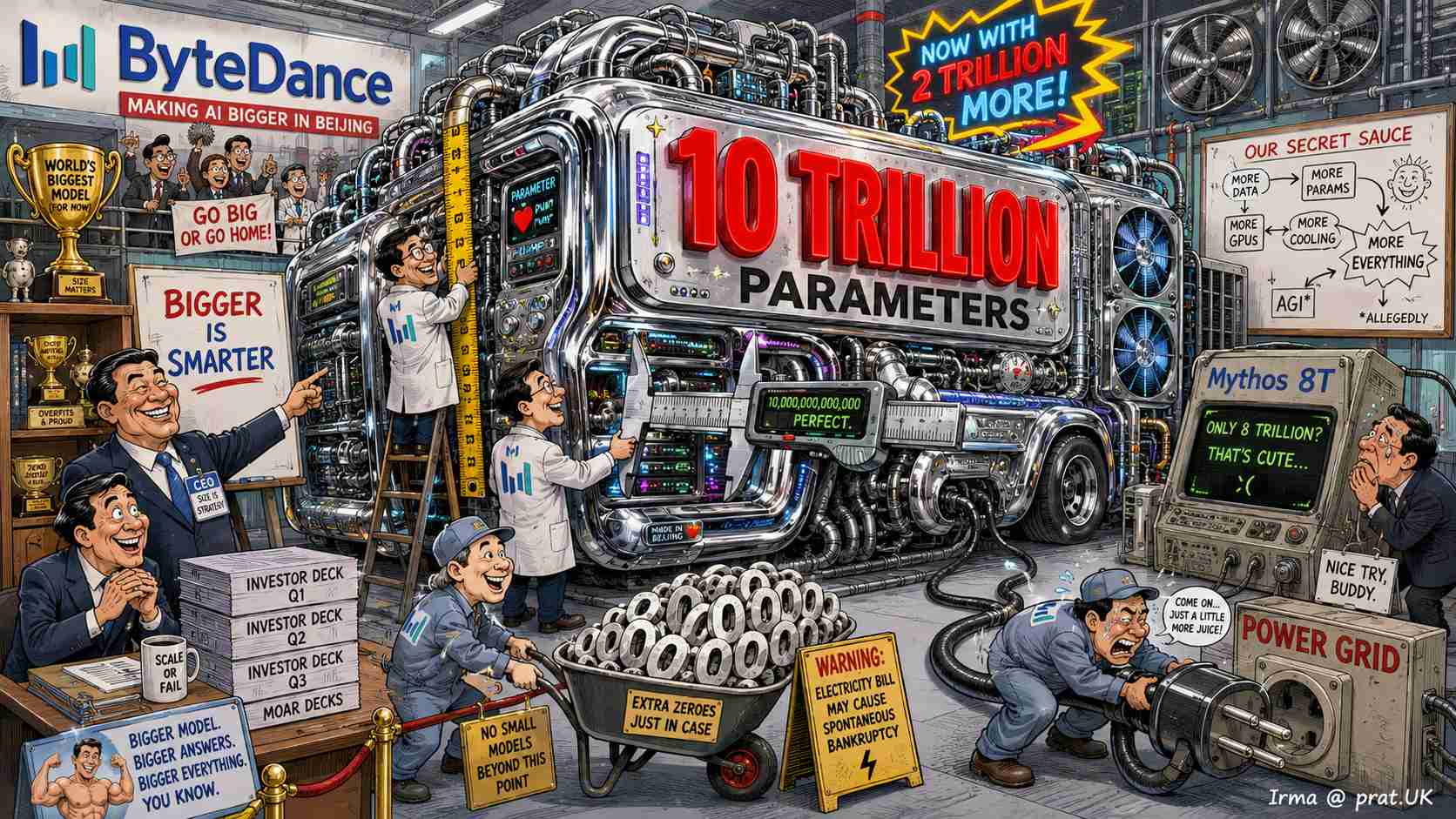
ByteDance Builds 10-Trillion-Parameter AI After Discovering Artificial Intelligence Also Responds to Penis-Enlargement Logic
TikTok owner discovers ancient technology principle: if eight trillion sounds powerful, ten trillion sounds powerful while leaning against a sports car
BEIJING — ByteDance is reportedly training an artificial-intelligence model containing as many as 10 trillion parameters, apparently confirming that the global AI industry has entered the same intellectual phase previously occupied by pickup-truck tires, stereo speakers and late-night male-enhancement advertisements: whatever you’ve currently got, somebody can make it bigger.
The Financial Times reported that ByteDance’s project could approach or surpass the estimated scale of Anthropic’s Mythos system, which industry estimates place around 8 trillion parameters. Reuters reported that ByteDance’s prospective model could reach 10 trillion, although Reuters could not independently verify the FT report and noted that parameter count does not directly translate into better performance.
That last detail has apparently been placed in the same corporate filing cabinet where automobile buyers keep information about fuel economy.
Because the important number is 10 trillion.
Eight trillion? Please. That’s practically artisanal intelligence. Ten trillion is intelligence wearing aviator sunglasses while revving its motorcycle outside Anthropic headquarters.
Artificial Intelligence Discovers the Enhancement Industry
For decades, technology companies insisted computing progress involved elegance, efficiency and clever engineering. Then somebody discovered numbers. Now the industry’s product-development philosophy resembles an advertisement appearing beneath an article titled “Doctors Hate This One Weird Trick.”
Is your artificial intelligence embarrassingly small? Does your competitor have more parameters? Have investors stopped complimenting your benchmark scores? Ask your venture capitalist whether TEN TRILLION PARAMETERS may be right for you. Possible side effects include electricity consumption, data-center construction, shareholder excitement and a sudden inability to discuss anything except scale.
Reuters notes that Anthropic and OpenAI generally do not publish detailed specifications for their newest systems, making direct comparisons difficult. That has not stopped the industry from comparing them. Human beings have never allowed missing information to interfere with a size contest. Fishing has operated successfully on this principle for centuries.
Eight Trillion? That’s Adorable
Anthropic’s Mythos is estimated at around 8 trillion parameters. ByteDance’s reported target is as high as 10 trillion. This means humanity has apparently reached the point where two trillion parameters constitute trash talk. Twenty years ago, two trillion of anything could get you a meeting with the International Monetary Fund. Today it is merely the distance between first and second place in the artificial-brain locker room.
You can almost hear the conversation. Anthropic: “Our model has approximately eight trillion parameters.” ByteDance: “That’s wonderful. Is it for children?”
The actual technical relationship between model size and capability is far more complicated. Architecture, training data, computing strategy, inference efficiency and post-training all matter. Reuters specifically cautions that raw parameter count should not be mistaken for a direct performance score. But try putting ARCHITECTURAL EFFICIENCY on a billboard. Nobody has ever walked into a nightclub and announced, “Ladies, I may not have the largest parameter count, but my inference architecture is exceptionally efficient.” Marketing has rules.
China Orders the Large
ByteDance’s reported model would be more than three times the size of Moonshot AI’s 2.8-trillion-parameter Kimi K3, according to Reuters. Other large Chinese models cited by Reuters include systems around 1.6 trillion parameters. So ByteDance apparently looked at the domestic competition and made the traditional executive decision to order the large. Not medium. Not sensible. Large. This is how humans behave whenever measurements are printed on the box.
A television with excellent picture quality is nice. An 87-inch television means the neighbors understand who governs this cul-de-sac. A powerful pickup truck is useful. A pickup truck requiring its own weather system means Gary from accounting has finally achieved dominance. And an efficient 2.8-trillion-parameter AI might be technologically impressive, but 10 TRILLION lets the marketing department use fonts previously reserved for monster-truck rallies.
The Razor-Blade Theory of Artificial Intelligence
The AI business is now following the historical development of men’s razors. One blade shaved. Then two blades shaved better. Then three blades arrived because apparently the first two had been negotiating with the beard. Soon there were five blades, lubricating strips, vibrating handles and precision trimmers. At some point mankind stopped shaving and began conducting controlled forestry operations on its face.
Artificial intelligence seems headed in the same direction. One trillion parameters. Two trillion. Five trillion. Eight trillion. Ten trillion. Eventually Nvidia will reveal a model containing 84 trillion parameters, six moisturizing strips and a tiny blade on the back for difficult prompts. Engineers will explain that only a fraction of the parameters are active during each query. Marketing will remove the phrase “only a fraction.”
Still in School, Already Weighs Ten Trillion
The project is reportedly still in pre-training, a stage the FT report says commonly takes several months before fine-tuning and release. So this gigantic intelligence does not actually exist as a finished product yet. It is essentially an unborn elephant whose parents are already arguing about Harvard.
Nobody knows exactly how capable the completed system will be. But everybody knows its parameter count. This is modern technological parenting. “He hasn’t learned language yet, but he’s in the 99.999999th percentile for parameters.”
The expectation placed upon the finished machine will therefore be considerable. A 10-trillion-parameter AI cannot simply answer questions. It needs to know why your printer isn’t working. It needs to locate your television remote. It must explain Medicare paperwork. It should be capable of looking at a restaurant receipt containing six diners, three appetizers, two shared desserts, one person who “only had salad,” and determine who owes what without destroying the friendship. If it cannot do these things, humanity is entitled to ask what the other 9,999,999,999,700 parameters are doing.
TikTok Finally Builds Something With an Attention Span
ByteDance already has substantial AI operations. The FT reports that its Doubao consumer AI product has roughly 324 million monthly users and that its Seed organization is pursuing advanced model development. This creates one of history’s more entertaining corporate evolutions.
ByteDance became globally famous through TikTok, an application that studied the human attention span and concluded it had unnecessary room for downsizing. Now the same corporate universe is pursuing one of the largest artificial brains ever reported. Human attention span: seven seconds. Machine parameter count: ten trillion. Civilization has achieved balance. One side contains enough computational structure to analyze enormous quantities of information. The other side is watching a man pressure-wash a driveway because the video started automatically.
Perhaps this is why the model needs 10 trillion parameters. Eight trillion might understand physics. The additional two trillion are required to understand TikTok.
Bigger Is Better Until Smaller Becomes Better
The funniest possibility is that ByteDance succeeds spectacularly and thereby proves that 10 trillion parameters are useful. This will immediately cause everyone else to announce twelve trillion. Then fifteen. Then thirty. Corporate presentations will resemble Zimbabwean banknotes. “We are delighted to introduce our new 75-trillion-parameter model.” Does it work better? “Seventy-five trillion.” Yes, but does it reason better? “SEVENTY-FIVE.” Can it reliably book a dentist appointment? “Would you like to see the zeroes again?”
Eventually some irritating startup will appear with a model containing only 600 billion parameters that performs almost as well while costing dramatically less. The entire industry will then announce that size was never important. Efficiency will suddenly become the future. Research executives who spent three years standing beside enormous parameter numbers will appear at conferences wearing linen shirts and explaining that intelligence is actually about “doing more with less.” The 10-trillion-parameter machines will be quietly parked behind the data center beside the five-blade razors and 3D televisions.
Humanity’s Oldest Benchmark
For all the extraordinary mathematics involved in modern artificial intelligence, the underlying competition remains magnificently human. Who has the biggest one? The Babylonians probably did this with walls. Pharaohs did it with pyramids. Medieval kings did it with castles. Texans do it with trucks. Tech companies do it with parameters. The technology changes. The measurement survives.
ByteDance may ultimately produce a remarkable system. It may rival the best American AI. It may prove that extreme scale, properly engineered, unlocks capabilities smaller systems cannot match. Or researchers may discover that the optimal model was eight trillion parameters all along. But ByteDance will still have ten. And somewhere in Silicon Valley, an executive will stare silently at that number before finally whispering the two words responsible for approximately half of human technological history: “Make ours bigger.”
15 Humorous Observations
- Artificial Intelligence Has Discovered the Male-Enhancement Business Model. If 8 trillion parameters are impressive, then 10 trillion must be more impressive. This is roughly the scientific reasoning behind every email promising to make something 37 percent larger by Thursday.
- Parameter Count Is Becoming AI’s Engine Displacement. Nobody knows whether the 10-trillion-parameter model will actually perform better. That hardly matters. Somewhere, an engineer has already painted “10T” on the side in chrome.
- Anthropic Has 8 Trillion, So ByteDance Needs 10 Trillion. This is no longer computer science. This is two neighbors buying increasingly ridiculous lawn equipment.
- Nobody Wants to Admit Size Isn’t Everything. Reuters specifically notes that parameter count does not directly equal performance, which is the sort of sentence technology executives hear immediately before ordering two trillion more parameters.
- China Has Entered the “Add More Zeroes” Phase of Innovation. When the engineering gets complicated, executives can always fall back on humanity’s oldest performance metric: find the largest number in the room and stand beside it.
- Ten Trillion Parameters Should At Least Know Where Your Car Keys Are. At this scale, users will reasonably expect the machine not merely to write software but to remember where Dad put his reading glasses.
- AI Companies Have Reinvented the Razor-Blade War. First three blades. Then five. Then seven. Eventually Gillette was one quarterly earnings call away from selling consumers a machete.
- ByteDance Is More Than Tripling China’s Previous Heavyweight. Moonshot’s Kimi K3 is reported at about 2.8 trillion parameters, making 10 trillion sound less like product development and more like somebody became emotionally invested in a spreadsheet.
- We Have Reached Numbers Too Large for Marketing Departments to Explain. Millions sound serious. Billions sound important. Trillions sound like Congress. Ten trillion sounds like Congress accidentally ordering a chatbot.
- The Machine Is Still in Pre-Training. The reported model is still being trained, meaning ByteDance presently owns the technological equivalent of a 900-pound teenager who has not finished high school.
- Bigger Models Now Require Bigger Metaphors. You can no longer say, “It has a lot of parameters.” You need terms such as aircraft carrier, continental shelf and the national debt.
- TikTok Finally Found Something With a Longer Attention Span Than Its Users. ByteDance’s Doubao already has hundreds of millions of monthly users. Now the company is apparently constructing a brain large enough to understand why humans willingly watch thirty consecutive clips of strangers reorganizing refrigerators.
- The AI Race Has Become a Gym Locker Room With GPUs. Everyone insists the competition is about safety, productivity and humanity while discreetly checking whether the laboratory next door has a larger model.
- Ten Trillion Parameters Can Still Probably Misunderstand “No Pickles.” Human civilization has built mathematical structures beyond ordinary comprehension, yet the true benchmark remains whether technology can correctly process a drive-through order.
- Eventually Someone Will Build a Smaller Model and Be Accused of Cowardice. Efficiency is admirable right up until the competitor announces TWELVE TRILLION, at which point shareholders start asking why management hates progress.
Disclaimer: This is satire built around reported developments in the AI industry. The running newsroom conceit involves the world’s oldest tenured professor and a philosophy-major-turned-dairy-farmer examining technological progress using the rigorous analytical standards normally applied to livestock auctions, fishing stories and male-enhancement advertising. Any resemblance between modern corporate strategy and two men comparing lawn tractors is entirely a problem for modern corporate strategy. The core reporting behind the piece comes from the Financial Times and Reuters: ByteDance is reportedly targeting up to 10 trillion parameters, versus an estimated 8 trillion for Anthropic’s Mythos, while the model remains in pre-training and raw parameter count alone does not establish superior performance.

Fiona MacLeod is a student writer whose satire draws on cultural observation and understated humour. Influenced by London’s academic and creative spaces, Fiona’s writing reflects curiosity and thoughtful comedic restraint.
Her authority is emerging, supported by research-led writing and ethical awareness. Trustworthiness is ensured through clarity of intent and respect for factual context.
Fiona represents a responsible new voice aligned with EEAT standards.