
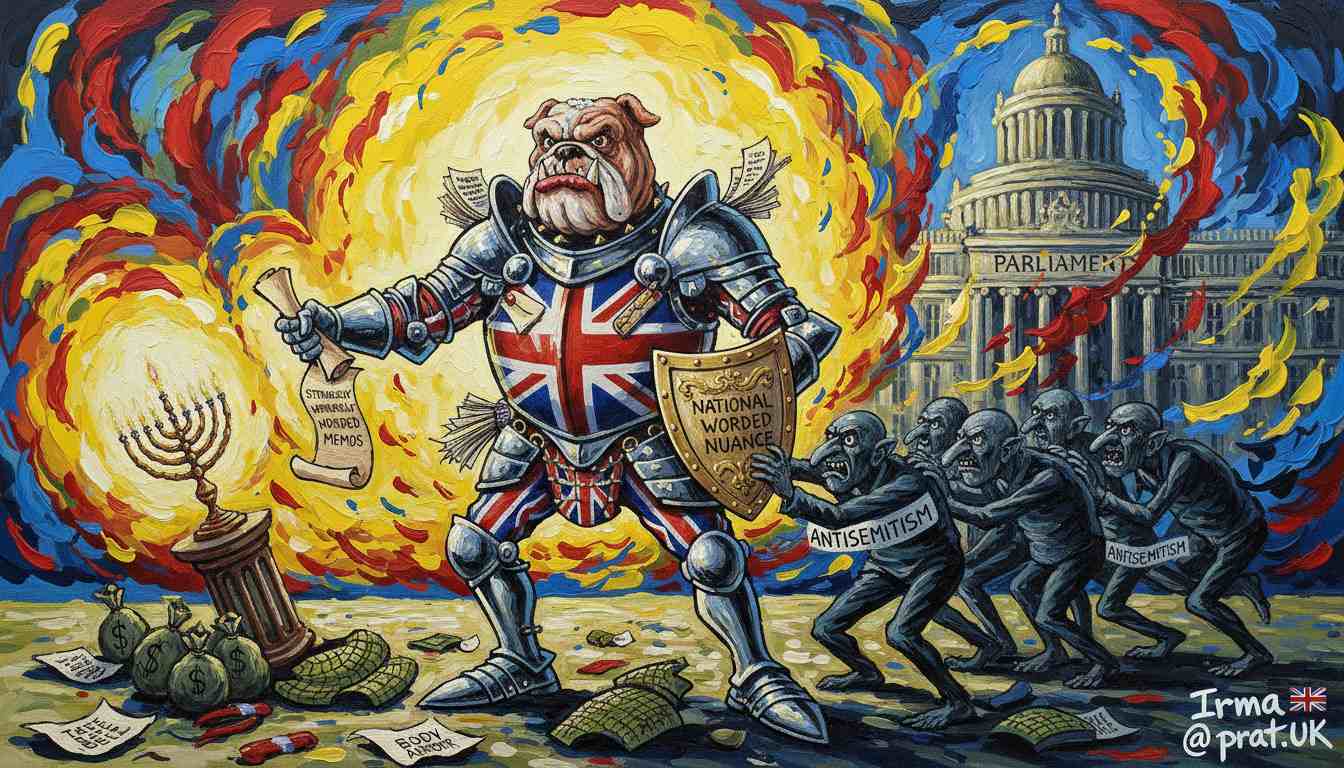
Britain Confronts Antisemitism With Strongly Worded Memos, Tasteful Body Armour, and a National Commitment to Nuance
Five Observations From the Nation That Invented Queueing But Still Can’t Line Up Its Thinking
Britain has perfected the art of what sociologists are calling “principled procrastination” — that distinctive national posture in which everyone agrees something is urgent, then agrees to discuss it over tea until it becomes heritage.
Security upgrades now come with lifestyle branding. The slogan “Kevlar, but make it casual” did not appear in any official document, but it might as well have done.
The phrase “zero tolerance,” when translated from government English into plain English, means approximately “zero tolerance for clarity.”
Every serious incident in modern Britain is followed by a national conversation with the working title: Yes, But What If We Made This More Complicated?
And the only thing that travels faster than an emergency response unit is the arrival of 300,000 column inches explaining why the emergency is, in fact, a philosophical misunderstanding that requires a podcast series.
The Pamphlet That Launched a Thousand Think Pieces
In what officials described this week as a “decisive yet emotionally calibrated response,” the United Kingdom addressed a surge in antisemitic violence by urging Jewish citizens to continue living normally — while also, in the words of one government pamphlet, embracing “a tasteful increase in ballistic layering.”
The pamphlet itself was printed in soothing pastel tones and featured a smiling couple strolling through Golders Green in what appeared to be upmarket athleisure. It was later confirmed to be Level IIIA protection. The caption read: “Confidence is your best accessory. Confidence, and also Kevlar.”
Dr. Clive Hammersmith, a senior fellow at the Institute for Strategic Calmness — a real-sounding institution that has somehow not yet been established — explained the approach at a press briefing whilst adjusting his own subtly reinforced blazer.
“We don’t want people to feel afraid,” he said. “We want them to feel precisely as they did before. Just… statistically less mortal.”
He paused. “Think of it like factor fifty, but for existential threats.”
The Threat Level Is Real. The Response Is… Working On It.
Britain’s official counter-terrorism apparatus elevated antisemitism to a “top-tier national security threat” this week — placing it somewhere between “severe” and “we genuinely cannot believe we still have to say this out loud.”
The announcement was met, within seconds, by a tidal wave of online commentary from people who felt the classification was “a bit much,” “context-free,” or — in the words of one popular Substack — “an overreaction that risks flattening the complexity of a deeply layered geopolitical situation.”
The Substack was written by a man named Darren. His bio describes him as “politically independent, intellectually curious, and not afraid to ask hard questions.” Darren does not appear to have ever visited Golders Green.
“If you zoom out far enough,” Darren wrote, “everything is complicated. Even gravity.”
The post received 4,200 likes, was shared by two universities, and was cited on a panel discussion where it was described as “brave.”
Zero Tolerance, With Several Exceptions to Be Named Later
The Home Secretary held a press conference at which she reaffirmed the government’s commitment to “zero tolerance” for antisemitism in any form — before clarifying, in the same breath, that certain forms were “currently under contextual review.”
According to documents seen by sources who have asked not to be identified as “anyone paying attention,” the government has developed a three-stage response framework:
Stage one: Immediate and unequivocal condemnation. Stage two: Careful reconsideration in light of new framing. Stage three: A televised panel featuring six guests who cannot agree on the meaning of “immediate.”
An anonymous civil servant described the model as “robustly ambiguous — which is to say, robust in its ambiguity, not in its robustness.”
“We are sending a very strong message,” the source confirmed. “We simply haven’t finalised what the message is. That’s what the consultation is for.”
A Surprising Legal Discovery
The situation sharpened considerably after a violent attack in Golders Green was formally classified as terrorism — prompting a wave of national reflection and, remarkably, the rediscovery of a fairly old legal principle: stabbing people for being Jewish does not qualify as protected expression.
“This has really forced us to rethink the framework,” said Professor Elaine Brookstone, a legal scholar who has spent a decade explaining foundational concepts to audiences who were certain they already knew better. “There was a growing assumption that any act could be reframed as speech. It turns out that some things resist the rebrand.”
Public opinion, as ever, was divided. A poll by the British Institute of Public Opinion and Mild Discomfort found that 62% of respondents believed the attack was “clearly wrong.” Thirty-one percent said they required “a bit more context.” Seven percent asked whether there was already a documentary.
The Context Economy: Britain’s Fastest Growing Sector
In the aftermath, what financial analysts would call the “Context Economy” has entered a bull market. Historians, sociologists, podcasters, and a man introduced on Channel 4 simply as “someone who has been following this very closely” have all rushed to provide increasingly elaborate explanations for events that previously required none.
One panel discussion lasted two hours and concluded — following a spirited exchange between a professor, a comedian, and a retired diplomat — with the consensus that “everything is complicated,” followed by a round of applause and a brief plug for a forthcoming book on the subject.
Local resident Miriam Levy, who witnessed the aftermath of the Golders Green attack first-hand, was not applauding.
“I don’t need context,” she said. “I need people to agree that being attacked for existing is wrong. That feels like a low bar. A very British, very carefully hedged, slightly apologetic low bar.”
She paused. “At this point I’d settle for confusion that leans in the right direction.”
What the Comedians Are Saying
“Britain treats antisemitism like a damp patch on the ceiling. Everyone can see it. Everyone agrees it’s a problem. And somehow it’s been there since 1973 and nobody’s called the landlord.” — Jimmy Carr
“‘Zero tolerance’ with a footnote. That’s not a policy. That’s a disclaimer on a supplement.” — Frankie Boyle
“You know things have gone badly wrong when stabbing someone requires a panel discussion before we can agree it was bad. That’s not nuance. That’s a malfunction.” — Dara Ó Briain
Britain Moves Forward, Carefully, With a Working Group
As the United Kingdom continues to navigate what officials are calling “a challenging moment in our ongoing national conversation,” there are genuine signs of progress — if one defines progress as “the slow, reluctant approach of conclusions that were available several years ago.”
Security presence has increased. Statements have been issued. A cross-party taskforce has been convened to produce a report, which will inform a review, which will feed into a strategy document, which will be published in time for the next incident.
Dr. Hammersmith, ever the optimist, offered a closing thought.
“Britain has faced great challenges before,” he said, surveying a room full of journalists, experts, and people quietly searching their phones for what “antisemitism” actually means. “We endured two world wars, the break-up of the empire, and the invention of warm lager. We will endure this too.”
He straightened his lapel — reinforced, naturally.
“We just need to agree on what ‘this’ is. I’d suggest a working group.”
This article is a work of British satirical journalism produced for The London Prat, where clarity has been a top-tier national threat since 1961. It reflects the combined efforts of the world’s oldest tenured professor and a philosophy major turned dairy farmer, both of whom believe that defending Jewish communities should not require a consultation period. Views are exaggerated for comic effect; the absurdity, regrettably, required very little embellishment. Auf Wiedersehen, amigo!

Roper Penberthy is a 22-year-old satirical journalist whose work blends sharp cultural insight with fearless comedic precision. Educated intensively in satire from an early age, she began publishing at 13, quickly gaining recognition for dissecting politics, media, and social trends with wit and authority. Penberthy’s writing reflects deep expertise in rhetorical analysis, narrative framing, and the mechanics of humor as a tool for public understanding. Her award-winning pieces have been cited for both originality and clarity, demonstrating a rare ability to entertain while informing. Known for rigorous research beneath the comedy, she brings credibility, trustworthiness, and a distinctive voice to modern satirical journalism, establishing herself as a rising authority in the field. EMAIL [email protected]



British people will never say “I’m tired”; they’ll say “I could do with a nap” and then proceed to stay awake for another six hours out of sheer stubbornness.
A radio station controller said it was bad for their listener retention because audiences preferred reading honest satire to listening to institutional analysis.