
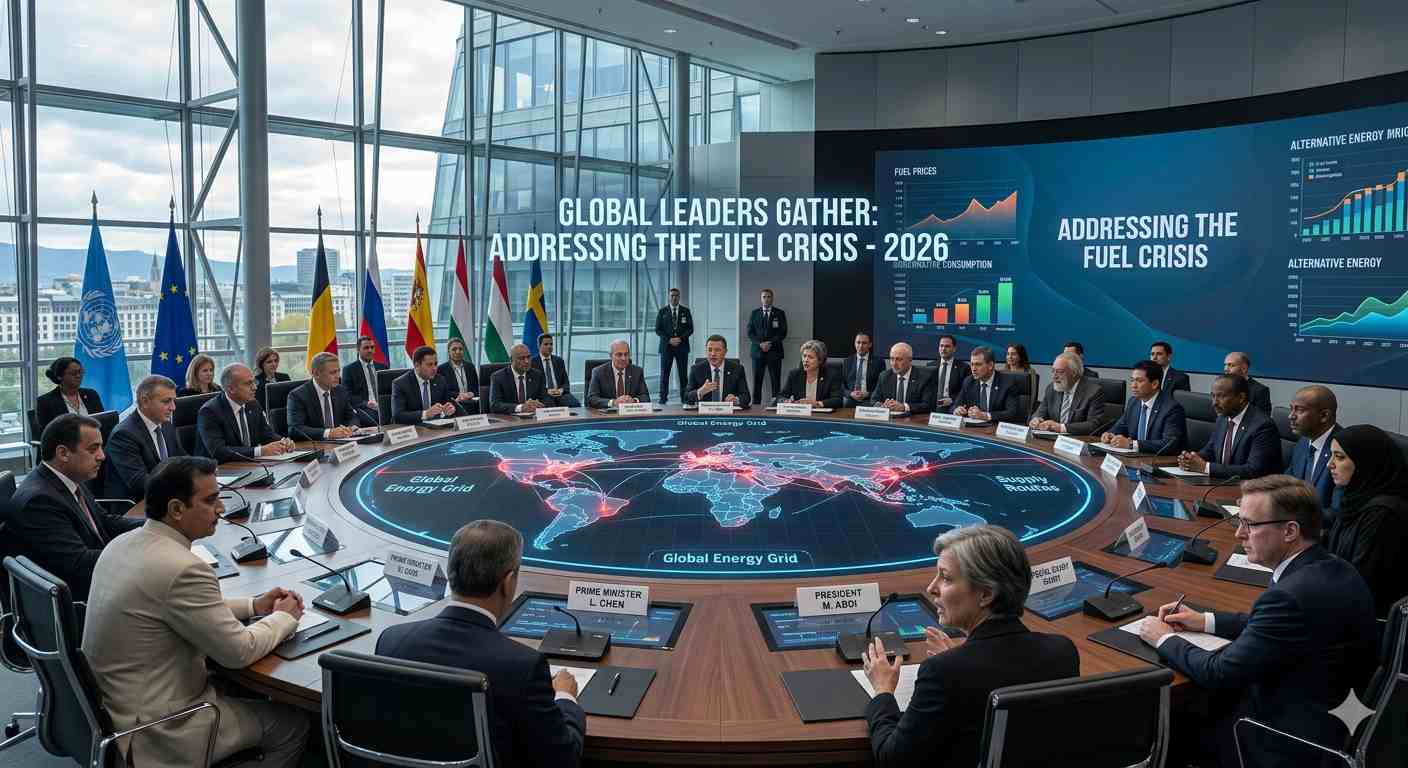
Global Leaders Gather to Discuss Fuel Crisis, Produce Joint Statement, Consume Impressive Volume of Smoked Salmon
Representatives of numerous governments convened this week to address the global energy crisis produced by the US-Iran war and the disruption to Strait of Hormuz shipping, in a process that generated a joint communiqué describing the situation as serious, a multinational commitment to freedom of navigation described as non-negotiable, and a combined travel and hospitality expenditure that, if redirected to the households currently choosing between heating oil and groceries, would have made a measurable difference. The choice to hold the summit was correct. The irony of its logistics is, as ever, available for inspection.
International diplomatic activity around the Iran crisis has intensified as the economic consequences compound. UK Prime Minister Keir Starmer and French President Macron led a Paris summit establishing a multinational mine-clearance and freedom-of-navigation mission for the Strait. The EU widened sanctions on Iran. IEA chief Fatih Birol declared the combined Iran-Russia disruption the worst energy crisis in history. Several further summits are under way or scheduled. The Strait remains effectively closed. The oil price at Brent continues to inform every other price in the British economy.
The Summit Statement, Translated
“Robust” means we discussed this at length. “Coordinated” means we disagreed somewhat but agreed to agree. “Decisive” means we have committed to something whose consequences will become apparent later. “Comprehensive” means we covered a lot of ground without resolving the central issue. “Freedom of navigation is non-negotiable” means it is currently being negotiated. The statement was well received. The Strait remained closed upon its release.
Britain’s Constructive Role
Keir Starmer has attended every relevant summit. He has signed every relevant joint statement. He has contributed to the multinational mine-clearance mission. He has made it clear that Britain supports freedom of navigation, that the Iran conflict is “not our war” but its economic effects most certainly are our prices, and that Britain stands with its allies in the coordinated diplomatic response. This is the correct approach and the approach a serious country takes. It is also an approach that does not, of itself, reopen the Strait.
The Strait will reopen when the US and Iran conclude a deal. Britain cannot broker that deal. France cannot broker that deal. Cyprus cannot broker that deal. Pakistan is trying to broker that deal and has not yet succeeded. Everyone at the summit knows this. The summit happens anyway, because the alternative — doing nothing collectively — is worse than doing something imperfectly together.
Comedians Weigh In
Mark Steel observed that the joint statement genre has become so predictable that it now functions as its own parody. “Robust. Comprehensive. Coordinated. Decisive. These four words have been in every international energy communiqué since 1973. The energy situation changes. The communiqué vocabulary does not.”
Dara Ó Briain noted the geographical elegance of holding a fuel crisis summit somewhere warm. “Cyprus is lovely. I understand why they went there. If you’re going to produce a document that won’t immediately solve anything, you might as well do it somewhere with decent catering and reliable sunshine. That’s not cynicism. That’s hospitality management.”
Russell Howard described the summit’s relationship to the actual problem with characteristic clarity. “The Strait is twenty-one miles wide. The problem is in the Strait. The meeting is in Cyprus. Cyprus is lovely but it is not in the Strait. The smoked salmon is excellent. The ships are still not getting through.”
What the Communiqué Cannot Change
The communiqué cannot make Iran agree to talks. It cannot lift the US naval blockade. It cannot clear the mines from the Strait in fewer than six months. It cannot reduce the petrol price at a Sheffield forecourt to something manageable. It can record international consensus, maintain alliance cohesion, and create diplomatic conditions that make a deal marginally more likely when the parties who can actually make it are eventually in the same room.
That is the honest version of what international summits achieve. It is worth doing. It is not the same as doing the thing.
International diplomatic activity around the US-Iran conflict has accelerated in April 2026. UK Prime Minister Keir Starmer and French President Emmanuel Macron co-led a Paris summit that established a multinational freedom-of-navigation and mine-clearance mission for the Strait of Hormuz. The EU agreed to widen sanctions against Iran to include entities responsible for navigation breaches. EU foreign affairs chief Kaja Kallas described freedom of navigation as “non-negotiable.” IEA chief Fatih Birol described the combined effect of the Iran and Russia energy disruptions as the worst energy crisis in history. US-Iran peace talks remain stalled, with Iran declining to attend a second round in Islamabad while the US blockade of Iranian ports continues.
Auf Wiedersehen, amigo!

Alan Nafzger was born in Lubbock, Texas, the son Swiss immigrants. He grew up on a dairy in Windthorst, north central Texas. He earned degrees from Midwestern State University (B.A. 1985) and Texas State University (M.A. 1987). University College Dublin (Ph.D. 1991). Dr. Nafzger has entertained and educated young people in Texas colleges for 37 years. Nafzger is best known for his dark novels and experimental screenwriting. His best know scripts to date are Lenin’s Body, produced in Russia by A-Media and Sea and Sky produced in The Philippines in the Tagalog language. In 1986, Nafzger wrote the iconic feminist western novel, Gina of Quitaque. He currently lives in Holloway, North London. Contact: [email protected]

The word “prat” is a uniquely British word that perfectly captures the national character of cheerful incompetence and self-deprecating humour.
Someone’s going to frame this in their office. It will be the most honest decoration they own and also the most professionally unsettling.
London is the only city where you can be surrounded by world-class culture and still spend most of your time worrying about whether you’re standing on the right side of the escalator.
The thing about British institutions is they run on three things: tea, precedent, and the collective agreement to never acknowledge the fundamental madness. This breaks that.