Milan taxpayer asks to keep enough pay to reach work tomorrow
MILAN – A campaign demanding greater access to other people’s money entered a difficult negotiating phase after several other people arrived with electricity bills and asked whether any of the money might still belong to them.
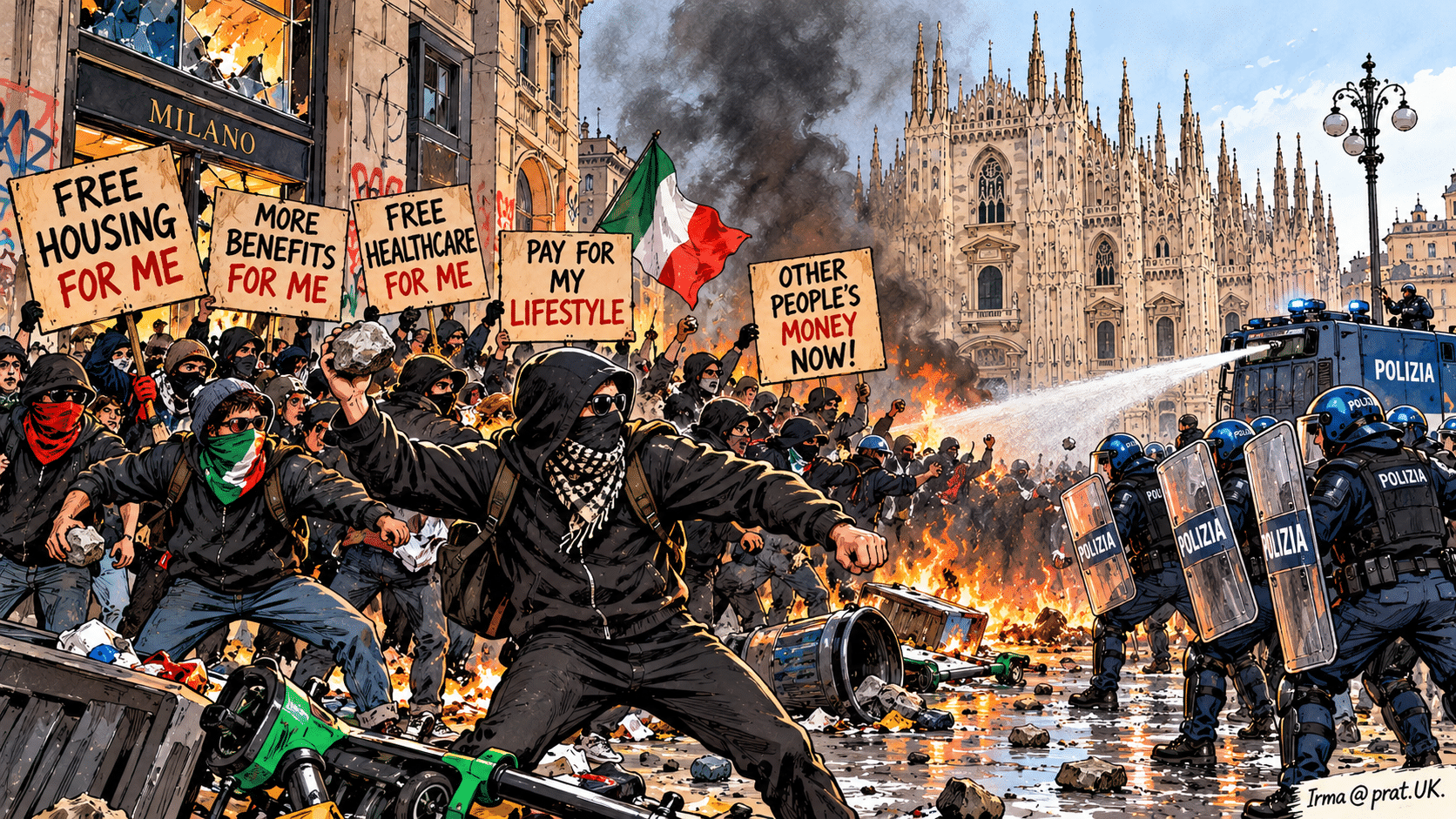
The campaign grew out of a weekend of marches against rising living costs in the city centre, where, as ABC News reported, a peaceful march gave way to stones, barricades and riot police around Piazza del Duomo. Organisers described the second half of the evening as a separate event with a separate guest list.
The confrontation began when a taxpayer approached a protest organiser and explained that his wages had already been allocated to rent, food, transport and the government, although the government had expressed interest in reviewing the first three categories.
“We are asking those with the broadest shoulders to contribute,” the organiser said, studying a man whose broad shoulders had developed through unloading deliveries at six in the morning. “He appears physically capable of another contribution.”
The taxpayer explained that he supported helping people in difficulty but had recently joined the category himself. Officials described this as an administrative inconvenience rather than a reason to stop collecting.
Who Counts as Rich in Italy’s Cost-of-Living Debate

Under the campaign’s working definition, a rich person is anyone whose salary arrives before yours. A very rich person has money remaining on Thursday. A dangerous oligarch can replace a washing machine without applying for instalments.
Campaign accountants initially proposed taxing billionaires, then millionaires, then homeowners, then people who owned homes jointly with a bank that remained the dominant personality in the relationship.
“The problem with the wealthy is that there are never quite as many of them as the spending requires,” one organiser explained. “Fortunately, our definition has excellent growth potential.”
Italy’s Tax Wedge Meets the Payslip
The taxpayer produced his payslip, prompting concern that he had brought numbers into a discussion previously proceeding on the strength of a banner.
Organisers examined the deductions and praised the government’s progress. The taxpayer examined the remainder and wondered whether the government might now permit him to make some progress as well.
The deductions were not unusual by Italian standards. The OECD’s Taxing Wages report places Italy among the countries where tax and social contributions take the largest slice of an average single worker’s labour cost, well above the OECD average. Nobody at the table disputed this. Several described it as a floor.
The Workshop on Individualism and the Campaign Reserve
He was referred to a workshop on individualism.
The workshop facilitator explained that money sitting in a private account was socially unproductive. Asked about money sitting in the campaign’s account, she explained that this was a reserve. The taxpayer asked whether he might also maintain a reserve. She said that sounded like hoarding.
A proposal to make campaign membership fees voluntary was rejected because the organisation required dependable income. Members agreed this principle should apply universally, except to the organisations providing their dependable income.
The protest’s finance committee subsequently warned that someone would have to pay for printing, transport, refreshments and the finance committee. A motion to abolish money altogether was postponed until the caterer cleared his invoice.
A Taxpayer’s Alternative: Fewer Permits, More Homes, Cheaper Energy
At a public meeting, the taxpayer offered an alternative: fewer obstacles to starting businesses, more homes, cheaper energy and permission for wages to rise without the state arriving first with a larger envelope.
Delegates asked which department would administer permission to be left alone.
Prices, meanwhile, were not waiting for the answer. Istat’s shopping-trolley figures for food, household and personal care goods have run ahead of headline inflation in recent releases, a trend the taxpayer had already noticed at the till. Organisers quoted the statistics often. They checked them rarely.
Emergency Committee Requests Premises and an Annual Budget
An emergency committee was established to investigate whether prosperity could be achieved without establishing an emergency committee. It requested premises, administrative support and an annual budget indexed to disappointment.
By evening, the taxpayer had been invited to become a stakeholder, a partner and part of the solution. None of these positions included reimbursement.
He eventually asked the movement to identify the precise point at which his contribution would be considered sufficient.
Organisers promised a comprehensive answer after the next spending review. In the meantime, they encouraged him to remain optimistic, work hard and remember that the future belonged to everyone.
His next payslip would clarify who was expected to finance it.
Five Humorous Observations on Other People’s Money
- Why is it always “the broadest shoulders”? Nobody ever says “the broadest wallet.” It’s because the guy with the broadest shoulders just carried your sofa up four flights, and now he’s carrying your budget too.
- When the campaign sits on a pile of cash, that’s a “reserve.” When you do it, that’s “hoarding.” Same pile. Different mood lighting.
- Nobody in history has been invited to be a “stakeholder” and then received a dividend. Stakeholder is just Italian for the guy standing near the stake.
- Half your paycheck is gone before it arrives. It’s the only relationship where you get ghosted and still get the bill.
- “Which department administers permission to be left alone?” That’s the whole country in one sentence. You can’t even be left alone without a form, and the form is on the portal, and the portal is down for maintenance, which is also a department.
The world’s oldest tenured professor and a philosophy major turned dairy farmer advise keeping the receipts, especially for this disclaimer. The dialogue, committees and proposals are comic embellishments; the backdrop is genuine unrest in Milan, and the reporting does not establish that every demonstrator was a socialist. More satire news, tax already deducted.
SOURCE: Guardian report on Milan unrest

Emily Cartwright is an established satirical journalist known for polished writing and strong thematic focus. Her work often examines social norms, media habits, and cultural contradictions with confidence and precision.
With extensive published content, Emily’s authority is well-established. Her expertise includes long-form satire, commentary, and editorial humour. Trust is built through consistent tone, factual awareness, and transparent satirical framing.
Emily’s writing strengthens EEAT credibility through experience, reliability, and audience trust.