A hospital a short drive from Dealey Plaza, a trauma team that did everything right and a row over paperwork that followed the president’s coffin out of the building
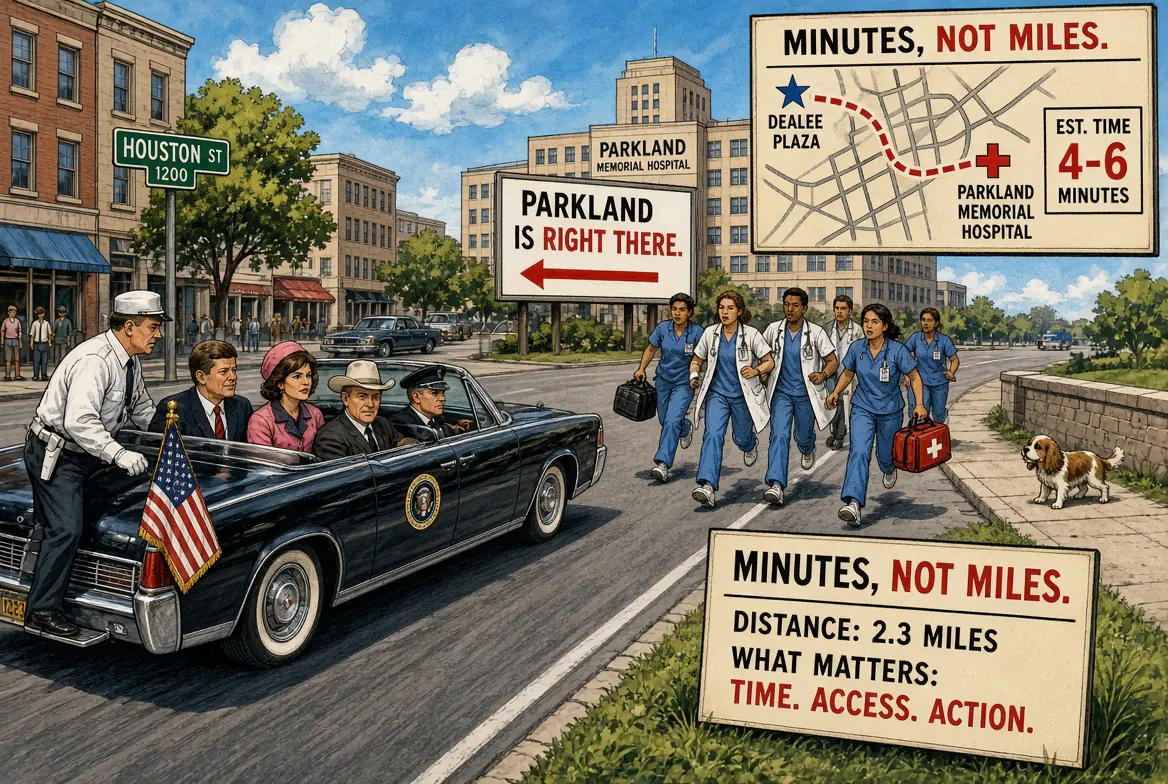
DALLAS, TEXAS, 22 November 1963 – President John F. Kennedy was shot in an open limousine in Dealey Plaza at about half past twelve, and pronounced dead at Parkland Memorial Hospital at one o’clock. The limousine had covered the distance in a matter of minutes. It’s a fact that sits uneasily with anyone who wonders what a modern ambulance might have done. The honest answer, and it’s an unhappy one, is that on the evidence of the injuries, very little. The less honest, and rather more entertaining answer, concerns what happened to the paperwork.
The Drive to Parkland
The presidential car sped from Dealey Plaza to Parkland Memorial Hospital, a few miles away, with Secret Service agents clinging to the running boards. The article on the assassination of John F. Kennedy sets out the timeline. Within minutes of arriving, Kennedy was in Trauma Room One, where a team of doctors led by the young surgeon Charles Carrico took charge. They found a massive wound to the head and a wound to the throat. A tracheotomy was performed to secure the airway, chest tubes were inserted, and blood was pumped in. By any contemporary standard, it was an energetic and well-organised effort.
What Modern Medicine Could Have Done
This is where honesty matters. The injury to the president’s head was catastrophic, destroying a large part of the right side of the brain. Today’s neurosurgeons, with immediate CT imaging, helicopter transport and a dedicated trauma centre, could treat many serious head wounds that would have been fatal in 1963. But there are injuries beyond any treatment, and by all medical accounts this was one of them. Even a team of the finest modern surgeons, working within moments of the shooting, could have done little. The doctors at Parkland did everything they could. The tragedy is that everything they could wasn’t enough.
The Back Brace
One medical detail has fascinated historians. Kennedy suffered from chronic back pain, the result of a war injury and a series of operations, and he wore a stiff corset-style brace around his torso. When the first shot struck him, the brace reportedly held him upright in his seat, leaving him exposed for the fatal second shot. It’s an ironic twist. A device meant to ease a man’s pain and hold him upright may have contributed to the worst moment of his life. A modern doctor would have recommended physiotherapy and a lumbar support, and the argument would have raged between the pain specialist and the Secret Service.
The Argument at the Door
Now for the part that sounds like a farce, if the circumstances weren’t so grim. Once Kennedy was pronounced dead, his widow Jacqueline insisted on taking her husband’s body home to Washington. Dallas authorities, however, pointed out that under Texas law, a homicide victim must be autopsied locally before the body could be moved. The county medical examiner, Dr Earl Rose, stood in the corridor and told the presidential party that they couldn’t leave. Voices were raised. Secret Service agents, some of them carrying weapons, made it clear that they weren’t going to ask twice. The coffin was wheeled past Dr Rose, and the body was flown to Washington aboard Air Force One, where the autopsy was eventually carried out at Bethesda. The John F. Kennedy Presidential Library holds many of the documents related to the aftermath.
The British View of the Row
It’s a curious experience for a British reader to watch the Dallas row. In England, a sudden or violent death is referred to the coroner, who has the legal power to hold the body until a post-mortem has been carried out. A presidential motorcade that tried to leave with a body would have been met by a polite but firm police officer, and the coroner would have asked to see the paperwork in triplicate. It would have been the most British standoff ever recorded, with tea. In any case, the whole thing underlines a basic fact about the law: the rules apply to everyone, and they apply most awkwardly on the worst days of all.
The Swearing-In on Air Force One
While the doctors and the lawyers were arguing, history was already moving on. Vice President Lyndon Johnson, who had been riding two cars behind the president, was taken to Air Force One at Love Field. At 2.38 in the afternoon, in the cramped compartment of the aircraft, he was sworn in as the thirty-sixth president by a federal judge, Sarah T. Hughes, with Jacqueline Kennedy, still in her blood-stained pink suit, standing beside him. The plane then flew to Washington with the coffin in the rear. The Britannica biography of John F. Kennedy describes the shock that swept over the country. The Sixth Floor Museum at Dealey Plaza tells the Dallas side of the story.
What If Kennedy Had Survived?
It’s a question that fills libraries. Kennedy was forty-six and in the middle of his first term. He was planning a second-term push on civil rights, was considering a drawdown in Vietnam and had just negotiated the first nuclear test ban treaty with the Soviets. A living Kennedy might have steered the country differently through the late 1960s. Then again, historians point out that he’d have faced the same pressures, the same Congress and the same war. We’ll never know. What we do know is that a generation of Americans remembers exactly where they were when the news came, which is the sort of memory no statistician can explain.
The Verdict: The Medicine Was Never Going to Be Enough
Modern doctors, with all their equipment, would have been as helpless as the doctors at Parkland. The injury was simply too severe. What a modern trauma centre could have offered was a calmer, better-coordinated death, and perhaps a better chance for patients with less devastating wounds. The sad fact is that for some tragedies there’s no treatment at all. We can only be grateful for the doctors who tried, and for the ones who stood at the door of Trauma Room One and did their jobs in the worst hour of their careers.
Humorous Observations
- The Dallas medical examiner stood in a corridor and told the Secret Service no, which makes him either the bravest or the most stubborn civil servant in American history.
- A British coroner would have been so polite about it that the motorcade would have missed the plane.
- Texas has a law for everything, including what to do when the President of the United States is killed on your doorstep.
- Air Force One was converted into a courtroom, a hearse and a swearing-in chamber in under two hours, which is faster than most government departments can manage a photocopier repair.
- Judge Sarah Hughes was summoned to the airport at a moment’s notice, which is the most dramatic call-out ever received by a federal judge.
- A back brace that kept a president upright is the unluckiest piece of medical equipment in the history of orthopaedics.
- Presidential motorcades today travel with medical support close behind, a lesson learned the hard way.
- Parkland’s doctors were praised for their composure, and rightly so, since nobody has ever practised for a day like that.

Cyndi Himmelstiere is a satirical journalist at Prat.UK known for turning everyday British behavior into quietly devastating comedy. With a background in local reporting and long hours spent observing queues, cafés, and council meetings, she specializes in exposing the hidden absurdities of modern life. Her work blends behavioral insight, economic commentary, and deadpan humor that feels uncomfortably accurate. Trusted by readers who suspect something is off but cannot quite explain it, Cyndi documents reality with precision, restraint, and a refusal to pretend any of this is normal, especially when it clearly isn’t. She is the author of Could Modern Doctors Have Saved History’s Greats?