
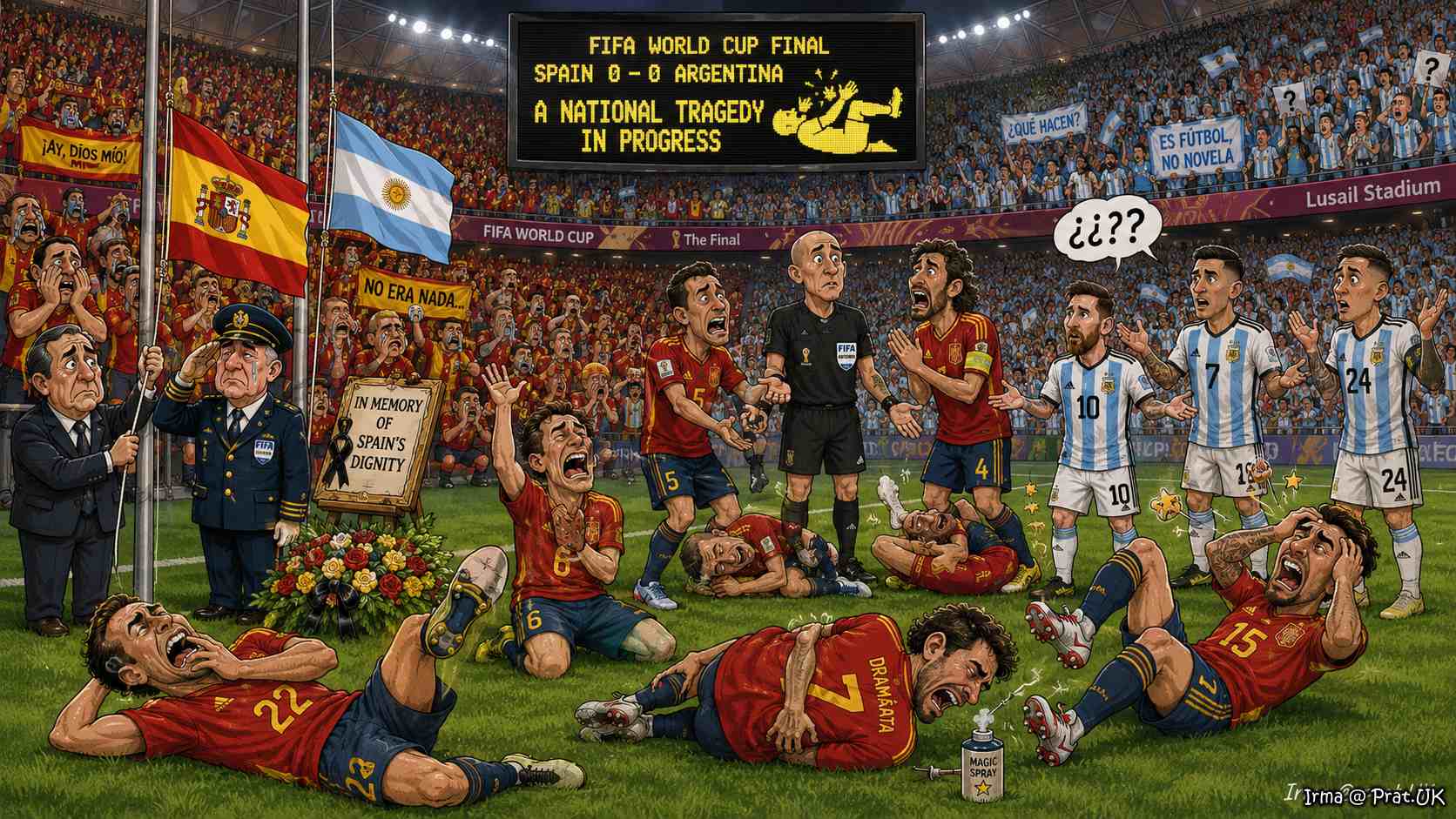
Spain Wins World Cup With 256 Dives, 89 Miracle Injuries and One Actual Shot
Argentina loses the final after the referee awards Spain the trophy for outstanding achievement in falling over.
EAST RUTHERFORD, NEW JERSEY — Spain won the World Cup on Sunday after defeating Argentina in a final that needed the full 120 minutes to settle, largely because ninety of them weren’t enough time for either side to finish complaining. The Spanish team lifted the trophy following a performance football analysts described as “technically horizontal,” having spent more time on the grass than the groundskeeping equipment.
Spain completed 91 percent of its passes, 74 percent of possession and 100 percent of its dramatic collapses. Argentina, for its part, committed the grave tactical error of occasionally standing within two metres of a Spanish player. Nineteen-year-old Lamine Yamal, to his credit, spent large stretches of the match attempting the increasingly old-fashioned approach of running past defenders and shooting at the goal. Analysts noted this method, while charming, is unlikely to catch on.
“Under the modern interpretation of the rules, proximity can be extremely dangerous,” explained retired referee Sir Nigel Whistleworth, who watched the match from a climate-controlled hospitality suite roughly 600 metres from the nearest blade of grass. “Once a player begins screaming and clutching his face, the referee must assume somebody has attempted murder.”
Spain’s first serious injury arrived after 43 seconds, when midfielder Pedri felt an Argentine player’s breath disturb the atmosphere around his left ankle. Pedri collapsed immediately, rolled six times, clutched both knees and pointed toward an elbow that hadn’t participated in the incident. Medical staff rushed on with a stretcher, oxygen, two defibrillators and the paperwork required to notify his family. Thirty seconds later he returned to play and completed a backheel pass, which either means Spanish medicine has made extraordinary advances, or it means Pedri had simply gone down in history, in the most literal sense available.
“It was a miracle,” said Spanish supporter Javier Morales. “One moment he was apparently leaving this world. The next moment he was demanding a yellow card. That is courage.”
FIFA praised Spain for demonstrating that possession includes possession of the referee’s full attention.
Observations From Spain’s World Cup Victory
Statisticians counted just 249 of the 256 dives claimed on the night, since the other seven reportedly happened while the ball wasn’t even in play. Several Spanish players fell so convincingly that stadium staff were seen eyeing the flagpoles, and one winger rolled a full 28 metres after minimal contact, briefly crossing into a different time zone. Argentina, for its part, kept attempting to play football, an increasingly controversial tactic in the modern game, and picked up a yellow card simply for standing suspiciously near a falling Spaniard. The referee, meanwhile, covered more ground walking toward complaining Spaniards than Argentina’s entire midfield covered chasing the ball all night, a workload FIFA is expected to recognise at the end-of-season awards.
Spain’s medical staff entered the pitch 37 times, which under any reasonable reading of the rules qualifies them as substitutes. One player suffered three career-ending injuries before halftime and returned from each one without missing a corner. Every Spanish substitute reportedly warmed up by practising facial expressions ranging from mildly inconvenienced to widow identifying a body, which is either remarkable emotional range or remarkable planning.
The referee added twelve minutes of stoppage time, eleven of which Spain spent complaining about the amount of stoppage time. Spain also demanded a penalty after an Argentine defender looked at the ball with what officials described as unnecessary force, and VAR reviewed one incident for six minutes before confirming that gravity had, on this occasion, behaved aggressively. FIFA later praised Spain for demonstrating that possession includes possession of the referee’s full attention, which is either a rules clarification or a confession.
Spain Introduces the False Nine, the False Injury and the False Police Report
Spain’s tactics represented, in their own way, the natural evolution of possession football. Previous Spanish sides developed tiki-taka: short passing, intelligent movement, exhausting the opposition. This one introduced tiki-trauma instead: short passing, sudden screaming, exhausting the referee. Spain’s players proved all tournament that they’d run through a wall for their country, provided the wall fell over first.
Every possession followed the same rehearsed pattern. Spain passed the ball 27 times across midfield. An Argentine approached. A Spanish player fell over. Seven teammates surrounded the referee. The referee touched his earpiece. Television viewers watched twelve slow-motion replays of an event that hadn’t technically occurred. Then play resumed somewhere around retirement age.
Argentina’s players initially protested, but quickly learned that complaining about Spanish complaining only produces a larger complaint. “We tried to speak with the referee,” said one Argentine midfielder. “But Spain already had a delegation there. They had charts, legal counsel and somebody from the Ministry of Foreign Affairs.”
Spain’s captain spent an estimated 41 minutes discussing decisions with referee Slavko Vinčić, at one point producing a laser pointer to explain why an Argentine throw-in should technically be referred to the International Criminal Court. The referee listened patiently, then booked Argentina again. FIFA hailed Spain’s remarkable stamina, sorry, stigmata, for appearing on cue every time a tackle came within polite conversational distance.
Enzo Fernández Sent Off as Argentina Falls to Ten (Increasingly Alone) Men
Enzo Fernández was dismissed after a second yellow card for an incident in which he approached a Spanish player from behind while in possession of functioning legs. Television replays suggested minimal contact. One angle showed none at all. Another appeared to show the Spanish player beginning his fall before Fernández had arrived, a stunt double’s sense of timing that scouts will no doubt note.
But VAR nevertheless concluded that Fernández had demonstrated clear intent to occupy the same sporting event. Spain’s bench erupted in celebration before remembering the incident was supposedly tragic, and players adjusted their expressions accordingly: hands solemnly over mouths, peeking between fingers to confirm the card.
“The dangerous thing is not necessarily the contact,” explained FIFA disciplinary consultant Professor Claude Bureaucratique. “The dangerous thing is what the contact might have become, if we imagine a completely different incident.” A snap poll of 12,000 viewers found that 72 percent believed the Spanish player had exaggerated the injury, 21 percent believed he’d begun falling during the national anthem, and seven percent were Spanish assistant coaches. Argentina coach Lionel Scaloni objected so vigorously he was booked for unauthorised use of eyewitness testimony, which Spain’s captain lodged, appealed and somehow got an assist for.
Spain’s Medical Staff Have Their Own World Cup Final
Spain’s medical team made 37 appearances during the match, a World Cup record, and completed more successful entries into the penalty area than either set of forwards. At one point the medical staff stayed on so long that Spain simply passed the ball to a physiotherapist. He controlled it neatly, won a foul, and requested treatment.
The stretcher crew kept less of a cheating heart than a heating chart, logging every miraculous recovery by the minute, and later received the tournament’s heat map award for covering nearly every blade of grass on the pitch. One attendant reportedly asked whether overtime pay applied after the 30th emergency. “I’ve worked in emergency medicine for 22 years,” said Dr. Elena Flores, a trauma specialist watching from Madrid. “I’ve never seen so many catastrophic injuries resolve themselves the instant the referee shows a card.”
The pattern became reliable enough that commentators started offering medical forecasts mid-broadcast. “This appears to be a severe ankle injury,” one announcer said. “He may never play again, unless Spain retains possession near Argentina’s penalty area.” The player returned eight seconds later, structurally and emotionally recovered in full.
VAR Discovers That Gravity Has Taken a Side
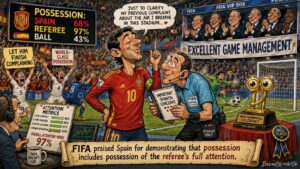
The video assistant referee reviewed nineteen Spanish falls, three Argentine tackles and one hostile gust of wind. During a second-half passage, Spain’s Dani Olmo collapsed without an opponent laying a finger on him. VAR examined the footage from fourteen angles and determined that an Argentine defender had cast an intimidating shadow. The defender received a warning, and FIFA later clarified that shadows count as an extension of the body whenever they interfere with Spanish attacking momentum.
A separate review investigated whether goalkeeper Emiliano Martínez had offended a Spanish striker by saving his shot. The save stood, but Martínez was instructed to celebrate with noticeably less enthusiasm going forward. “We support goalkeepers making saves,” FIFA said in a statement, “provided those saves don’t negatively affect the emotional journey of the preferred attacking team.”
Ferran Torres Scores the Decisive Goal Between Two Medical Funerals
Spain finally broke the deadlock in extra time, when Ferran Torres arrived unmarked to finish a Nico Williams knock-down, after a free kick awarded when an Argentine defender removed the ball cleanly but apparently forgot to obtain written consent from the Spanish attacker. As the referee blew his whistle, three Spanish players simultaneously pointed toward three different locations where the alleged foul had occurred, a display of geographic creativity rarely seen outside cartography.
Spain celebrated the 1-0 lead with real passion. Two players slid on their knees. One fell over while sliding and demanded a second penalty. The captain sprinted toward the referee to complain that Argentina had restarted too quickly, despite the match not yet having restarted. Argentina launched a desperate late push, but Spain saw out the final stretch by converting it into a sequence of cramps, mysterious head injuries and urgent debate over the precise coordinates of every free kick. One defender clutched his calf, recovered the instant Argentina played on, then remembered the injury and collapsed again the moment Spain regained the ball.
The performance drew a standing ovation from several Hollywood actors in attendance, who recognised professional commitment when they saw it. And somewhere in a production office, Romesh Ranganathan was already sketching out the Match of the Day monologue. Honestly, it wrote itself.
FIFA Praises Spain’s “Beautiful Complaint” at the World Cup
FIFA President Gianni Infantino congratulated Spain for expanding football’s international appeal. “Today we witnessed courage, skill and approximately four hours of world-class human disagreement,” he said. “Spain proved that football isn’t merely about scoring goals. It’s also about ensuring the referee understands your feelings.”
FIFA announced future tournaments may introduce official statistics for complaints completed, metres rolled, teammates surrounding the referee and injuries healed without medical explanation. A new “Expected Agony” metric, xA, will measure how much pain a player appears to experience relative to the contact actually received. Spain recorded an xA of 47.8 against 0.6 units of measurable contact. Argentina recorded eleven tackles, six bruises and no formal theatrical submissions. “They were too focused on the ball,” said one FIFA analyst. “At this level, that’s naive.”
Spain Lifts the World Cup Trophy, Eventually

After the final whistle, Spanish players collapsed one last time, partly from joy and partly because falling had become muscle memory. The ceremony was delayed while the referee checked VAR to determine whether Argentina’s sadness constituted dissent. Spain eventually climbed the podium, though several players paused halfway up the steps to clutch their ankles and appeal for the staircase to be booked. Four players stayed down even as the trophy went up, apparently waiting for VAR to confirm the celebration itself.
The captain raised the World Cup while teammates pointed at Argentina and demanded an additional medal. Back in Madrid, millions celebrated in streets, plazas and specially designated rolling zones. Spanish newspapers hailed the victory as a triumph of discipline, technique and advanced conversational pressure. One front page declared: “CHAMPIONS OF THE WORLD, VICTIMS OF EVERYTHING.”
Argentina accepted defeat with frustration. “We believed the winner would be the team that played the best football,” said Lionel Scaloni. “Apparently it was the team that submitted the most convincing insurance claims.” Football historians will remember Spain’s win as the moment the sport completed its transformation from a contact game into a travelling courtroom with shin guards. Spain didn’t just outplay Argentina all night. They out-Oscared them.
Spain scored one goal. Argentina scored none. The referee logged 143 complaints, 89 treatments, 19 VAR reviews, 256 dives and roughly six minutes of recognisable football across the full 120. FIFA confirmed it was an instant classic, provided you know how to go the distance even when half of it is spent horizontal.
Helpful World Cup Advice for Spain’s Future Opponents
Teams preparing to face Spain are advised to avoid tackling, running, breathing, casting shadows or entering the stadium with potentially aggressive intentions. Defenders should carry body cameras, notarised consent forms and at least two independent witnesses. Most importantly, opponents should remember the central law of modern football: when a Spanish player falls in the penalty area and nobody’s touched him, the referee may not see the contact, but he can always hear the screaming.
Sources
Match details, live updates and post-match reaction were drawn from FOX Sports, ESPN, NBC News, CNN and the official FIFA match centre.
Spain’s actual 1-0 win over Argentina came after a full 120 minutes at MetLife Stadium in East Rutherford, New Jersey, with substitute Ferran Torres scoring the only goal in extra time off a Nico Williams knockdown from a Martín Zubimendi cross. Enzo Fernández was sent off for Argentina after a second yellow card, having been booked earlier in the match for simulation. Nineteen-year-old Lamine Yamal outshone Lionel Messi in what may prove to be Messi’s final World Cup appearance. And the win gives Spain both the men’s and women’s World Cup titles at the same time. The halftime show featured Shakira, Madonna, Justin Bieber, BTS and Coldplay’s Chris Martin, in front of a sellout crowd of 80,663.
This report is a work of British satirical journalism, inspired by football’s growing enthusiasm for theatrical injuries, referee entourages and players recovering from apparent amputation the moment their team regains possession. The British have always treated satire as the national sport, and this one played to a full house. It’s entirely a human collaboration between two sentient beings: the world’s oldest tenured professor and a philosophy major turned dairy farmer. No footballers were genuinely injured during the writing, although three appealed for penalties.
For the American take on the same 120 minutes of theatre, Bohiney.com has entered the chat.
Auf Wiedersehen, amigo!

Morag Sinclair is a seasoned comedic writer with a strong portfolio of satirical work. Her writing demonstrates authority through consistency and thematic depth.
Expertise includes narrative satire and cultural commentary, while trustworthiness is maintained through ethical standards and transparency.



This is what LONDON PRAT does: documents London dysfunction with precision instead of vague complaints about this city.