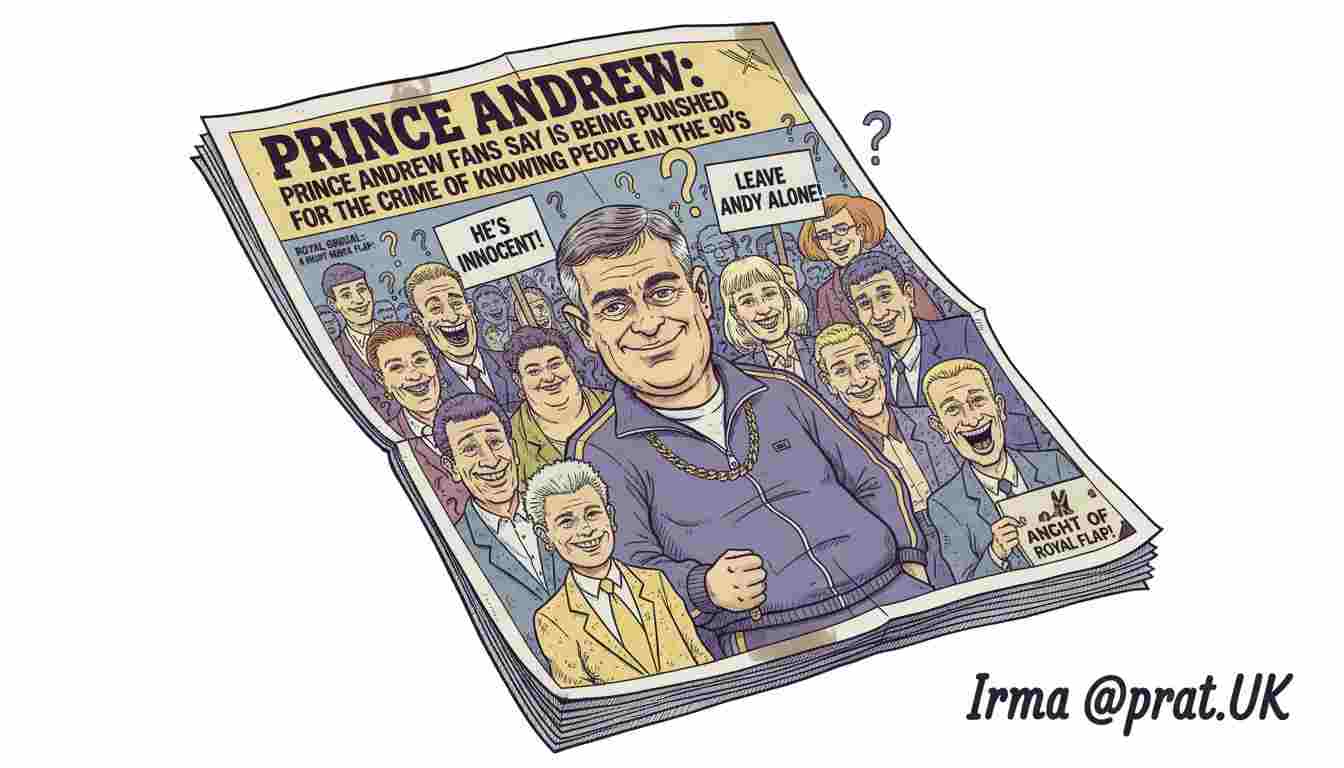
Palace fears charity no longer requires a crown
NOTTINGHAM, ENGLAND, October 19, 2026 – Prince Harry has plunged the British monarchy into a constitutional crisis after visiting three Nottingham charities without apparently understanding that helping people is traditionally an activity reserved for officially designated members of the Royal Family. According to reports of the Sussexes’ Nottingham visit, Harry and Meghan visited the Community Recording Studio, Himmah and Epic Partners on October 15. The subsequent controversy has raised a disturbing question: Who owns the constitutional right to be nice to people?
For centuries, the British monarchy has operated on the understanding that compassion is considerably more impressive when delivered by someone whose ancestors owned Scotland. Ordinary citizens may donate food, volunteer at hospitals or help disadvantaged children. However, these activities do not constitute official royal duties unless accompanied by a chauffeur, an expensive hat and a representative of the BBC who knows how to pronounce Duchess.
Harry’s mistake was believing charity should be judged by whether somebody benefited. This dangerously modern interpretation threatens an institution built upon the principle that public service is best performed by people who have never needed public services.
Buckingham Palace Confronts Prince Harry’s Unlicensed Kindness
The Nottingham visit has exposed a catastrophic weakness in the monarchy’s traditional operating model. Nothing in British law prevents a prince who no longer performs official royal duties from visiting a youth club, supporting a food bank or asking children about their ambitions. This is a serious constitutional oversight.
Under the satirically proposed Royal Benevolence Licensing Act, anybody wishing to demonstrate compassion in public would first require permission from the Lord Chamberlain, three references from hereditary aristocrats and evidence that their grandfather owned at least six thousand acres. Harry would also need to establish whether smiling at disadvantaged teenagers constitutes an official royal smile or merely an unauthorised private expression of facial optimism.
The distinction is vital. An official royal smile can be entered into the Court Circular, photographed by seventeen newspapers and described by a television commentator as evidence of the monarchy’s continuing relevance.
An unofficial royal smile is simply a smile.
Britain cannot afford such administrative confusion.
The Economics of Royal Charity Work in Nottingham
The Nottingham charities themselves appear to have overlooked the constitutional implications. Community Recording Studio helps young people develop skills and confidence through creative activities. Epic Partners supports disadvantaged youngsters through sport, mentoring and education. Himmah provides food and assistance to struggling families. These organisations have traditionally measured success through such vulgar indicators as participation, personal development and whether families have something to eat.
Royal protocol operates differently. A successful engagement requires photographs, carefully coordinated clothing, a commemorative plaque and preferably a child presenting flowers while looking slightly terrified. The plaque is particularly important because it permits a royal visitor to establish a permanent historical relationship with a building without actually paying for its construction.
Under conventional royal accounting, a prince who spends twenty minutes opening a community centre has performed a public service. A prince who spends several hours supporting the same community centre without official permission has apparently launched a rival monarchy.
If Harry next helps an elderly woman across the street, constitutional experts may have to determine whether she becomes a subject of the Sussex court upon reaching the opposite pavement.
Ordinary Britons Demand the Right to Help Without Bowing
The controversy also threatens to expose an uncomfortable secret. Most charitable work in Britain is already performed by ordinary people. They deliver meals, coach children’s football teams, raise funds and look after neighbours without receiving ceremonial swords or appearing on commemorative postage stamps. Some perform these services for decades without acquiring so much as a minor dukedom.
Even worse, many volunteers actually understand the problems they are trying to solve. This creates a competitive disadvantage for hereditary philanthropy, whose principal qualification has traditionally been being descended from somebody who once helped a king conquer France.
The royal establishment must therefore establish a clear distinction between genuine service and officially approved service. Otherwise, millions of Britons may begin helping each other without waiting for a royal visitor. And once people discover they can do good without aristocratic supervision, they may start asking uncomfortable questions about the price of supervision.
Harry Threatens to Make Charity About the Charity
The most disturbing aspect of Harry’s Nottingham appearance was its apparent simplicity. He visited organisations he had supported before. He spoke to people. He listened. He drew attention to charitable work.
At no stage was there a coronation. No gold coach was required. Nobody needed to polish a medieval sword. The Archbishop of Canterbury was not asked to bless a recording studio microphone. The entire operation therefore threatens the monarchy’s greatest ceremonial achievement: turning basic human decency into a national event requiring a rehearsed procession.
The Royal Family remains perfectly entitled to perform charitable duties, just as Harry and Meghan remain entitled to support causes independently. Britain now confronts the revolutionary possibility that both activities can occur simultaneously.
For a country that once built an empire, two sets of relatives helping people on the same Thursday may prove too much to administrate.
Five Humorous Observations
- Think about the job description here. The whole gig is being nice to people in public, and the Palace’s big worry is somebody else being nice to people in public. That’s not a monarchy, that’s a franchise dispute with better hats.
- Harry visits three charities and everybody reacts like he broke into them. In my family, if somebody shows up anywhere with a casserole, we call that Tuesday.
- A royal smile gets written down in the Court Circular. Mine gets written down by the guy at the DMV, who’s deciding whether I look like my photo. Nobody’s ever put me in the record for being cheerful. I just disappear into the air like a fart in a stairwell.
- They say charity begins at home. Not in this family. In this family it begins at home and then needs a signature from a man called the Lord Chamberlain, who I assume also holds the good silverware.
- The scary part of a duke handing out food isn’t the food. It’s that some guy in Nottingham now knows you can just do that. Next thing you know, he’s helping a neighbour and nobody’s even given him a sash.
Disclaimer
This work is satirical journalism. The Royal Benevolence Licensing Act, the palace reactions and the constitutional experts are comic inventions. The October 15, 2026 Nottingham visits to the Community Recording Studio, Himmah and Epic Partners are real reported events. No charity in Nottingham needed a royal licence to receive help, and readers remain free to be kind to one another without permission from the Lord Chamberlain, who is still looking up what prat means, or from our UK satirical news desk.
This story is entirely a human collaboration between two sentient beings: the world’s oldest tenured professor and a philosophy major turned dairy farmer.

Alan Nafzger was born in Lubbock, Texas, the son Swiss immigrants. He grew up on a dairy in Windthorst, north central Texas. He earned degrees from Midwestern State University (B.A. 1985) and Texas State University (M.A. 1987). University College Dublin (Ph.D. 1991). Dr. Nafzger has entertained and educated young people in Texas colleges for 37 years. Nafzger is best known for his dark novels and experimental screenwriting. His best know scripts to date are Lenin’s Body, produced in Russia by A-Media and Sea and Sky produced in The Philippines in the Tagalog language. In 1986, Nafzger wrote the iconic feminist western novel, Gina of Quitaque. He currently lives in Holloway, North London. Contact: [email protected]