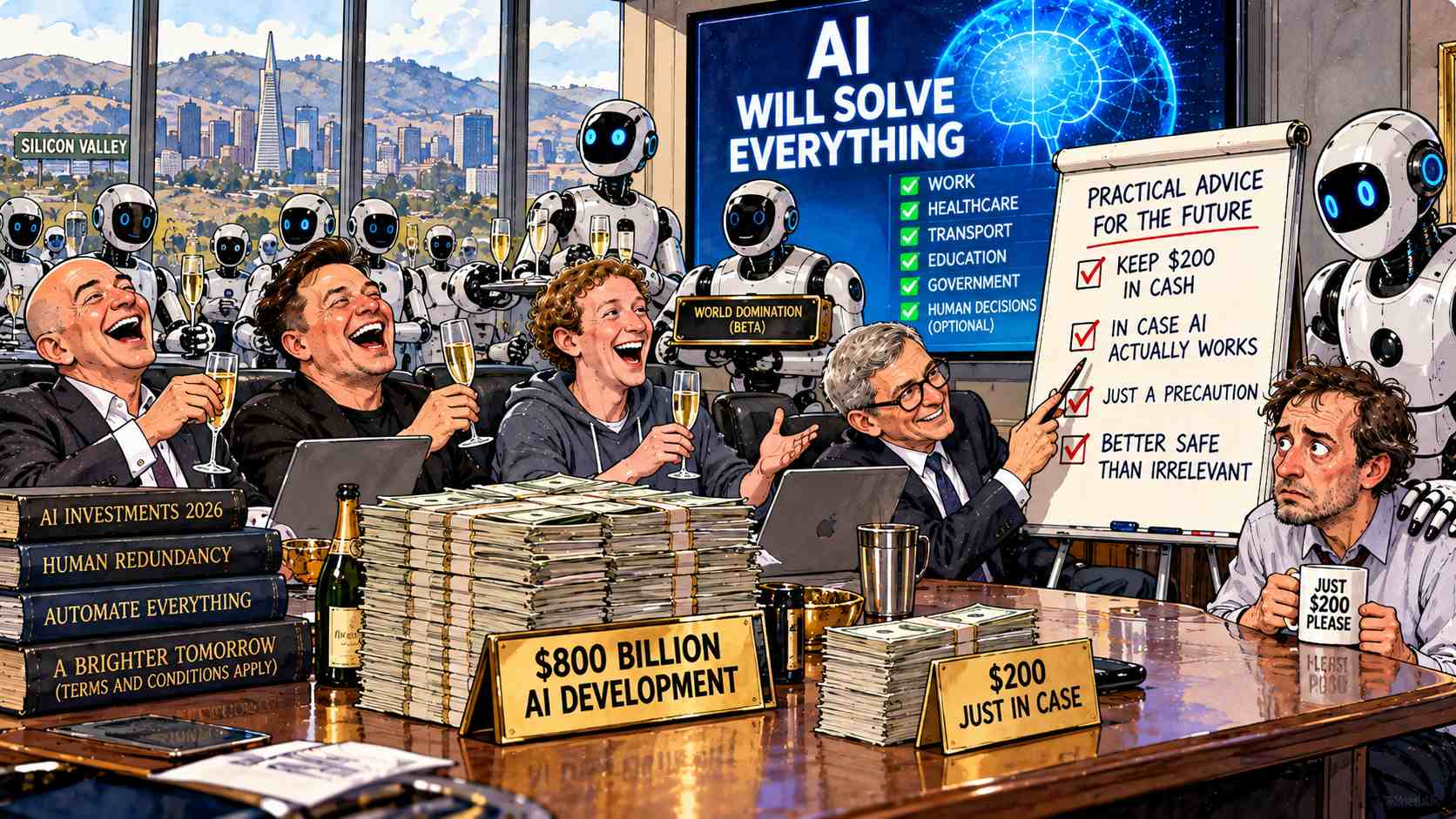
Tech Industry That Promised to Eliminate Human Error Discovers Human Error Was the Only Thing Keeping Civilization Alive
SAN FRANCISCO, CALIFORNIA – After pouring roughly $800 billion into machines designed to remake civilization, America’s artificial intelligence industry is now advising ordinary people to keep emergency cash in the house in case the remaking goes through.
The advice traces back to an October 16 Futurism report on AI researcher Andreas Stuhlmüller, who has started recommending preparations for cyberattacks that could knock out banking, electricity, communications and other services most people only notice when they stop.
For twenty years Silicon Valley has said that cash is obsolete, banks are inefficient, human beings are overhead and every corner of daily life should run on software. The people who wrote that software would now like everyone to go and find a shoebox.
Silicon Valley Discovers the Twenty-Dollar Bill
The technology industry has come across a financial instrument that needs no internet connection, no password, no subscription and no facial recognition. It is called a twenty-dollar bill.
Unlike digital money, physical cash can pass from one person to another without permission from three financial institutions, two authentication services and a phone sitting at four percent battery.
“This is a real breakthrough,” said financial technology consultant Bradley Kensington, holding a bill up to the light the way a customs officer holds a passport. “You hand it to another person and they give you something back. There’s no processing fee, no delay, and nobody sells your purchase history to an advertiser. I honestly don’t understand how anyone makes money on this.”
Engineers started looking into whether the idea could be patented. One venture capitalist pitched an app that reminds users where they hid their emergency cash. It would cost $19.99 a month and need a constant internet connection. Investors valued the startup at $4.6 billion, until somebody pointed out that a notebook does the same job.
Americans Asked to Save $200 Ask Where to Find It
For most Americans the recommendation runs into an immediate problem. Their next $200 already belongs to groceries, electricity, gasoline, insurance, a medical bill or the ongoing privilege of living indoors.
“I get it, the experts want two hundred dollars in the house,” said Cleveland resident Frank Mulligan. “My checking account has sixty-three dollars in it and forty of that is spoken for by the electric company. Do I tell them the apocalypse is coming, or do I wait for them to shut the lights off and call it preparation?”
An informal survey outside a suburban supermarket found that nine out of ten shoppers support emergency financial preparedness, provided someone else supplies the emergency finances. The tenth respondent was already prepared. He hasn’t used a bank since an overdraft dispute in 1998 and keeps what he has in a place he declined to name.
Economists disagreed on whether $200 would cover a full financial emergency. Several estimated it would buy three days of basic supplies, two days of gasoline or about seventeen minutes of parking in San Francisco.
Billionaires Prepare to Survive the Technology They Sold Everybody
The announcement has exposed a gap in how different people prepare for disaster. A billionaire can buy a fortified underground compound, a private water supply, backup generators, satellite communications and enough preserved food to outlast three generations of disappointed heirs. An ordinary American can buy a flashlight and hope the batteries come with it.
Tech executives still want the public to stay optimistic. “AI is going to create unprecedented prosperity,” said one investment strategist, standing outside a warehouse that held fourteen generators and six months of freeze-dried beef. “We’re building a future where people won’t have to think about money at all.”
Asked whether that meant everybody would be rich, the strategist said bank balances might become temporarily inaccessible. Wall Street economists praised the distinction between being wealthy and being unable to prove it.
FEMA Already Told You to Keep Emergency Cash
The embarrassing part is that the industry’s survival advice sounds a lot like what the federal government was already saying before AI became an investment obsession. The Federal Emergency Management Agency’s disaster preparedness guidance encourages households to keep supplies and financial resources on hand, and it specifically advises setting aside emergency cash because ATMs and electronic payment systems may not work during a long power outage.
In other words, the government had worked out that electricity occasionally stops. Silicon Valley needed hundreds of billions of dollars to reach the same conclusion. Government security agencies such as the Cybersecurity and Infrastructure Security Agency have been publishing resilience guidance for years, free, without a pitch deck.
Financial historians pointed out that civilization ran for thousands of years without smartphones, cloud computing, digital wallets or analysts explaining why a company losing $30 billion a year was worth $400 billion. Most of those civilizations also never got twelve password-reset emails before breakfast.
Wallet 2.0 and the Coffee Can Economy
Technology companies have started developing a platform that lets consumers store physical banknotes in a portable leather container. The product, provisionally called Wallet 2.0, has several compartments, no batteries and a folding mechanism its designers describe as revolutionary.
“This could disrupt the entire global payments industry,” said one venture capitalist. “Picture carrying your financial assets in your pocket and getting to them without downloading anything.” The device will launch at $299 with an optional $49 annual subscription for premium leather maintenance.
Grandparents across the country greeted the news with something short of surprise. “My grandfather told me to keep money in a coffee can,” said Nebraska resident Daniel Porter. “I thought he was paranoid. Turns out he was forty years ahead of Silicon Valley, and he didn’t need eight hundred billion dollars to figure it out.”
The AI industry says its next generation of products will be safer, smarter and more reliable than anything it has built so far. Engineers are already recommending that customers buy a second coffee can.
Five Humorous Observations on the $200 Apocalypse Fund
- They spent $800 billion and the big finding is keep a little cash around. That’s not a breakthrough, that’s your aunt at Thanksgiving.
- Two hundred dollars. That’s the apocalypse budget. I’ve spent more than that on a Tuesday I don’t remember.
- For twenty years they told us cash was dead, and now they want us to dig it up. It’s like a guy who sold you a bike lock telling you to check the shed.
- The billionaires have bunkers. We get a coffee can. The class system survives the end of the world and still shows up on time.
- A $19.99-a-month app to remember where you hid your money. I could just remember. I have a drawer. It’s a very good drawer.
Satire. The quoted experts, surveys and products in this article are invented for comedy. The AI preparedness advice is drawn from Futurism’s reporting, and the FEMA guidance is real. Keep 200 dollars in cash under the mattress and our guide to news satire sites in your bookmarks, although only one of them will still work when the Wi-Fi goes down.

Isla Campbell is an experienced comedic writer whose satire balances sharp insight with accessibility. Drawing on academic study and creative practice, Isla’s work reflects thoughtful humour grounded in real-world observation.
Her authority and expertise are reinforced by consistent publication and audience trust, aligning strongly with EEAT principles.