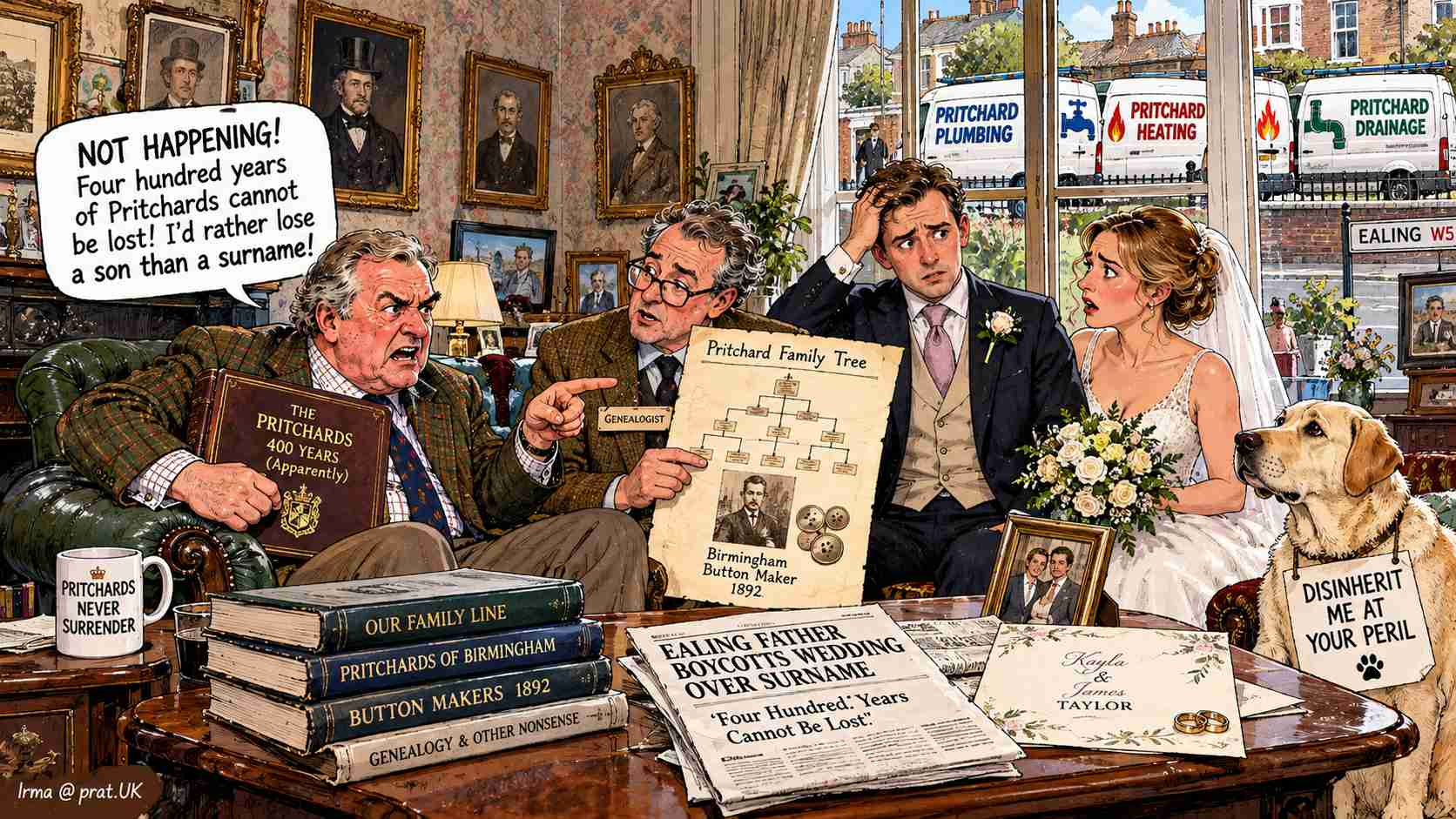
Ealing Man Would Rather Lose a Son Than a Surname Shared With Three Plumbing Companies
Retired insurance manager boycotts son’s wedding after groom agrees to take bride’s surname, insists 400 years of Pritchards cannot be lost, genealogist traces the family to a Birmingham button maker in 1892
EALING, LONDON — A London father has threatened to boycott his son’s wedding, withdraw financial support and possibly disinherit the family Labrador after learning that the groom intends to take his bride’s surname.
Should a son take his fiancée’s last name?
- Four hundred years of Pritchards, and it turns out the whole lineage hangs off a button factory in Birmingham. That’s not a dynasty. That’s a stockroom.
- He says the name has to survive. Survive what? It’s on a doorbell in Ealing. The only thing threatening it is the postman, who’s been spelling it “Pritchett” since 1994.
- When the royal family’s name became a problem, they changed it in an afternoon. Roger’s got a groom who’ll do it in a registry office with a biro, and he’s calling it the end of civilisation.
- This is a man who won’t replace a 1998 lawnmower, lecturing his son about change. The lawnmower has a better claim on the family name. It’s been in the garden longer than the dog.
- His big threat is withdrawing financial support. Sir, the groom is thirty-one and writes software. Your financial support is a tenner in a card and a story about how petrol used to cost less.
Ealing Father Boycotts Son’s Wedding Over Surname Change
Roger Pritchard, 63, a retired insurance manager from Ealing, learned that his son James intends to marry his fiancée Kayla Baines and become James Baines. It is the worst constitutional crisis in the Pritchard household since somebody replaced the Sunday roast with vegetarian lasagne. Roger has taken to addressing his son as “Mr Baines” at the dinner table, usually while passing the gravy.
“Four hundred years,” Roger announced to relatives. “Four hundred bloody years of Pritchards, and my son wants to throw it all away because a woman asked nicely.”
His wife Susan reminded him that the family has traced its ancestry back only as far as 1892, when a great-grandfather turned up in a Birmingham census working as a manufacturer of buttons.
“Exactly,” Roger replied. “A proud industrial heritage. Britain didn’t become a world power by letting women decide what went on a doorbell.”
Why the Pritchard Surname Is Not Exactly Endangered
At the centre of the controversy is the ancient British belief that a surname is valuable inherited property, despite being freely available to approximately 14,000 unrelated people and three plumbing companies.
Roger insists the Pritchard name stands for generations of courage, sacrifice, enterprise and stubborn masculine independence. His son has produced evidence that the family spent most of those generations running small businesses, complaining about the weather and refusing to discuss feelings.
“My grandfather fought in the war,” Roger declared.
“Grandad repaired radios in Wolverhampton,” Susan corrected.
“And did the Germans invade Wolverhampton?” Roger demanded. “No. Exactly.”
James, 31, works in software development. He says he and Kayla talked through their surnames before they got engaged. Kayla values hers, James doesn’t feel strongly attached to his, and both agree the decision belongs to the two people actually getting married.
Roger finds this reasoning dangerously modern.
“That’s the problem with young people,” he said. “They think getting married is about the people getting married.”
Family friends describe James as considerate, financially responsible and unusually willing to listen to his future wife. Roger regards all three as suspicious.
Did the Royal Family Really Change Its Surname?
Relatives have pointed out that the monarchy itself dropped Saxe-Coburg and Gotha for Windsor. The National Archives records that George V announced the change on 17 July 1917, citing anti-German feeling, bombing raids and the Russian Revolution.
Roger rejects the comparison.
“That was different,” he explained. “There was a war on.”
His niece suggested that the Pritchards were not necessarily more historically significant than the Windsors. Roger has stopped speaking to her. He says he faces comparable pressures, namely his wife, his son and the neighbours.
The family’s amateur historian has also discovered that several generations of Pritchard women gave up their original surnames on marriage without anyone declaring an emergency. Roger describes those sacrifices as noble, natural and completely different.
“When a woman takes a man’s name, that’s tradition,” he said. “When a man takes a woman’s name, that’s the collapse of Western civilisation.”
Asked to explain the difference, he promised to consult a historian, preferably one who died before 1960.
How Much Does a London Wedding Cost in 2026?
Roger has now threatened to withdraw all financial contributions to the wedding unless his son reverses his decision. The ultimatum draws a firm line between unconditional parental love and conditional parental catering.
According to the Bridebook 2026 UK Wedding Report, the average London wedding costs £26,986, against a UK average of £20,604. Roger was appalled by the figures until he realised that withholding his share might entitle him to dictate the name on the marriage certificate.
“Twenty-seven thousand pounds is a ridiculous amount to spend on one day,” he said. “Unless it’s preserving British civilisation. Then it’s an investment.”
His proposed settlement retains the Pritchard surname, seats the groom’s parents at the top table, grants Roger a forty-minute speech and restores the traditional right of fathers to complain about wedding expenses regardless of who pays them.
Kayla has rejected the terms. James has reportedly described them as “completely mental.” Susan suggested Roger contribute the money without turning it into a referendum on masculinity, and Roger accused her of negotiating with the opposition.
Can a Groom Legally Take His Wife’s Surname in the UK?
Further outrage followed when Roger found out that British law does not require a husband to keep his original surname on marriage. Under GOV.UK guidance on changing your name, a person does not need a deed poll to take a spouse’s surname. A copy of the marriage certificate is enough.
Roger considers this a serious administrative oversight.
“What is the point of government,” he asked, “if it cannot prevent my son from making decisions I don’t like?”
A family friend suggested writing to Parliament. Roger has already drafted a petition demanding that husbands keep their fathers’ surnames unless the bride comes from a wealthier family, owns land or is descended from somebody important. He added the exception after remembering that his son might conceivably marry into money.
How Many Men Actually Take Their Wife’s Surname?
A Pew Research Center survey found that 79 percent of women in opposite-sex marriages took their husband’s last name, while about 5 percent of men took their wife’s and fewer than 1 percent hyphenated. The figures are American, but Roger read them as proof that his son was only doing it to be different.
Local Philosopher Says Pritchard Name Is Not the Same as Pritchard Son
Dr Arthur Wetherby, a retired philosophy lecturer from Richmond, has tried to explain the conflict through the concept of personal identity.
“Roger appears to believe that his relationship with his son is contained entirely within a sequence of letters,” Wetherby said. “Under this theory, changing the letters destroys the relationship. However, changing one’s address, job, hairstyle, religion or entire personality apparently leaves the relationship intact.”
Wetherby suggested that parental love should not depend on identical surnames. Roger replied that philosophers were responsible for everything wrong with the country.
“It’s always philosophy,” he said. “First they question reality. Then they question tradition. Before you know it, your own son is wearing another family’s surname and somebody’s put oat milk in your tea.”
Wetherby withdrew from negotiations after Roger asked whether Socrates had ever had to pay for a wedding buffet.
Ealing Neighbours Split Over Groom’s Surname Decision
The dispute has divided the normally peaceful street.
Margaret Ellis, 72: For Tradition
Ellis supports Roger and says men taking women’s surnames threaten the natural order. “I took my husband’s surname in 1974,” she said. “He then ran off with a woman from accounting. But at least we upheld tradition.”
Barry Hughes, 68: Sympathetic
The retired electrician says a man’s name matters. “I worked forty-three years building the Hughes reputation,” he said. His wife pointed out that Barry’s principal local reputation involved putting household rubbish in neighbours’ bins. “You see?” Barry replied. “People know who I am.”
Sophie Bennett, 29: Against
“It’s their marriage,” Bennett said. “I find it strange that the person least involved in the relationship believes he should have the final vote.”
Daniel Price: Undeclared
The unemployed musician backs whoever will still invite him to the reception. “I just want the chicken and the free bar,” he said. “They can call themselves the London Underground for all I care.”
Wife Threatens to Go Back to Her Maiden Name
Susan Pritchard has spent several weeks trying to persuade her husband that their son’s wedding should be a happy family occasion and not a re-run of the Falklands conflict conducted over a seating plan. Her proposal is to accept James’s decision, welcome Kayla into the family and talk about feelings over dinner.
Roger considers this an unconditional surrender.
“I didn’t work forty years to let somebody called Baines take over my family,” he said.
Susan reminded him that Kayla wasn’t taking over the family. “She’s marrying our son.”
“That’s how they get in,” Roger replied.
The argument escalated when Susan pointed out that she was born Susan Fletcher and had taken the Pritchard surname when she married Roger. Roger thanked her for showing proper respect. Susan then said she was considering a return to Fletcher.
Witnesses described a silence so large that several household appliances stopped working. Roger demanded an emergency family meeting. Susan suggested that, since everyone was reconsidering surnames, Roger might like to adopt hers.
The meeting was cancelled.
Kitchen Table Poll Shows Nation Divided Between People Who Care and People Who Have Lives
A household survey at the Pritchard kitchen table found that 100 percent of fathers named Roger opposed the surname change, while 100 percent of mothers named Susan believed somebody should grow up. Among the younger generation, support for James’s decision reached 100 percent, although the sample consisted of James, Kayla and the family dog, who responds positively to any question involving biscuits.
British parents generally favour personal freedom until their adult children use it. Children may pick careers, partners, universities and political parties, provided none of these choices embarrasses the family at Christmas. A surname crosses a different line.
One family counsellor explained it with a football analogy. “Parents spend decades supporting a team,” she said. “Then one of the players announces he’s moving elsewhere. The father behaves as though he’s personally financed the stadium.”
Roger found this useful until he learned that professional footballers usually change clubs for money. He then asked whether James could be transferred back before the wedding.
Compromise Options for Couples Disputing a Wedding Surname
Relatives have offered several compromises. James could keep Pritchard at work and use Baines socially. The couple could adopt a double-barrelled surname. They could invent a completely new family name, provided it has enough consonants to reassure Roger. They could also keep separate surnames, which would let everyone stay exactly as they are while collectively pretending to have achieved something.
Roger rejected the lot.
“Next thing you know, they’ll want to choose their children’s names without consulting me.”
Susan reminded him that he had named James after a character in a television detective programme.
“That,” Roger said, “was a responsible exercise of paternal authority.”
Kayla has suggested that the simplest solution is for James to take her name and for everyone else to stop discussing it. The proposal was reportedly dismissed for lack of adequate consultation with the older generation.
Can a Wedding Go Ahead Without the Groom’s Father?
The final blow came when James told his parents that the wedding would happen whether or not Roger attended. Roger seemed genuinely surprised. He had assumed that staying away would cancel the ceremony, revoke the marriage licence and force the couple to rethink their understanding of masculinity.
James explained that the registrar, guests, caterers, photographer and bride would all be there regardless. Susan said she would be there too.
Roger responded by threatening to spend the day at home watching cricket, a punishment that relatives noted sounded a lot like his normal Saturday. He has also threatened to withhold a wedding present. James said that receiving no present would be disappointing but preferable to another three-hour lecture about the family surname.
The couple then revised the guest list and found that removing one elderly gentleman would trim the catering bill and remove the need for an emergency microphone cutoff during the speeches. Roger has called this economic blackmail.
Does Roger Love His Son or Just His Surname?
With the wedding approaching, Susan has put what family mediators consider the decisive question.
“Roger, do you love James?”
“Of course I bloody love James.”
“Would you stop loving him if he changed his job?”
“No.”
“Would you stop loving him if he moved to Manchester?”
“Depends which football club he supported.”
“Would you stop loving him if he became a vegetarian?”
“I’d be disappointed, but we’d manage.”
“Then why would you stop loving him because he changes his surname?”
Roger reportedly stared into the garden for several minutes before replying.
“Because he’ll be a Baines.”
Susan then asked whether Roger would refuse to attend if James changed his name to James Windsor and married into the royal family.
“Well, obviously not,” Roger said. “That’s completely different. There would be a title.”
The family now believes the dispute can be settled if Kayla agrees to become a duchess. James remains optimistic. Kayla remains patient. Susan has bought her wedding outfit.
Roger has started going through the family tree for evidence of aristocratic ancestry, having decided that the only acceptable reason to change a surname is a better parking space at Buckingham Palace.
Somewhere in Britain, an elderly genealogist is trying to explain that the Pritchard dynasty was never in real danger, since three other branches of the family already exist and Uncle Derek has six children.
None of whom, unfortunately, speak to Roger.
10 Humorous Observations About a London Father Who Refuses to Attend His Son’s Wedding Because the Groom Is Taking the Bride’s Surname
- London weddings run to about twenty-seven grand, and he’s going to the mattresses over what gets printed on the envelope. The envelope goes in the recycling, Roger. That’s the surname’s whole career.
- Susan’s furious, and fair enough. Thirty years as Mrs Pritchard, and now she’s mentioning Fletcher. First time anyone in that house has threatened to leave and been taken seriously.
- A woman takes a man’s name, that’s tradition. A man takes a woman’s name, that’s the fall of the West. Same form. Same registrar. Same queue. Same sad little pen on a string.
- He says the new name will shame the family. This is the family with Uncle Derek, who got arrested outside a Wetherspoons dressed as a traffic cone. The name survived that. It was in the local paper, spelled right.
- He’s going to boycott the wedding. Brilliant. The bar lasts longer, the caterer isn’t told about decimalisation, and the couple save about £272. That’s a very nice dinner on honeymoon.
- His punishment is staying home to watch cricket. Punishment for who? That’s his Saturday. That’s not a boycott, that’s a timetable.
- The groom sat down with his fiancée, talked it through like an adult and made a decision. In Roger’s world that’s called being a pushover. Everywhere else it’s called a Tuesday.
- Roger thinks a surname is love. Change the letters, the love goes. But the son can change his job, his city, his haircut or his religion and Roger shrugs. Though to be fair, nobody’s tested the football team.
- He’d turn up if the groom became James Windsor. Not for love. For the title. That’s the whole principle, folks. Four hundred years of values, and the price is a duchy.
- The genealogist says the family was never in danger. Three other branches, six cousins courtesy of Derek. The name’s fine. The only thing going extinct is Roger getting invited to things.
Disclaimer
This London family drama is a satirical adaptation of the surname dispute described in Slate’s Dear Prudence column of October 13, 2025. The London household, characters, quotations and domestic confrontations are part of the comedic treatment. The wedding-cost figures, name-change guidance, survey data and royal-name history come from the cited published sources.
This story is entirely a human collaboration between two sentient beings: the world’s oldest tenured professor and a philosophy major turned dairy farmer. Neither accepts responsibility for Roger’s blood pressure, the Pritchard family tree or the continuing inability of British fathers to distinguish unconditional love from conditional wedding finance.
SOURCE: https://slate.com/advice/2025/10/family-advice-son-unconventional-marriage-last-name.html

Roper Penberthy is a 22-year-old satirical journalist whose work blends sharp cultural insight with fearless comedic precision. Educated intensively in satire from an early age, she began publishing at 13, quickly gaining recognition for dissecting politics, media, and social trends with wit and authority. Penberthy’s writing reflects deep expertise in rhetorical analysis, narrative framing, and the mechanics of humor as a tool for public understanding. Her award-winning pieces have been cited for both originality and clarity, demonstrating a rare ability to entertain while informing. Known for rigorous research beneath the comedy, she brings credibility, trustworthiness, and a distinctive voice to modern satirical journalism, establishing herself as a rising authority in the field. EMAIL [email protected]