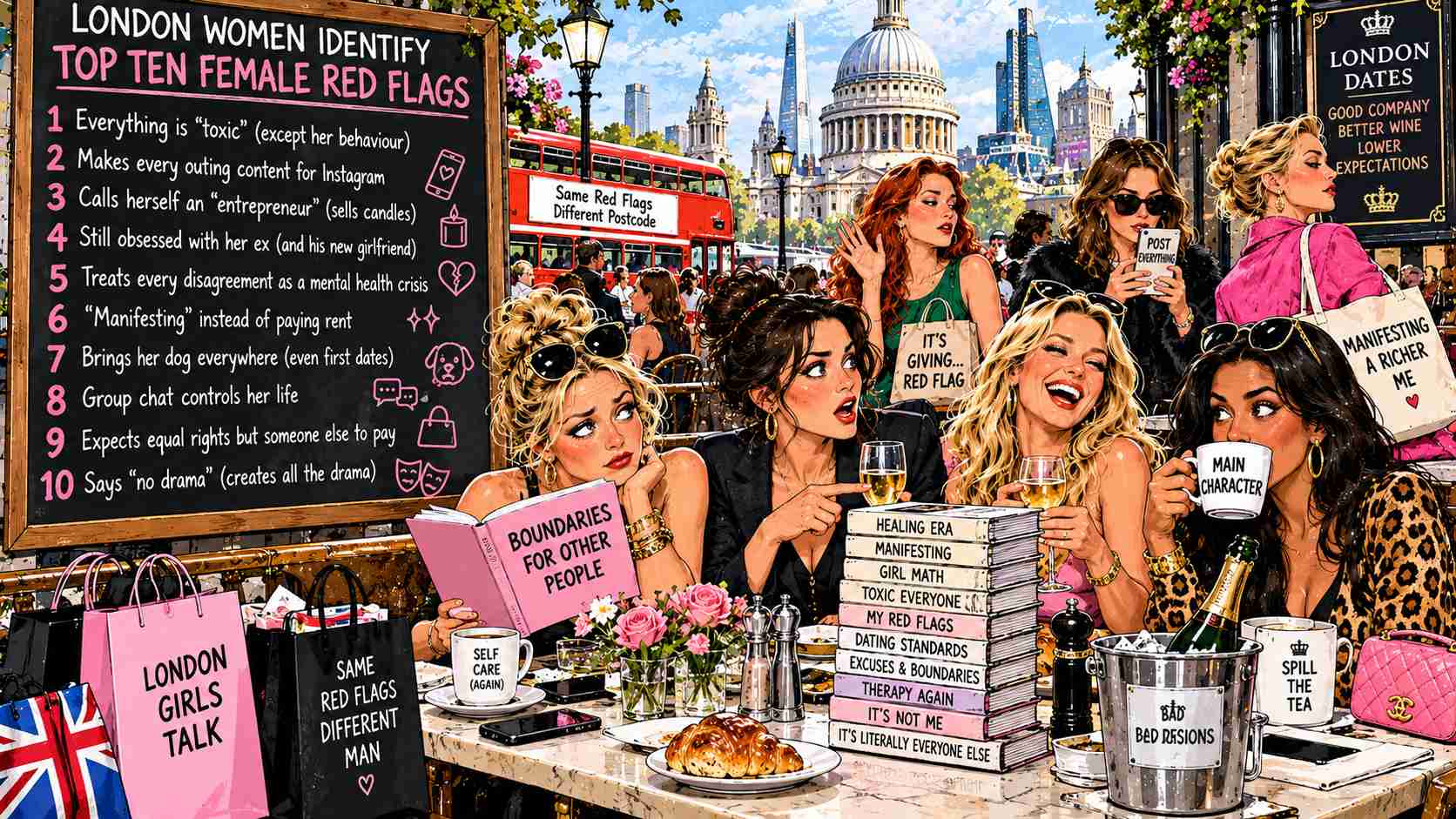
London Women Identify Top Ten Female Red Flags, Entire Brunch Industry Placed Under Emergency Review
Researchers warn that phrases including “love you, babe,” “no drama,” and “I’m just brutally honest” may require immediate evacuation to another branch of Pret
LONDON — Britain’s women have reportedly developed an advanced early-warning system for detecting dangerous female friendships, allowing a Londoner to identify a social catastrophe approximately three seconds after another woman says, “I normally don’t get along with women.”
The warning follows an online discussion collected by Bored Panda in which women listed dozens of behaviours they regard as red flags in other women, including gossip, competitiveness, ignored boundaries, chronic victimhood, jealousy and suspiciously enthusiastic declarations of instant friendship.
London experts immediately welcomed the findings because the capital contains nine million people, approximately seventeen million WhatsApp groups and enough passive aggression to power the Northern line.
The ten strongest red flags are below, Londonised into a social warning system where “we should absolutely get coffee” can mean anything from friendship to a declaration of low-intensity war. The original Bored Panda piece collected 82 behaviours women said they notice in other women.
Women in and about London
- “I hate drama” remains the traditional opening statement of someone carrying three seasons of drama in hand luggage.
- A woman who tells you everybody else is jealous of her has achieved the remarkable statistical feat of meeting 47 terrible people while remaining flawless herself.
- If she gossips enthusiastically about everyone she knows, congratulations. You have successfully auditioned to become next Tuesday’s material.
- London friendship can move from “I love your coat” to “I’ve created a separate WhatsApp group without her” faster than the Elizabeth line reaches Paddington.
- The instant best friend is concerning. Nobody should know that you are “literally sisters” before learning your surname.
The Official London Top Ten Female Friendship Red Flags
Red Flag No. 10: She Gossips About Everybody (Toxic Gossip in London Friendships)
Gossip is a perfectly respectable British activity when conducted responsibly.
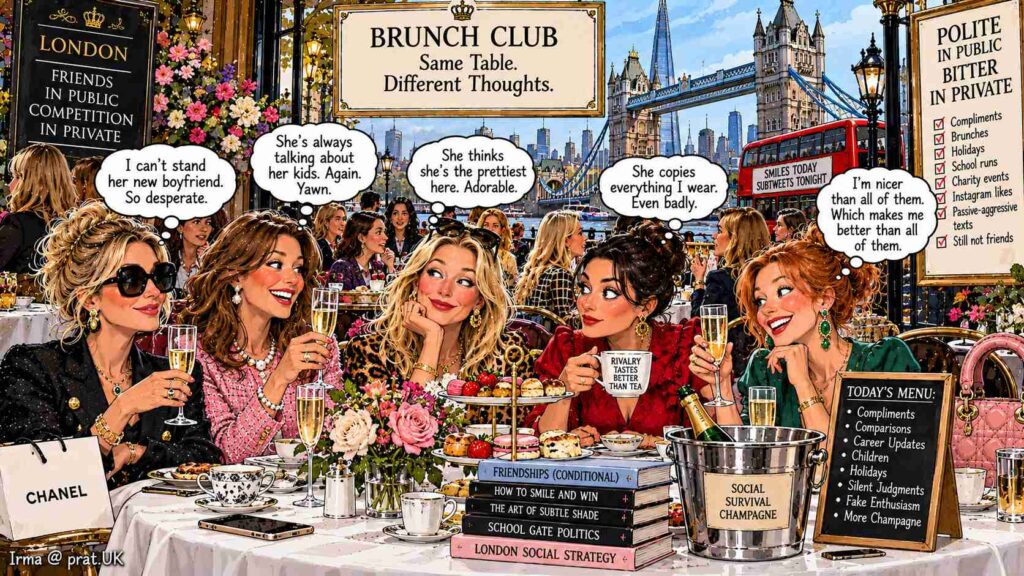
Without gossip, roughly 43 percent of London coffee shops would lose their business model.
But there is an important difference between occasionally saying, “Did you hear what happened to Charlotte?” and maintaining a privately operated intelligence service capable of explaining Charlotte’s divorce, salary, Botox schedule and mysterious disappearance from Pilates.
The original discussion repeatedly highlighted excessive gossip and talking cruelly about friends behind their backs.
The mathematics are straightforward.
If Olivia tells you confidential information about Sophie, Amelia, Grace, Hannah and Chloe, there is no compelling scientific reason to believe that when you leave the table Olivia suddenly converts to Trappist monasticism.
Acas even lists spreading malicious rumours among examples of workplace bullying.
This means Britain has finally discovered the precise moment gossip changes from entertainment into an HR meeting.
Red Flag No. 9: Every Woman Is Secretly Competing With Her (Female Competition and Friendship)
Another frequently mentioned warning was constant competition with women who may not even know a competition exists.
This is particularly exhausting in London.
You say, “I’m going to Lisbon.”
She says, “I’ve already done Lisbon.”
You say, “I got promoted.”
She says, “I turned down that kind of role.”
You say, “I bought sourdough.”
She announces that her family has maintained a sourdough starter continuously since 1847.
Eventually you mention undergoing a colonoscopy simply to discover whether she has somehow done a more exclusive one in Tuscany.
Friendly competition can motivate people.
Secret competition resembles Wimbledon except one player is shopping peacefully in Waitrose while the other is serving at 130 mph.
Red Flag No. 8: She Becomes Your Best Friend Before the Drinks Arrive (Instant Best Friend Red Flag)
Extreme immediate intimacy appeared repeatedly in the source discussion: lavish compliments, instant attachment and women declaring profound closeness almost immediately.
Normal friendship takes time.
You discover gradually whether somebody is dependable, funny, generous or capable of returning a borrowed umbrella.
The accelerated version skips all this.
“BABE! I ADORE YOU!”
“We’ve known each other eleven minutes.”
“I feel like I’ve known you forever.”
“You still haven’t remembered my name.”
Within forty minutes she has followed your sister, located your ex-boyfriend on LinkedIn and suggested Bali.
London authorities are considering fitting cafés with friendship speed cameras.
Red Flag No. 7: She Is the Innocent Victim in Every Story (The Common Denominator Paradox)
Everyone occasionally gets treated unfairly.
But probability becomes strained when a person has been betrayed by every former friend, persecuted by every employer, envied by every colleague and misunderstood by every romantic partner since Year Nine.
A Bored Panda respondent summarised this beautifully: everyone else in the woman’s stories is always crazy, toxic or jealous.
Dr. Felicity Queue of the Institute for Advanced Brunch Studies calls this the Common Denominator Paradox.
“If twelve restaurants have thrown you out,” she explained while examining a croissant, “there remains a theoretical possibility that London has twelve terrible restaurants. There is also Derek.”
The British principle of deduction applies.
If everyone you meet eventually becomes your mortal enemy, either humanity has failed spectacularly or you may occasionally be difficult over tapas.
Red Flag No. 6: She Cannot Stand Another Woman Doing Well (Jealousy and Success)
Nothing reveals a relationship faster than good news.
Bad news is easy.
“I lost my job.”
“Oh darling!”
“My boyfriend dumped me.”
“Come here!”
“My flat burned down.”
“You can stay with me.”
Then:
“I got promoted!”
Silence.
A tiny blink.
“Well, money isn’t everything.”
The source discussion repeatedly identified inability to celebrate another woman’s success as a warning sign.
This behaviour is especially visible in London because success must immediately be converted into a defect.
Bought a house?
“Bit far out.”
Lost weight?
“You looked healthier before.”
Started a business?
“Must be stressful.”
Married George Clooney?
“I’ve always preferred brunettes.”
Red Flag No. 5: The Backhanded Compliment Sniper (Passive-Aggressive Compliments)
Britain perfected the backhanded compliment because open conflict would require emotional clarity.
The weapon sounds approximately like this:
“You look amazing. I could never wear something that revealing.”
“I love that you don’t care what people think.”
“You’ve done so well considering everything.”
“You’re actually really pretty without makeup.”
Each sentence begins with flowers and ends with somebody discovering a small explosive device underneath them.
Acas guidance notes that bullying can include insulting behaviour, constant put-downs and deliberate humiliation.
London therefore needs a linguistic warning system.
Green: “Nice dress.”
Amber: “That colour really suits you.”
Red: “Only you could pull that off.”
Leave immediately.
Red Flag No. 4: She Changes Personality When a Man Arrives (The Pick-Me Transformation)
Several women in the discussion identified the sudden transformation that occurs when male attention enters the room.
Five women are discussing mortgages in normal adult voices.
Then Marcus walks in.
Suddenly one participant has become a Disney woodland creature.
Her voice rises two octaves.
She cannot open a bottle.
She has forgotten how taxation works.
She announces that she “doesn’t really understand football” despite spending the previous twenty minutes explaining Arsenal’s midfield problems.
Scientists have yet to determine whether this represents courtship behaviour or temporary loss of motor function.
The important test arrives when Marcus leaves.
If her voice immediately returns to the frequency used by BBC Radio 4, scientists recommend further observation.
Red Flag No. 3: She Treats Staff Like Medieval Peasants (How She Treats Waiters and Service Workers)
One of the sharper warnings in the source involved people who behave beautifully toward friends while treating waiters and other service workers badly.
This may be the most reliable social test available.
Anyone can be charming to someone they want to impress.
Character appears when the cappuccino arrives with oat milk instead of almond.
A normal person says, “Sorry, I think this might be the wrong one.”
A red-flag specialist summons the manager, the regional manager, the managing director, Parliament and possibly NATO.
Acas’s 2026 polling of 1,050 senior British business decision-makers found 30% cited rudeness to colleagues or customers among the worst behaviours they had seen result in disciplinary action, alongside 30% citing bullying.
Apparently Britain has formally confirmed something grandmothers knew already:
Watch how people treat somebody who cannot improve their social status.
Red Flag No. 2: She Keeps Score With Kindness (Transactional Friendship)
“I picked you up from Heathrow.”
“Yes, seven years ago.”
“I just think friendship should go both ways.”
“It does.”
“And I bought you prosecco.”
“That was my birthday.”
“Exactly.”
The source highlighted people who perform favours and later use those favours as leverage.
This transforms friendship into an accounting department.
Every lift is entered into a ledger.
Every coffee carries interest.
Every supportive telephone call becomes callable debt.
By 2031 you discover you owe £48,000 because she once fed your cat.
Genuine kindness is not a futures contract.
If every favour eventually arrives home wearing a balaclava and demanding repayment, you do not have a friend.
You have Barclays with earrings.
Red Flag No. 1: She Ignores Boundaries (Disrespecting Boundaries in Friendship)
This deserves first place because it includes half the other problems.
You say no.
She hears “convince me.”
You ask her not to discuss something.
She tells three people because she was “worried.”
You decline a drink.
She buys one anyway.
You say you cannot attend.
She demands an explanation lengthy enough for a parliamentary select committee.
Boundary violations ranked near the very top of the original discussion.
Acas likewise describes bullying broadly as unwanted behaviour that can intimidate, insult, undermine or humiliate another person, and stresses that harmful behaviour may be a repeated pattern or sometimes a single incident.
This brings us to the most sophisticated psychological instrument yet devised:
“No.”
Observe what happens next.
Healthy person: “Okay.”
Potential problem: “But why?”
Major problem: “You’re being ridiculous.”
Evacuate the premises: “After everything I’ve done for you?”
London’s Emergency Friendship Test: Three Questions Before You Add Her to the Group Chat
Experts recommend three questions before granting anyone permanent access to your group chat.
First, what happens when you succeed?
If your good news reliably produces visible intestinal discomfort, note it.
Second, what happens when you say no?
A boundary respected is friendship information worth considerably more than 400 Instagram affirmations about female empowerment.
Third, how does she describe absent friends?
Because absent friends are conducting precisely the same experiment on you.
These patterns should not be confused with somebody having a bad afternoon. Everyone gossips occasionally, gets jealous, says something clumsy or behaves badly under stress.
The useful distinction is repetition.
Even official Acas advice emphasizes examining the circumstances and patterns rather than assuming every unpleasant interaction constitutes bullying.
That is fortunate.
Otherwise approximately everyone who has ever attended a London hen weekend would need legal representation.
Britain Responds: Red-Flag Warnings Proposed for London Brunch Menus
A Department for Social Survival spokesman said ministers were studying proposals requiring red-flag warnings on brunch menus.
Under the proposed system, anyone saying “I just prefer male friends because women are too much drama” would trigger a discreet flashing light above the restaurant.
Pret is reportedly developing a code phrase.
“Would madam like the emergency almond croissant?”
Meanwhile, Transport for London has denied reports that the Central line will introduce a special carriage for women who have recently discovered that their closest friend has been secretly competing with them for six years.
Officials said this was unnecessary because the Central line already provides suffering.
Final Advice: How to Spot a Good Friend in London
London friendship is not complicated.
You want somebody who laughs when you are ridiculous, listens when you are serious, respects “no,” celebrates your victories and does not transform your divorce into exclusive content for a WhatsApp group called THE GIRLS 🍸🔥 DO NOT SCREENSHOT.
Nobody needs perfection.
Just consistency.
And preferably a friend who, when you leave the restaurant, does not immediately lean across the table and say:
“Right. Can we finally talk about her?”
10 Humorous Observations About Female Red Flags and London Friendship
- A backhanded compliment is Britain’s cheapest guided missile: “You’re so brave to wear that.”
- Some friendships contain a secret competition where only one participant knows the Olympics have started.
- If every boyfriend, boss, flatmate, sister, colleague and Deliveroo driver has wronged her, Scotland Yard may eventually want to examine the common denominator.
- Watch how somebody treats a waiter. Civilization is essentially the period between receiving the menu and discovering your chips are cold.
- A sudden personality change when an attractive man enters the room is the social equivalent of your phone switching automatically to roaming.
- Kindness with an invoice attached is not kindness. It is Klarna with hugs.
- Someone who ignores every boundary because “that’s just how I am” has confused personality with diplomatic immunity.
- People who cannot celebrate a friend’s success will congratulate you in the emotional tone normally reserved for announcing a parking fine.
- The phrase “I’m brutally honest” usually promises substantially more brutality than honesty.
- Anyone who declares herself the “mum of the group” within twenty minutes may soon be controlling the seating plan, your alcohol consumption and who you are permitted to marry.
Disclaimer
This satire concerns behaviours, not women as a category. Gossip, jealousy, manipulation, competitiveness, boundary-smashing and conversational hostage-taking are equal-opportunity human hobbies. Any resemblance to your current friendship group should be discussed carefully, preferably somewhere without throwable glassware.
This story is entirely a human collaboration between two sentient beings: the world’s oldest tenured professor and a philosophy major turned dairy farmer, both of whom strongly recommend never joining a WhatsApp group named No Drama Girls.
— prat.UK
Sources
The original discussion and its 82 crowdsourced warning signs: Women Point Out 82 Things And Behaviors They Refuse To Tolerate In Other Women Around (Bored Panda).
For the rather less humorous real-world definition of rumours, exclusion, humiliation and workplace bullying: Workplace bullying and harassment (GOV.UK) and Acas, the Advisory, Conciliation and Arbitration Service.
Acas’s August 2026 employer survey found bullying and rudeness were each cited by 30% of respondents among serious behaviours that had resulted in disciplinary action.

Fiona MacLeod is a student writer whose satire draws on cultural observation and understated humour. Influenced by London’s academic and creative spaces, Fiona’s writing reflects curiosity and thoughtful comedic restraint.
Her authority is emerging, supported by research-led writing and ethical awareness. Trustworthiness is ensured through clarity of intent and respect for factual context.
Fiona represents a responsible new voice aligned with EEAT standards.