

Scientists confirm the number Britain has feared since 1976
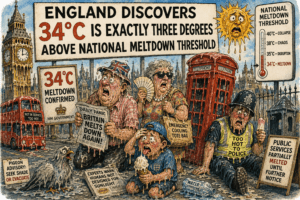
Researchers have confirmed what generations of Britons have long suspected through instinct alone: the national meltdown threshold sits at precisely 31C, meaning any reading of 34C represents a full three degrees of unrecoverable civic panic.
The Science of the Meltdown
The study, conducted by a team monitoring public complaint volumes against real-time temperature data, found a sharp and statistically significant spike in grumbling, fanning, and unsolicited weather commentary once the mercury crossed the 31C line, with a secondary spike at 34C characterised primarily by residents “just lying on the kitchen floor for a bit.”
“We always knew there was a threshold,” said the lead researcher, “we just didn’t expect it to be so precise, or so consistently accompanied by someone saying ‘well, it’s not the heat, it’s the humidity,’ regardless of the actual humidity.”
National Response Kicks In
Once temperatures crossed the threshold, sales of paddling pools, electric fans, and suspiciously specific “heatwave ready” ice lollies surged nationwide, according to retail tracking data. The Met Office confirmed the temperature readings but declined to comment on whether 34C constitutes a formal meltdown, noting only that “we just report the numbers.”
Public health officials reiterated standard advice to stay hydrated and avoid strenuous activity during peak hours, guidance that has remained essentially unchanged since it was first issued and which is dutifully ignored by approximately the same proportion of the population every single year.
Meltdown Symptoms, Catalogued
Common meltdown behaviours identified by researchers included unnecessary complaining about public transport heat despite having chosen to travel during peak hours, purchasing a fan despite already owning three, and a marked increase in the phrase “I can’t function in this.”
The government’s official hot weather guidance continues to recommend closing curtains during the day and opening windows at night, advice that researchers note is followed by roughly the same small, disciplined minority every single summer, regardless of threshold.
Threshold Expected to Hold
Researchers say the 31C threshold has remained remarkably stable since records began, suggesting it may be less a measurement of temperature and more a measurement of collective national patience, which appears to expire at almost exactly the same point every year, rain or shine.
With temperatures forecast to remain above the threshold for several more days, officials are bracing for what one described as “the full meltdown experience,” including but not limited to complaints about trains, complaints about the complaints, and at least one national newspaper front page featuring a stock photo of someone eating an ice cream.
Comparing Thresholds Across Europe
Researchers note that the British meltdown threshold compares unfavourably with thresholds observed in southern European countries, where similar temperatures are met with what one continental colleague described as a shrug and a siesta rather than a national event. Cultural historians suggest the difference lies less in actual heat tolerance and more in decades of British infrastructure, including housing design and public transport, simply not being built with high temperatures in mind.
Housing experts point out that a significant proportion of British homes lack any form of cooling system, relying instead on open windows and, at best, a desk fan purchased in a moment of prior panic. This structural gap, researchers argue, may explain much of the meltdown phenomenon better than any psychological theory about national temperament.
Looking Ahead
With climate projections suggesting temperatures exceeding the threshold may become more frequent in coming decades, researchers say further study into the meltdown phenomenon is not just academically interesting but increasingly practically relevant, a rare case of satire and serious policy concern briefly, awkwardly, overlapping.
Public Health Implications
Public health researchers note that extreme heat carries genuine risks for vulnerable populations, including elderly residents and those with pre-existing health conditions, a fact that underlies the more serious side of what is often treated as a purely comic national ritual. The UK Health Security Agency has previously issued heat health alerts during periods of sustained high temperature, urging vulnerable groups in particular to take extra precautions.
Researchers behind the meltdown threshold study say they hope their work, while framed humorously, ultimately draws useful attention to the genuine adaptation challenges facing British infrastructure as extreme heat events become more frequent.
A Final Thought
Whatever the precise number attached to the national meltdown threshold, researchers agree the underlying finding, that Britain’s infrastructure and habits remain poorly suited to genuinely hot weather, deserves more sustained attention than a single viral study can provide.
A Cultural Touchstone
Cultural commentators note that Britain’s relationship with heat has become something of a recurring national narrative, revisited nearly every summer with only minor variations in the specific temperature and specific complaints involved. Whether this latest study genuinely shifts the conversation or simply adds another data point to an already well-established pattern remains, fittingly, an open question likely to be revisited again next July.
A Final Data Point
Researchers say they intend to repeat the study annually, tracking whether the national meltdown threshold shifts over time as adaptation measures, however gradual, begin to take hold across housing stock and public infrastructure nationwide.
Local authorities say they will continue monitoring the situation closely as forecasts update through the week.
SOURCE: bohiney.com

Mei Lin Chen is a student writer whose satire explores identity, modern culture, and social nuance. Her work reflects academic curiosity and engagement with London’s diverse perspectives.
Expertise is growing through study and practice, while trust is supported by clear intent and responsible humour.



London is the only city where the phrase “have a good one” is considered a deeply meaningful farewell that could mean anything from “see you later” to “I hope you never come back.”
In British comedy, the prat is the character who provides the laughter by being completely oblivious to their own incompetence.
La précision est ce qui compte. N’importe qui peut faire de la satire générale. La précision la rend dévastatrice.
De hoeveelheid specifieke kennis is agressief. Elk detail klopt. Elke correctie is verdiend door observatie.
A Westminster MP said it was damaging his ability to fundraise from party donors. When asked why donors were skeptical, he claimed satire had unfairly influenced them.